1
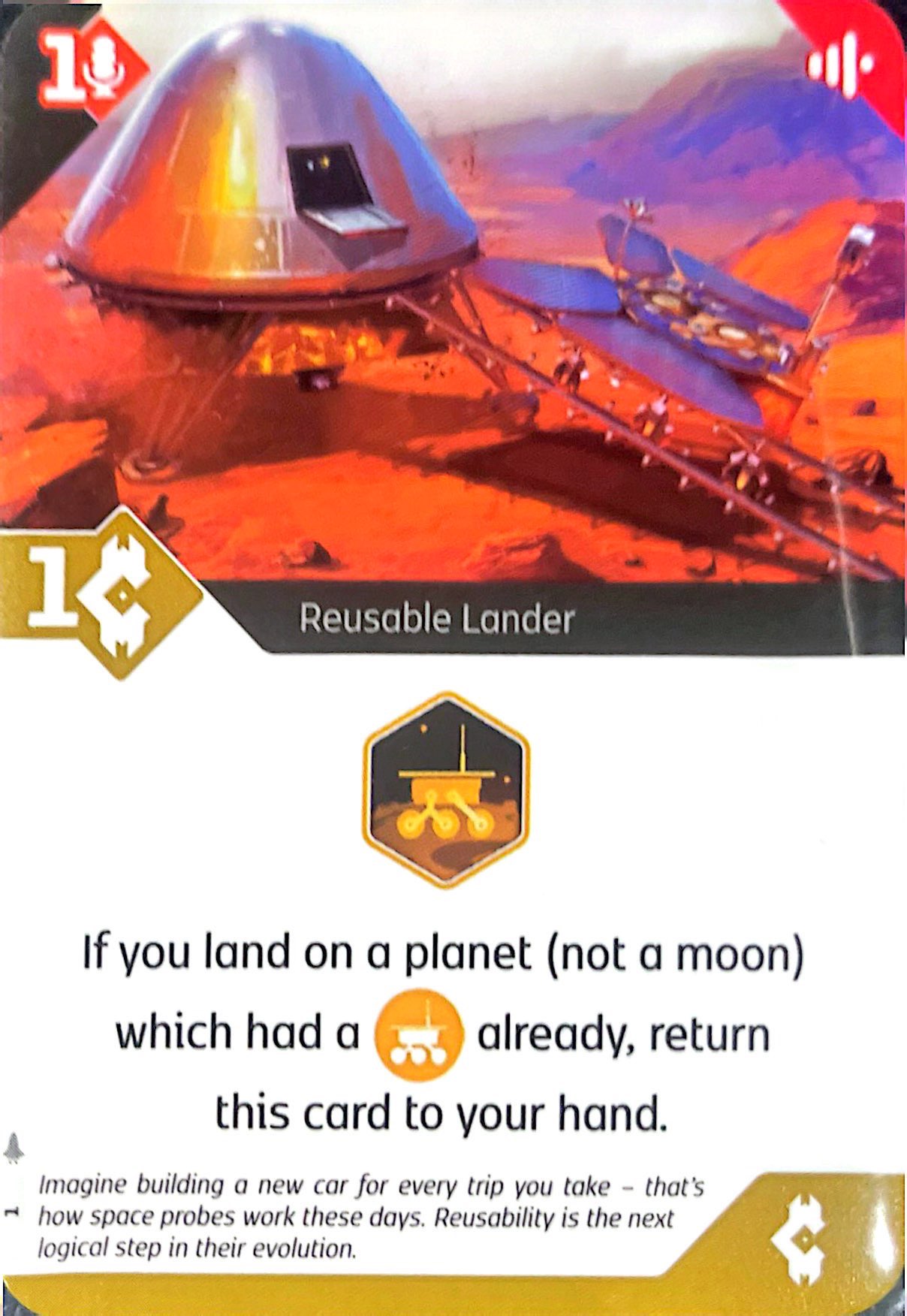
Reusable Lander
1
If you land on a planet (not a moon)
which had a already,
return this card to your hand.
SA.1
Imagine building a new car for every trip you take - that's how space probes work these days. Reusability is the next logical step in their evolution.
Not For Commercial Use
1
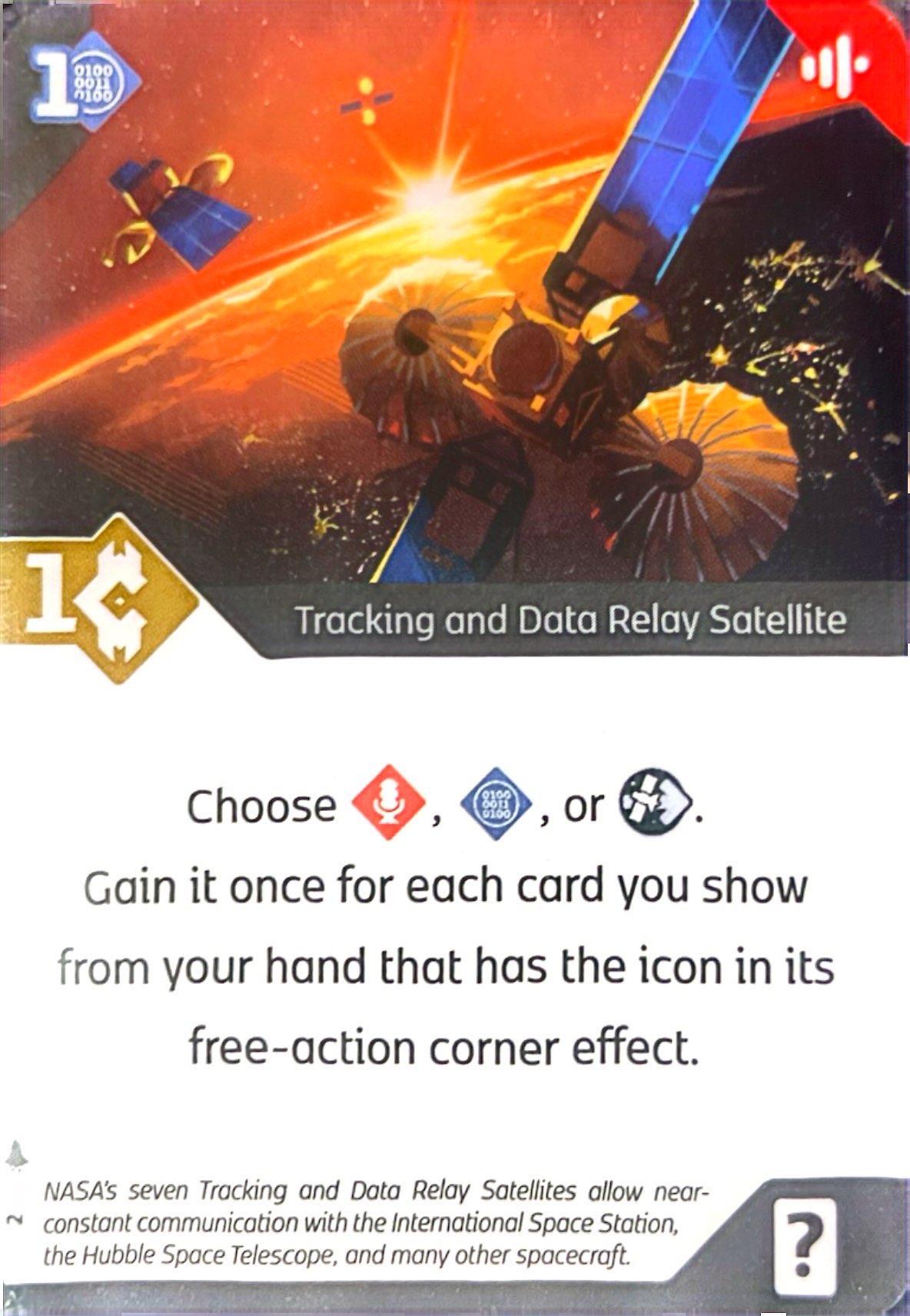
Tracking and Data Relay Satellite
1
Choose , , or
Gain it once for each card you show
from your hand that has the icon
in its free-action corner effect.
SA.2
NASA's seven Tracking and Data Relay Satellites allow near-constant communication with the International Space Station, the Hubble Space Telescope, and many other spacecraft.
Not For Commercial Use
1
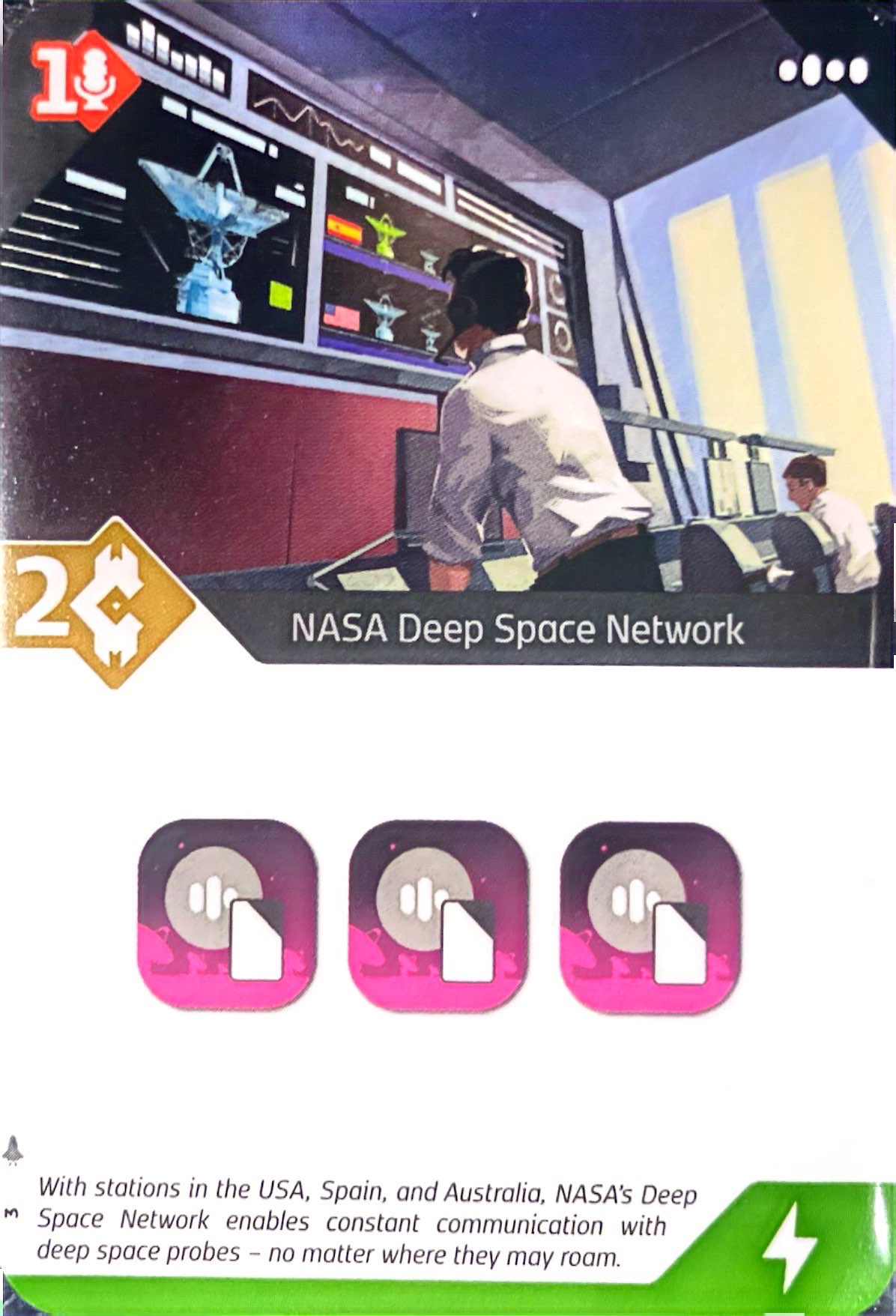
NASA Deep Space Network
2
SA.3
With stations in the USA, Spain, and Australia, NASA's Deep Space Network enables constant communication with deep space probes - no matter where they may roam.
Not For Commercial Use
1
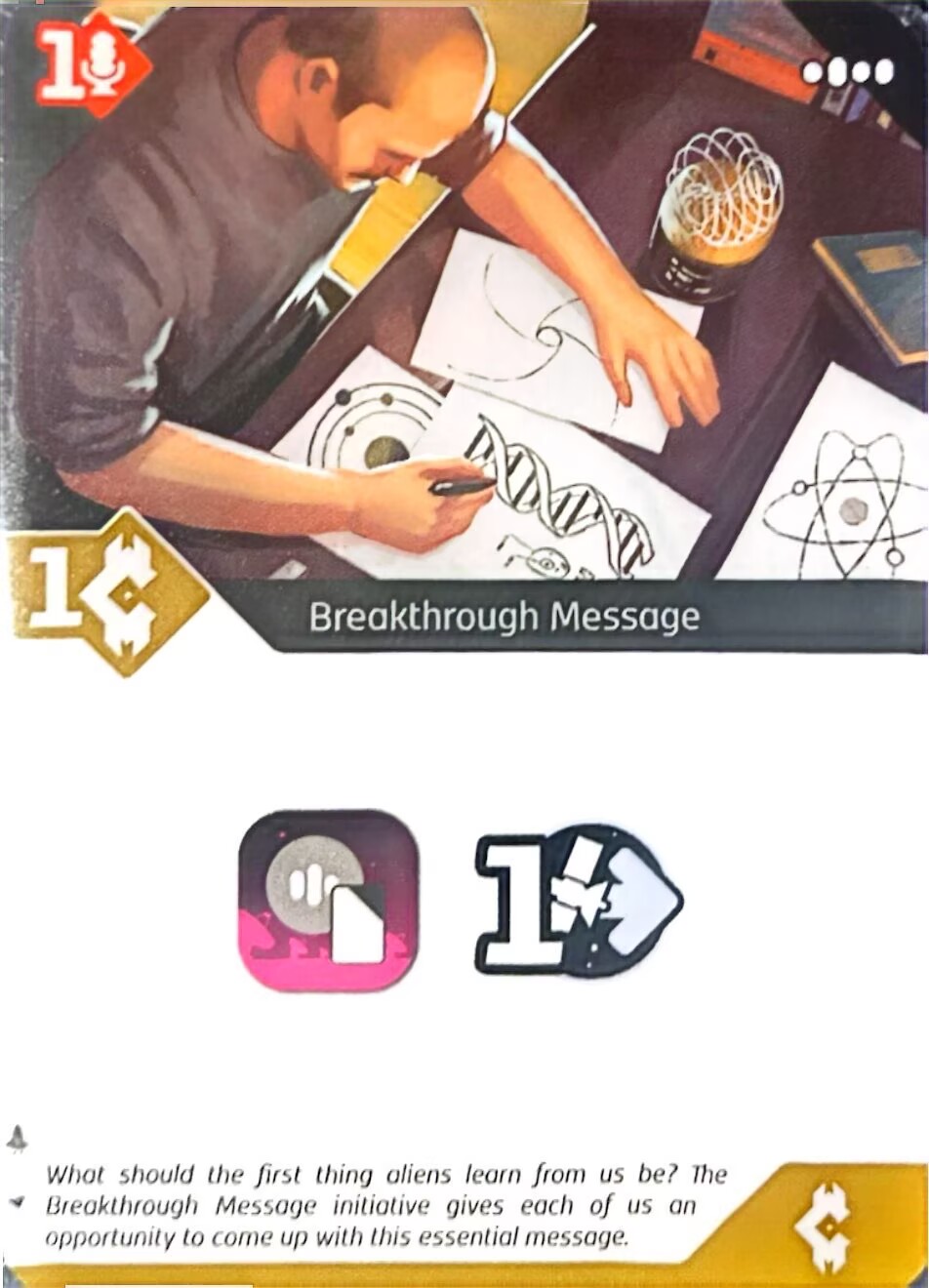
Breakthrough Message
1
1
SA.4
What should the first thing aliens learn from us be? The Breakthrough Message initiative gives each of us an opportunity to come up with this essential message.
Not For Commercial Use
1
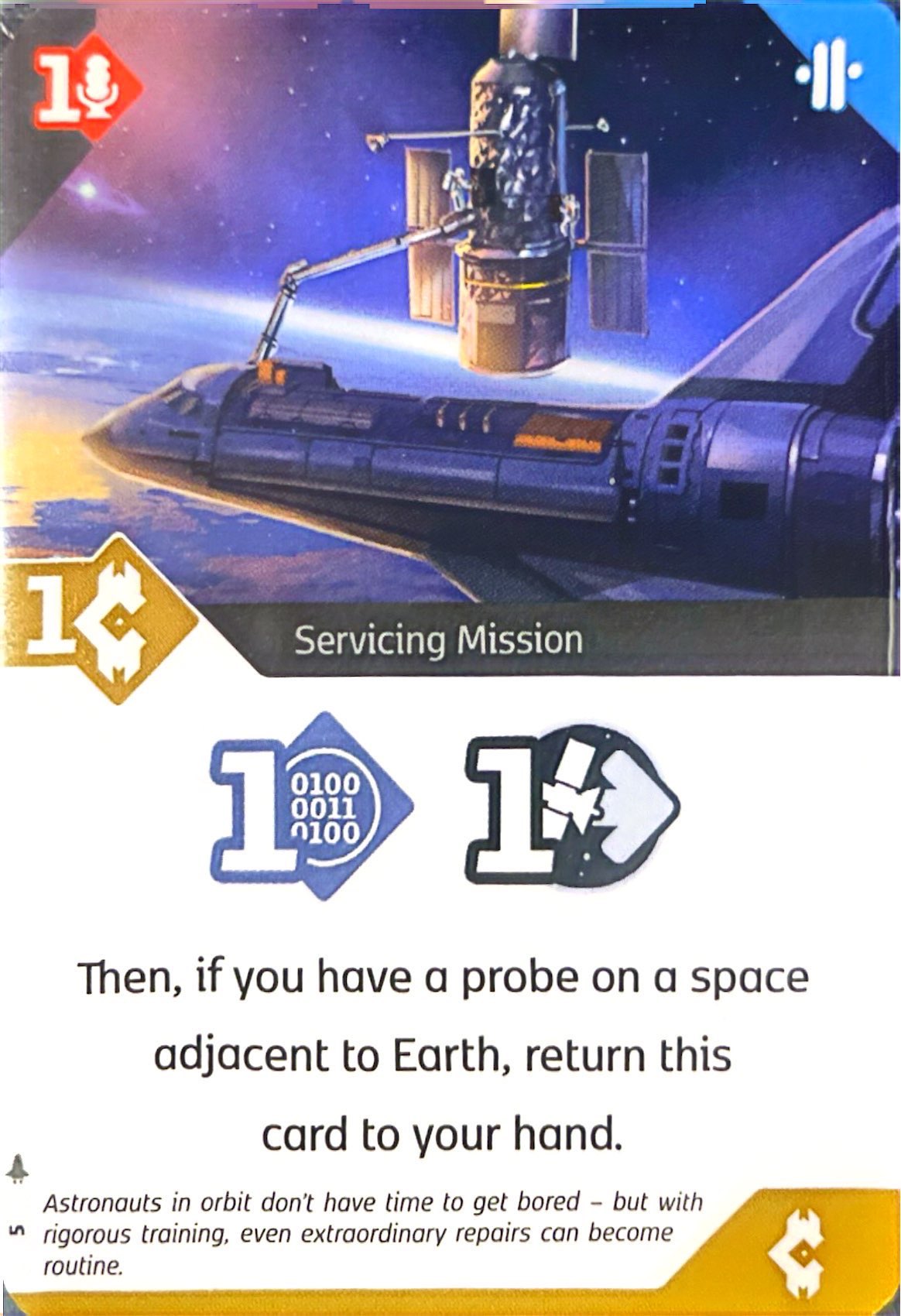
Servicing Mission
1
1
1
Then, if you have a probe on a space adjacent to Earth, return this card to your hand.
SA.5
Astronauts in orbit don't have time to get bored - but with rigorous training, even extraordinary repairs can become routine.
Not For Commercial Use
1
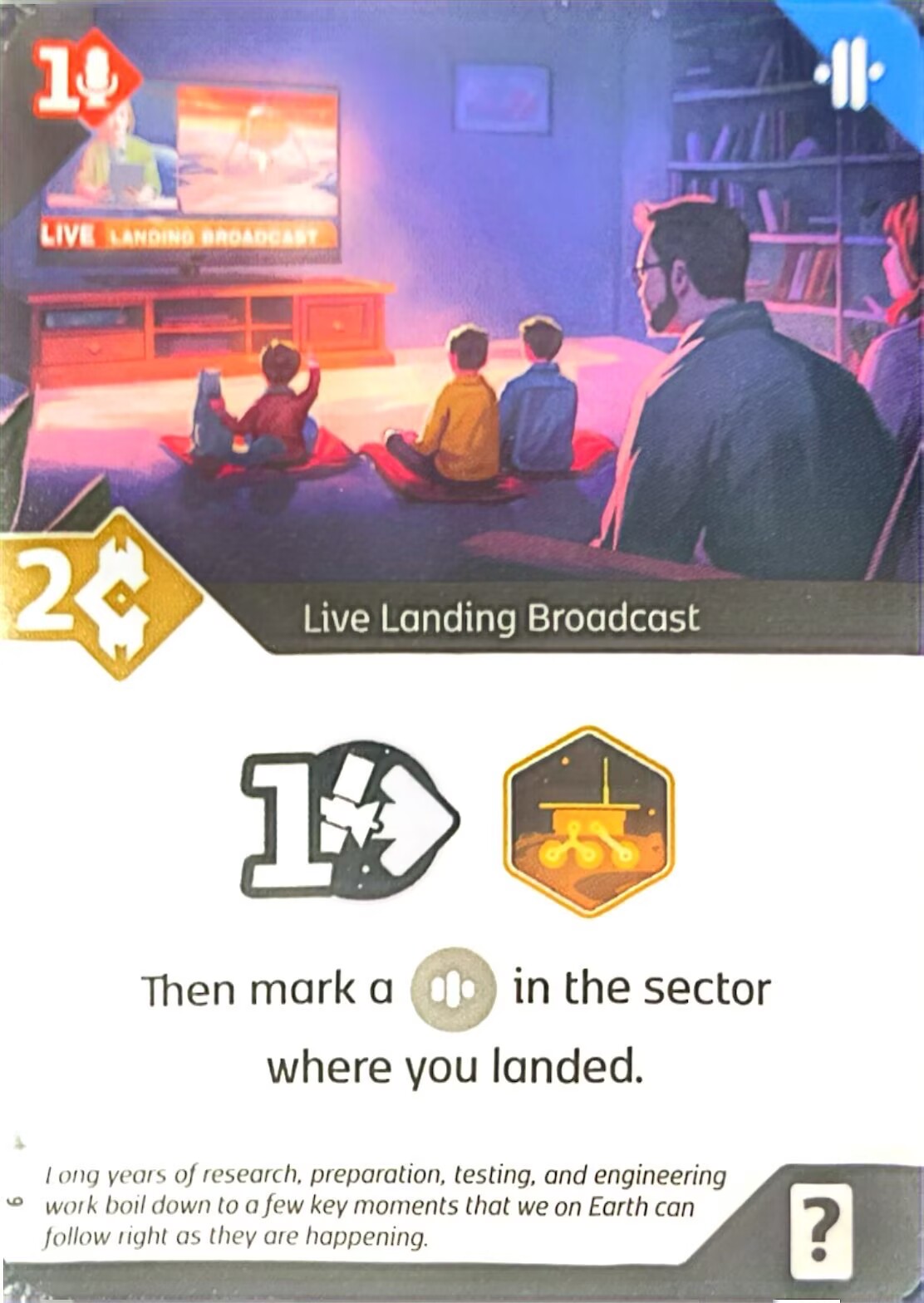
Live Landing Broadcast
2
1
Then mark a in the sector where you landed.
SA.6
Long years of research, preparation, testing, and engineering work boil down to a few key moments that we on Earth can follow right as they are happening.
Not For Commercial Use
1
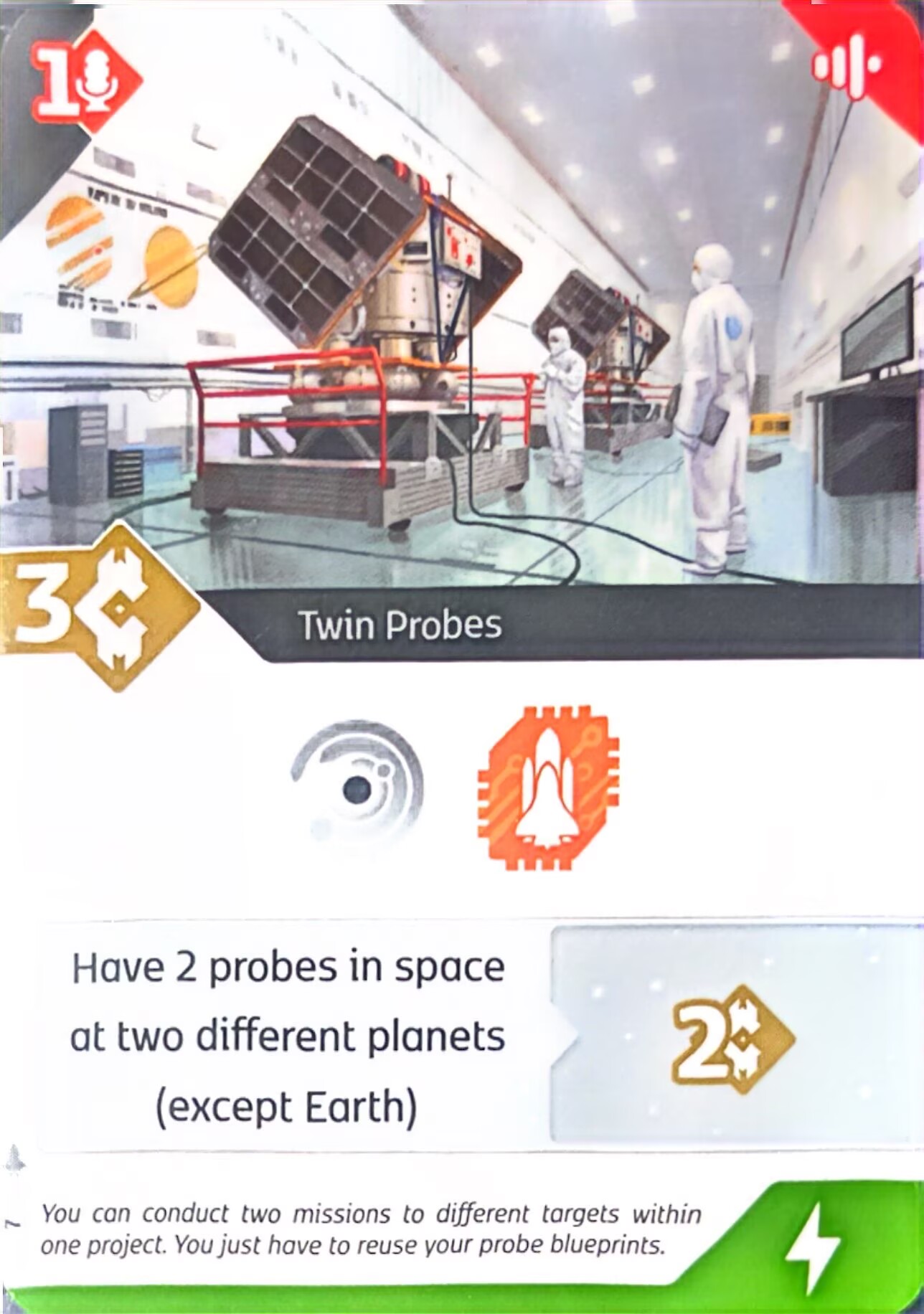
Twin Probes
3
Have 2 probes in space
at two different planets
(except Earth)
2
SA.7
You can conduct two missions to different targets within one project. You just have to reuse your probe blueprints.
Not For Commercial Use
1
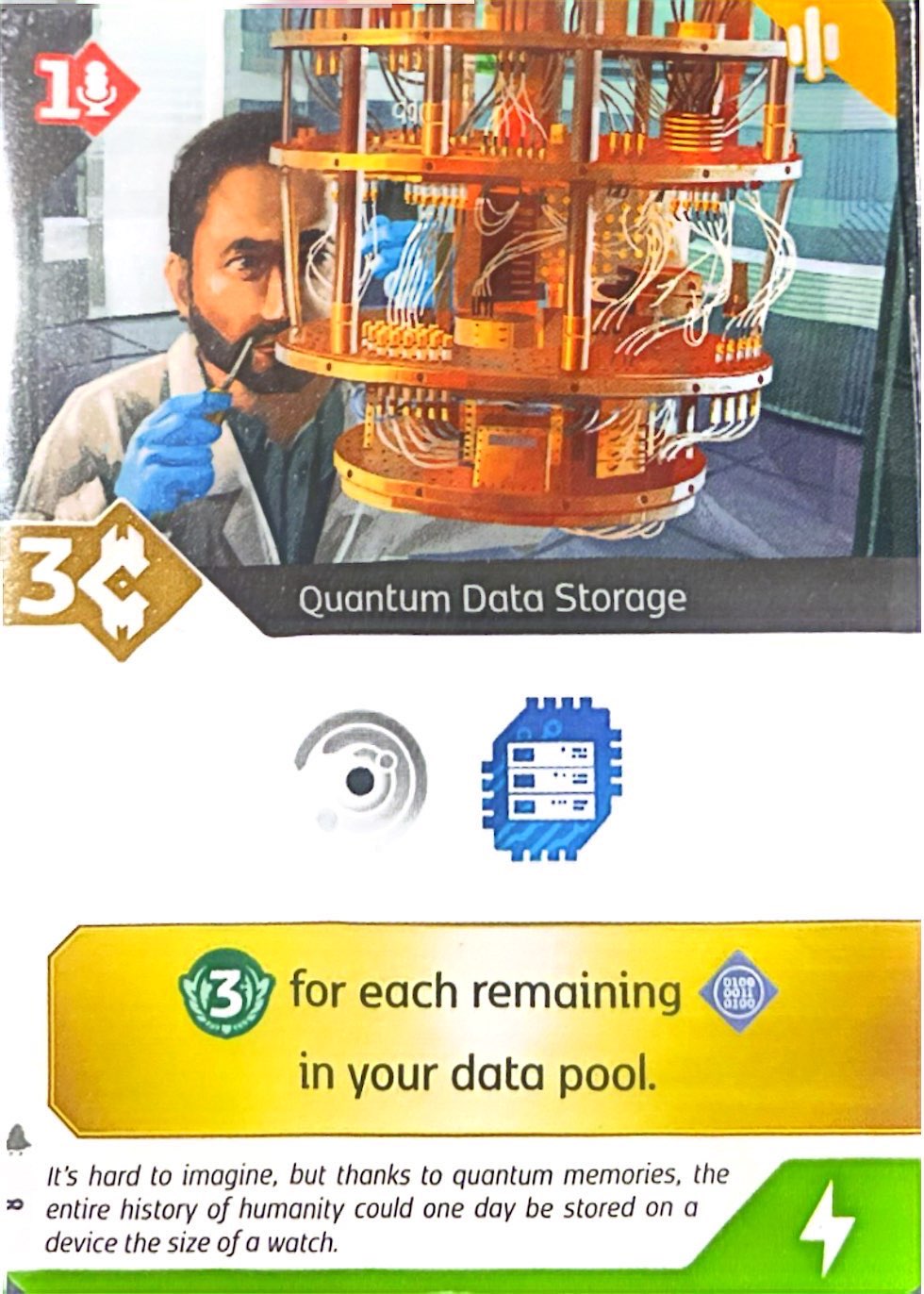
Quantum Data Storage
3
3
SA.8
It's hard to imagine, but thanks to quantum memories, the entire history of humanity could one day be stored on a device the size of a watch.
Not For Commercial Use
1
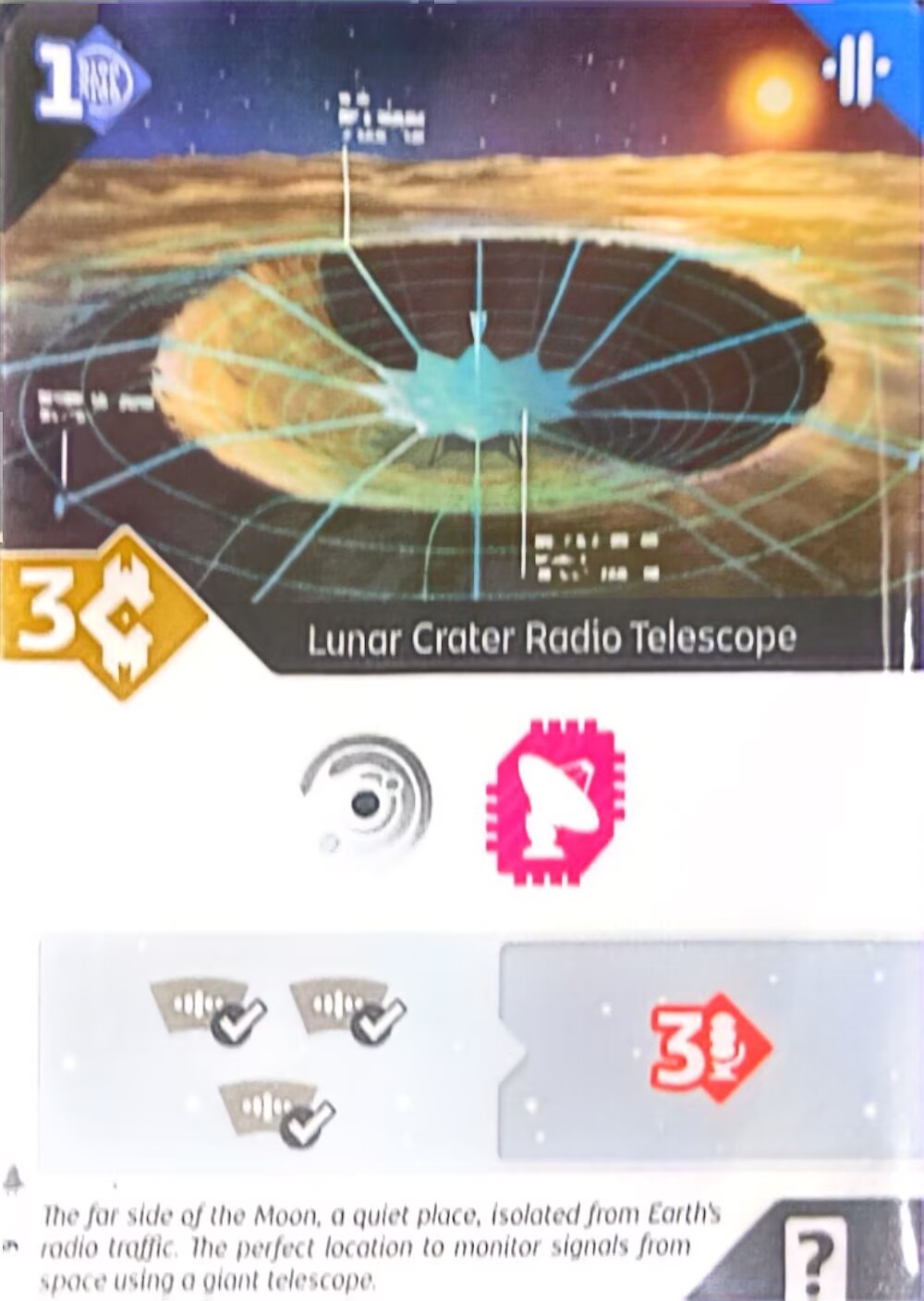
Lunar Crater Radio Telescope
3
3
SA.9
The far side of the Moon, a quiet place, isolated from Earth's radio traffic. The perfect location to monitor signals from space using a giant telescope.
Not For Commercial Use
1
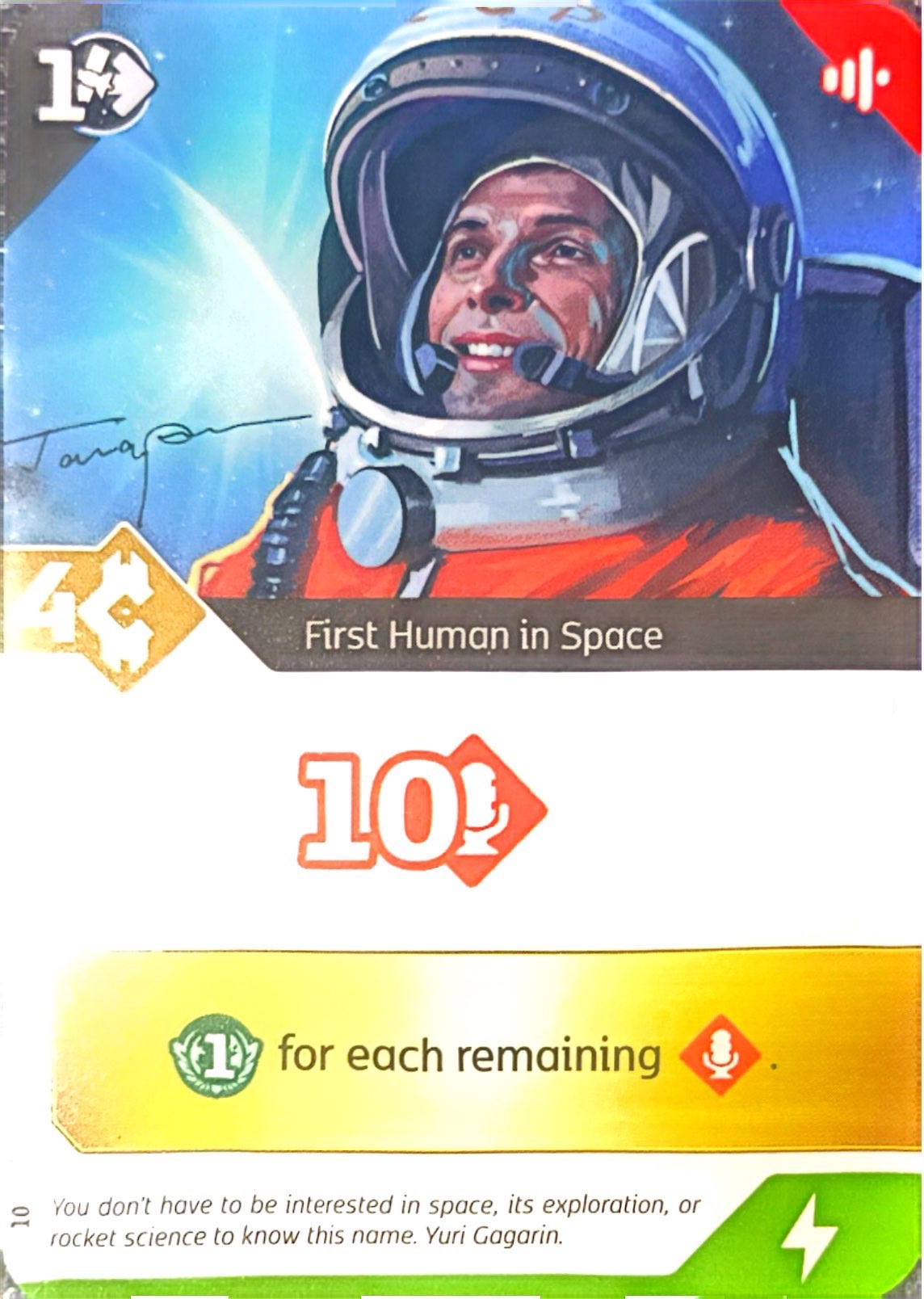
First Human in Space
4
10
1
SA.10
You don't have to be interested in space, its exploration, or rocket science to know this name. Yuri Gagarin.
Not For Commercial Use
1
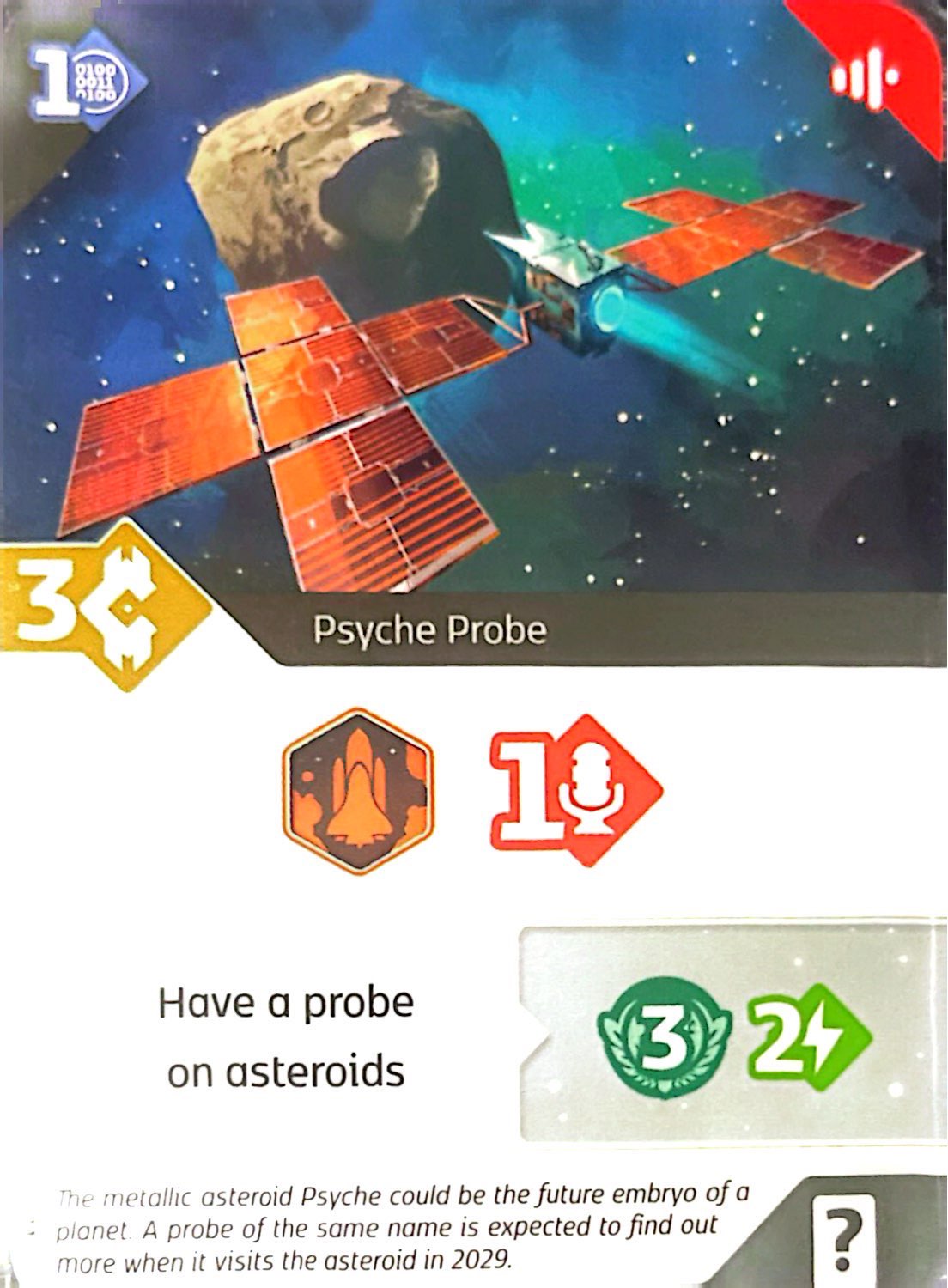
Psyche Probe
3
1
Have a probe on asteroids
3
2
SA.11
[待补充,看不清] its original mission is complete, a space probe may be tasked with a new objective. Some probes continue working long past their expected lifespan.
Not For Commercial Use
1
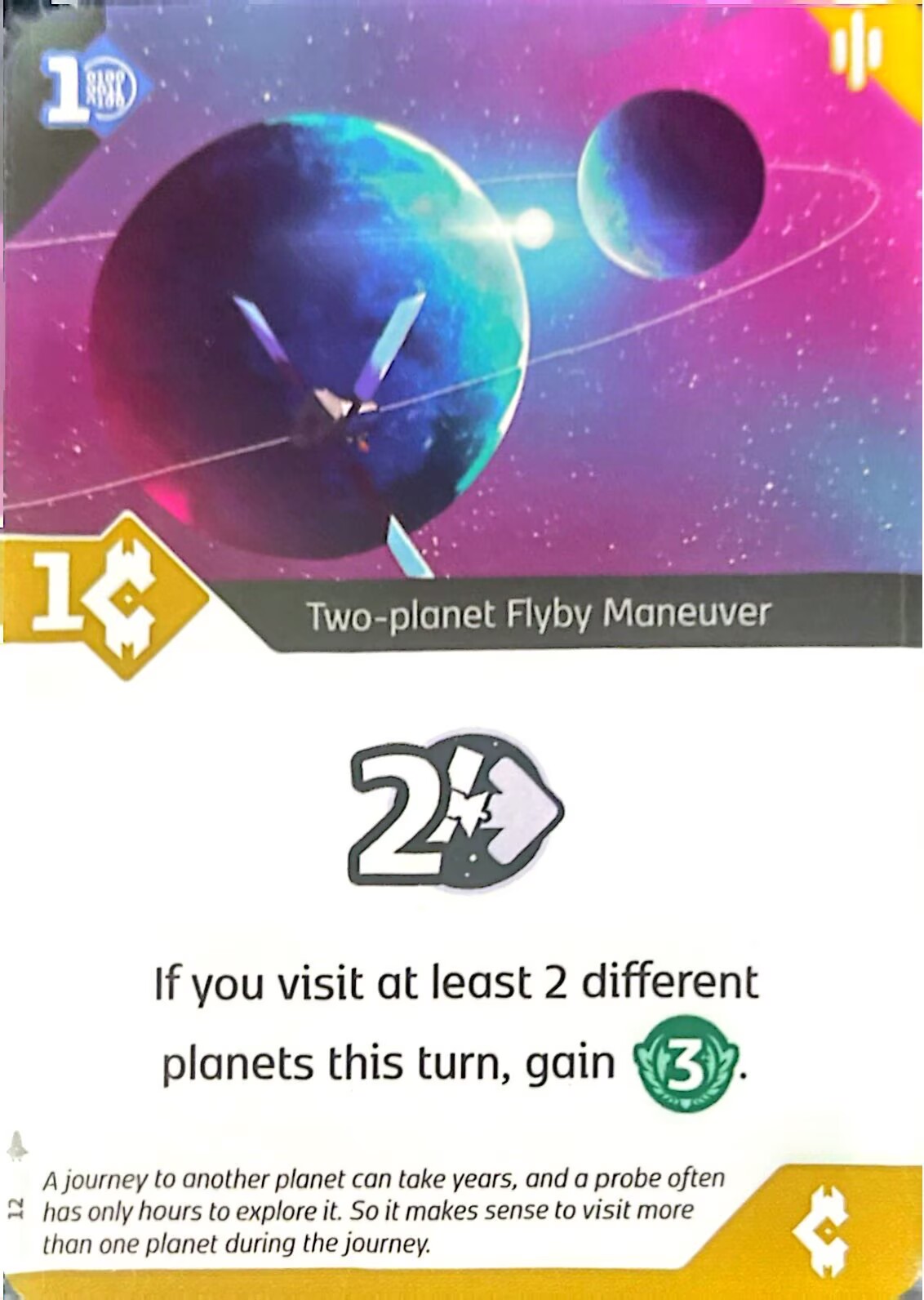
Two-planet Flyby Maneuver
1
2
If you visit at least 2 different
planets this turn, gain .
3
SA.12
A journey to another planet can take years, and a probe often has only hours to explore it. So it makes sense to visit more than one planet during the journey.
Not For Commercial Use
1
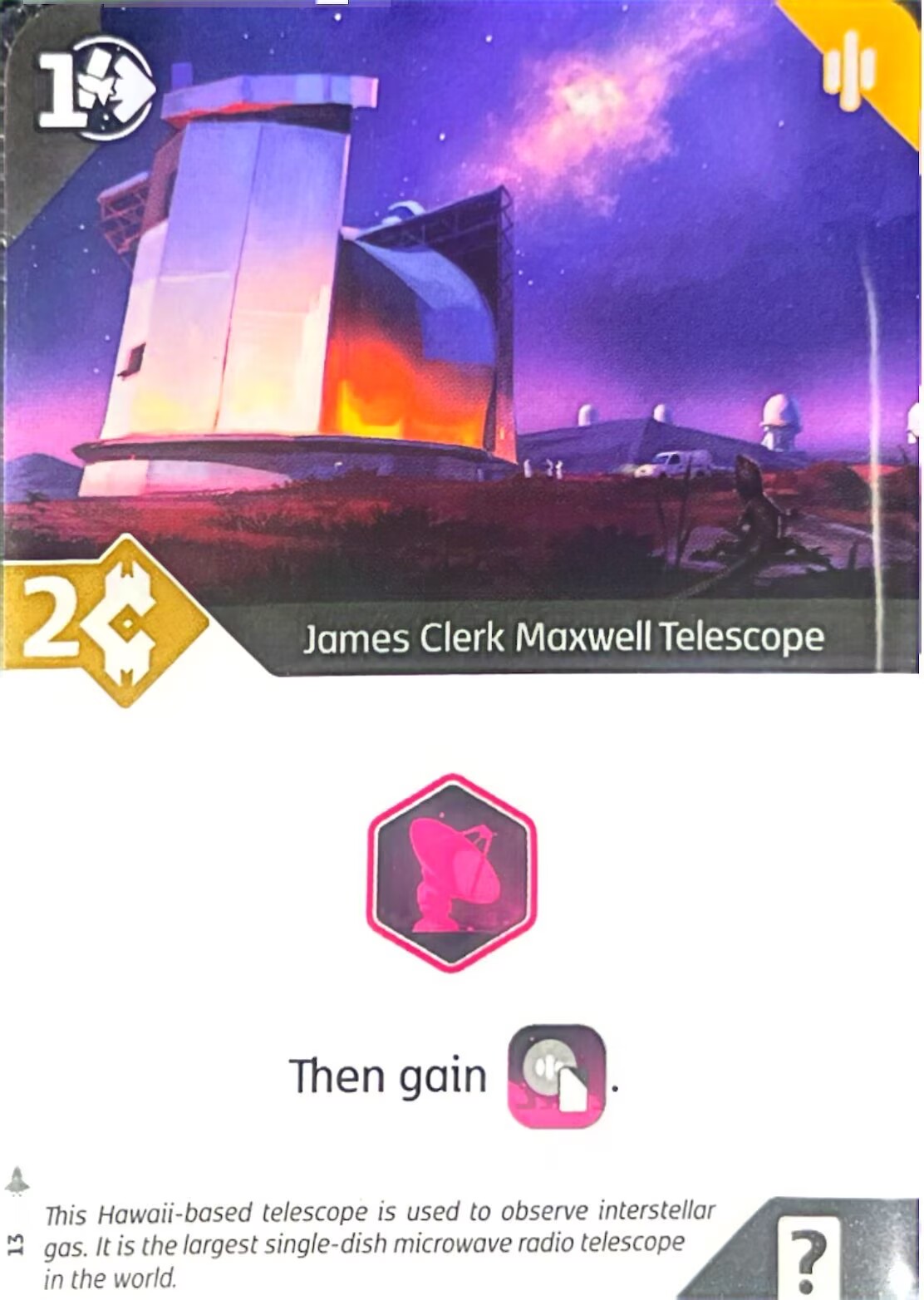
James Clerk Maxwell Telescope
2
Then gain .
SA.13
This Hawaii-based telescope is used to observe interstellar gas. It is the largest single-dish microwave radio telescope in the world.
Not For Commercial Use
1
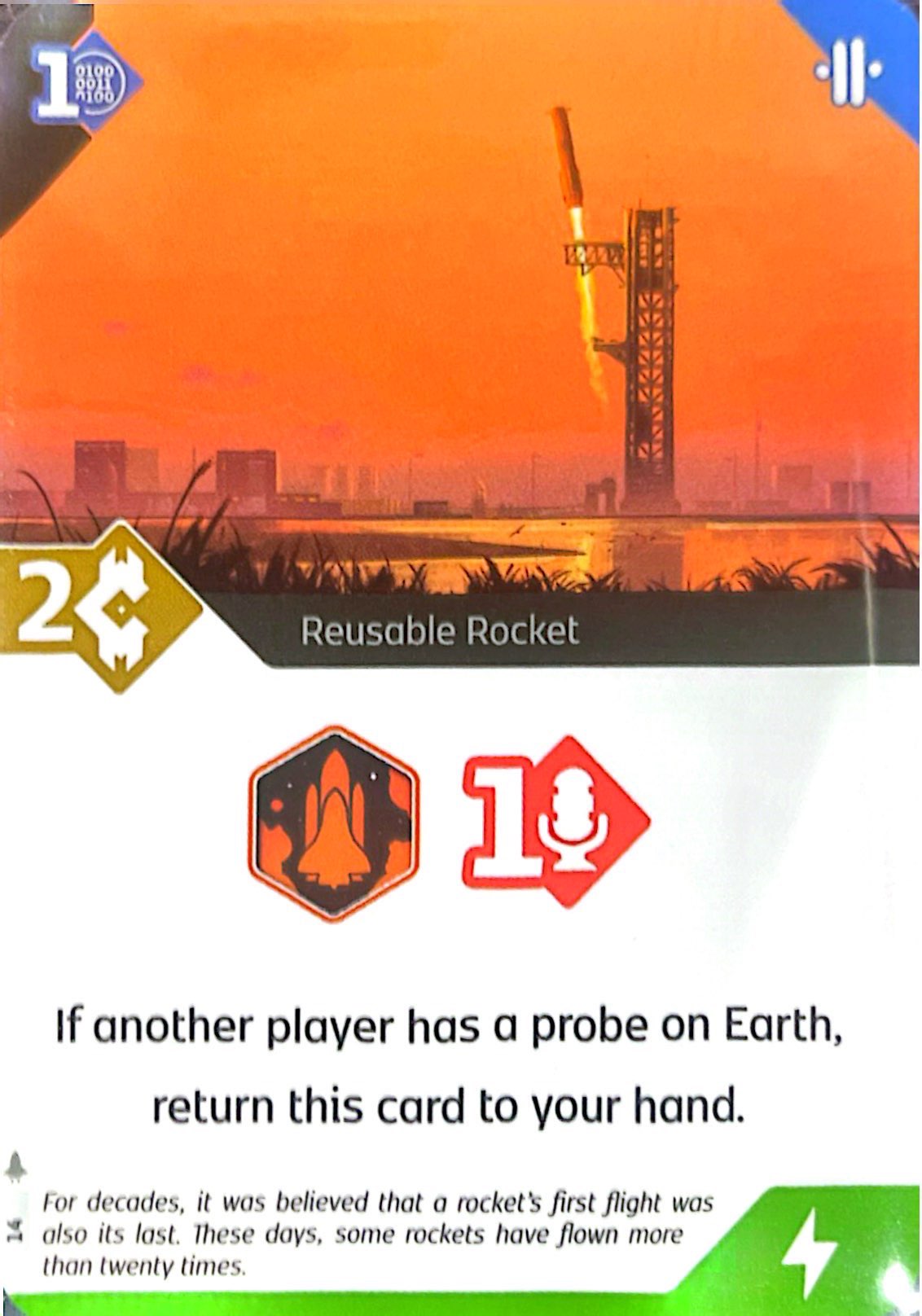
Reusable Rocket
2
1
If another player has a probe on Earth, return this card to your hand.
SA.14
For decades, it was believed that a rocket's first flight was also its last. These days, some rockets have flown more than twenty times.
Not For Commercial Use
1
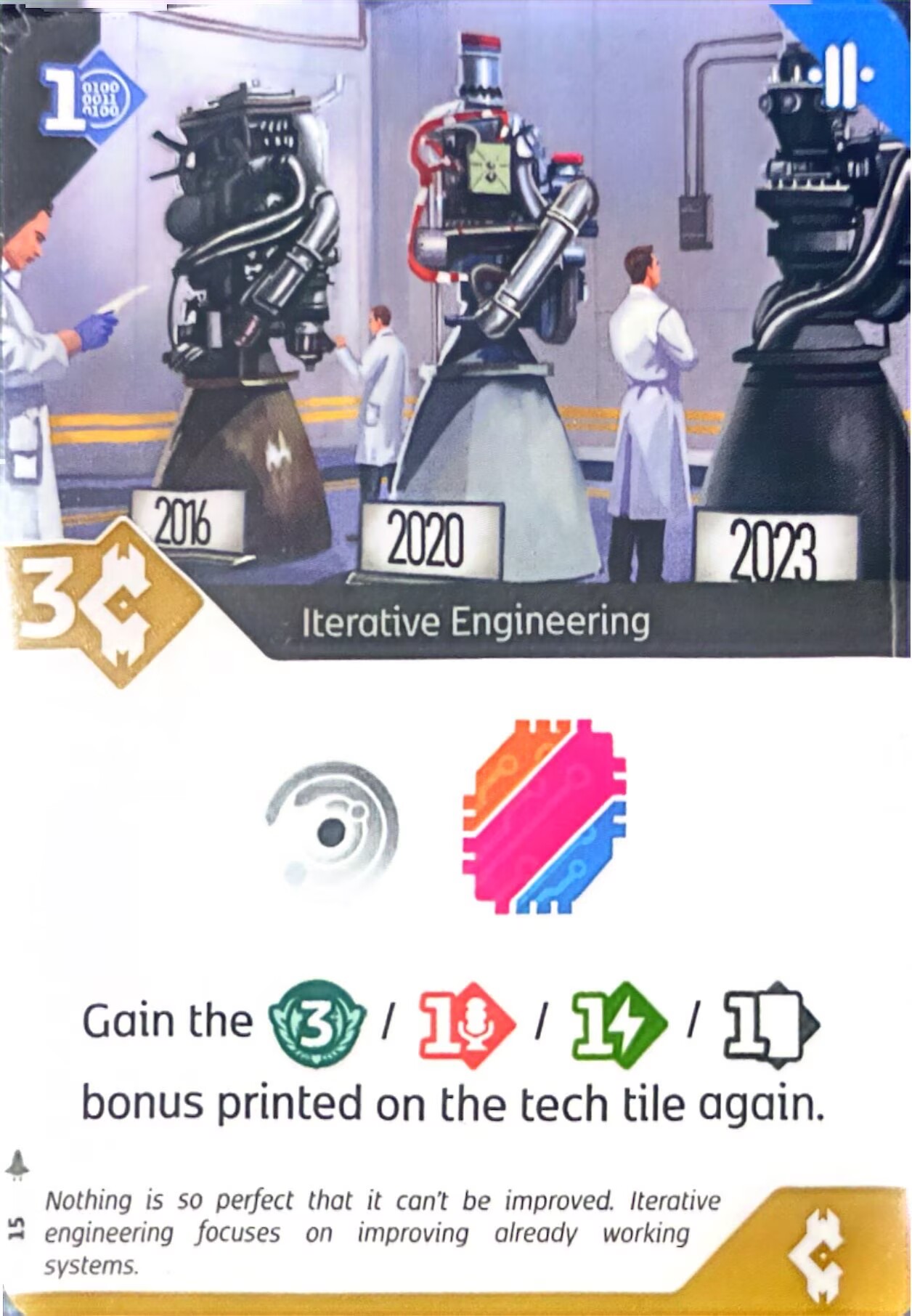
Iterative Engineering
3
Gain the / / / bonus printed on the tech tile again.
3
1
1
1
SA.15
Nothing is so perfect that it can't be improved. Iterative engineering focuses on improving already working systems.
Not For Commercial Use
1
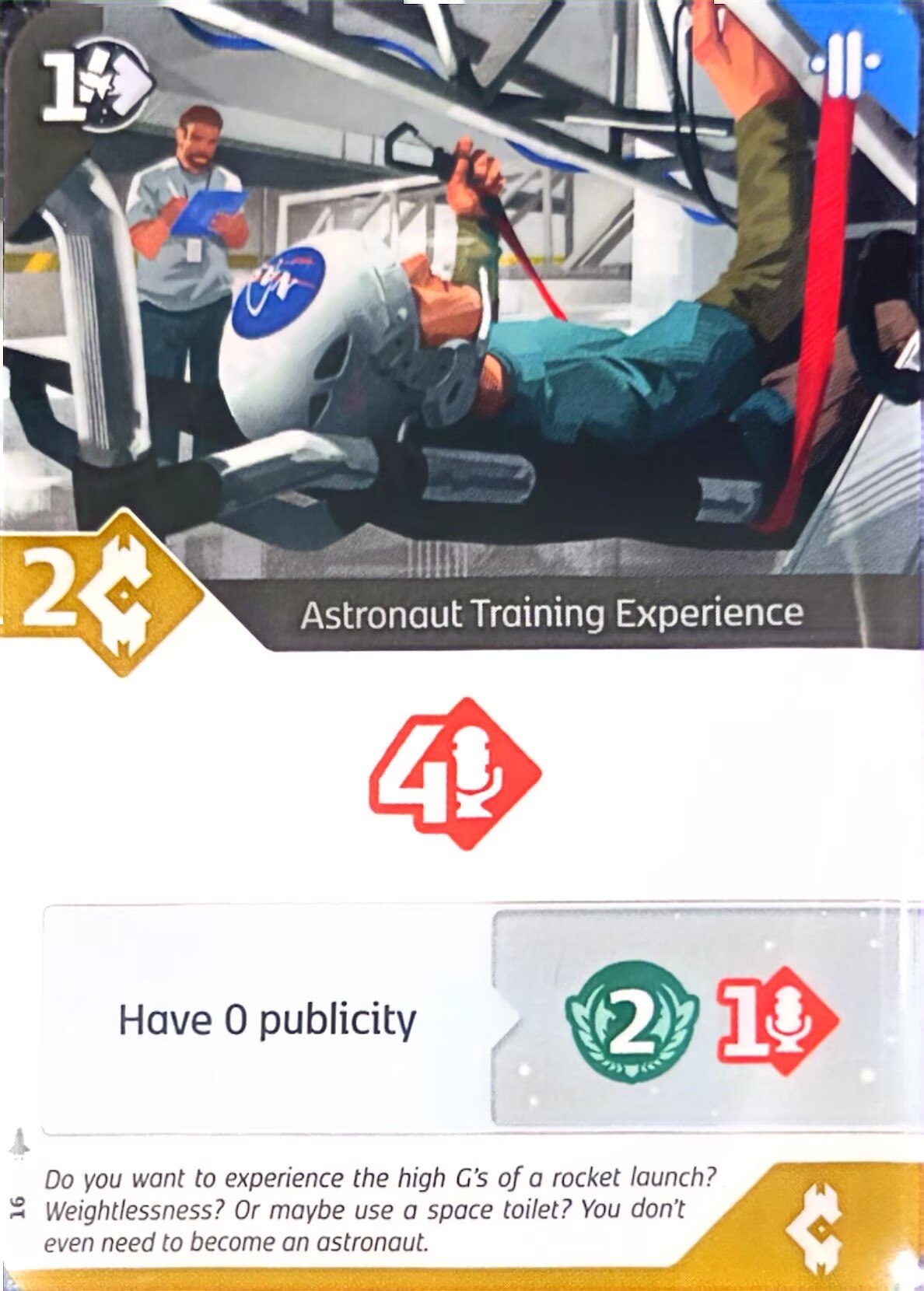
Astronaut Training Experience
2
4
Have no publicity
2
1
SA.16
Do you want to experience the high G's of a rocket launch? Weightlessness? Or maybe use a space toilet? You don't even need to become an astronaut.
Not For Commercial Use
1
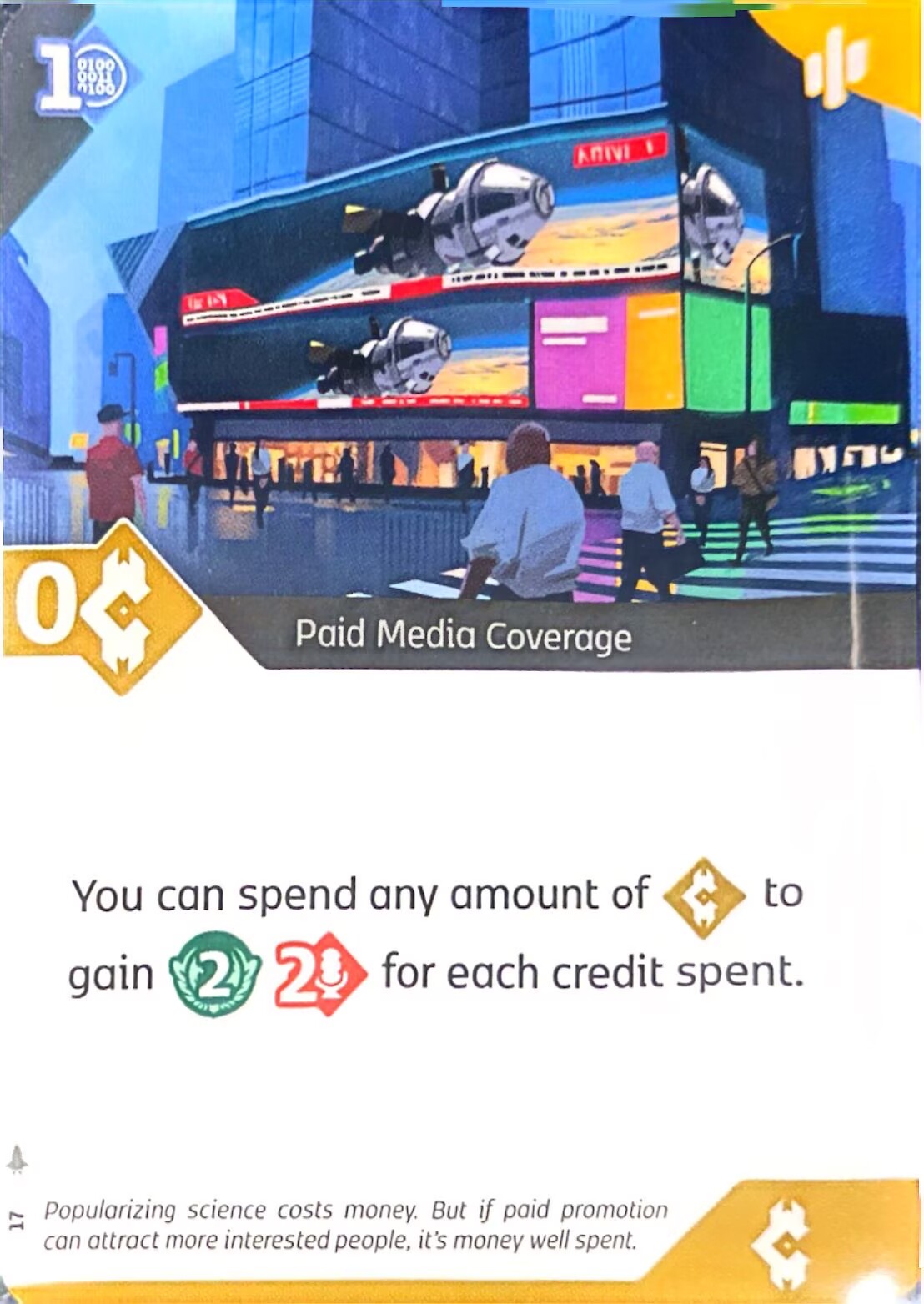
Paid Media Coverage
0
You can spend any amount of to gain for each credit spent.
2
2
SA.17
Popularizing science costs money. But if paid promotion can attract more interested people, it's money well spent.
Not For Commercial Use
1
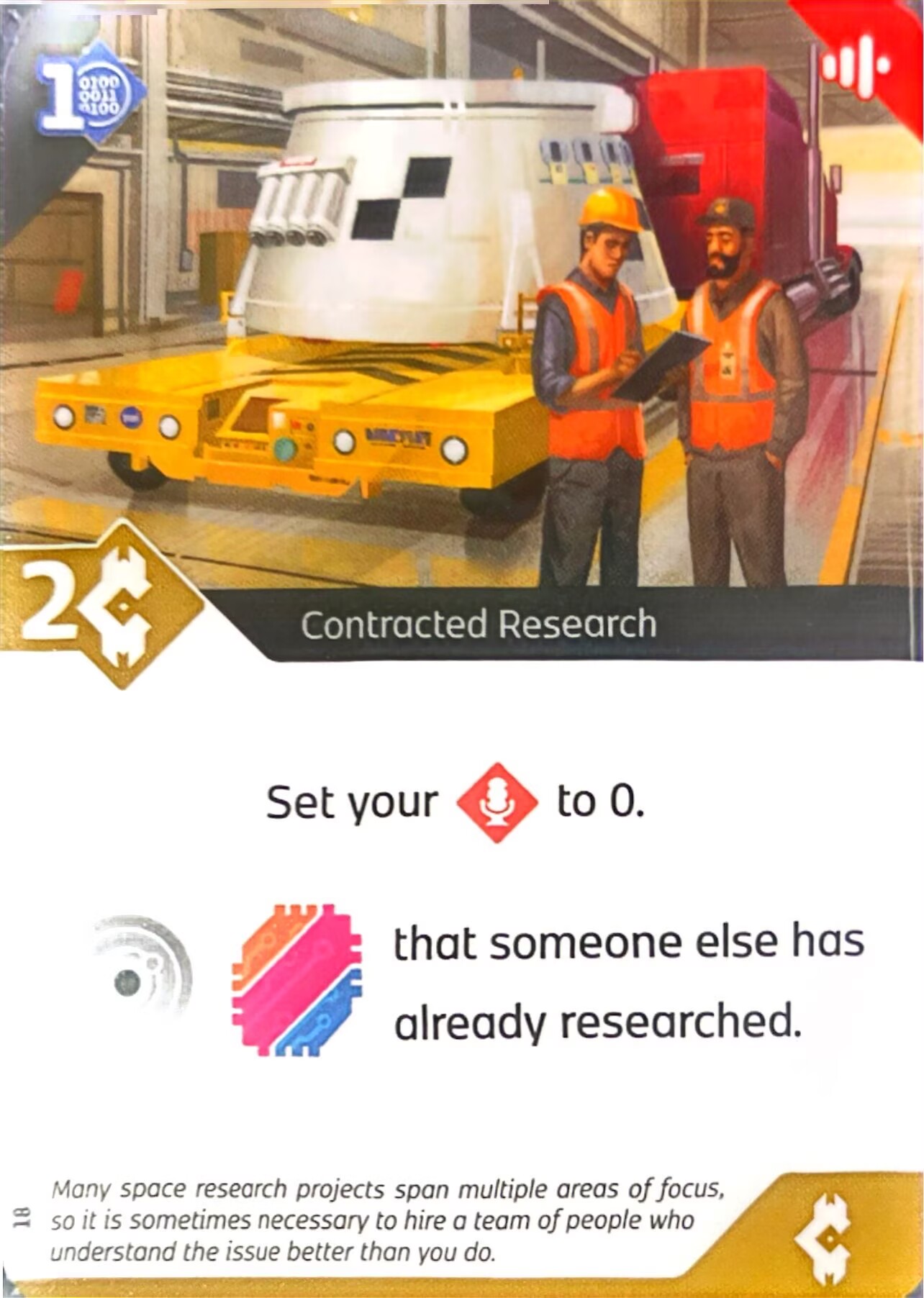
Contracted Research
2
Set your to 0.
that someone else has already researched.
SA.18
Many space research projects span multiple areas of focus, so it is sometimes necessary to hire a team of people who understand the issue better than you do.
Not For Commercial Use
1
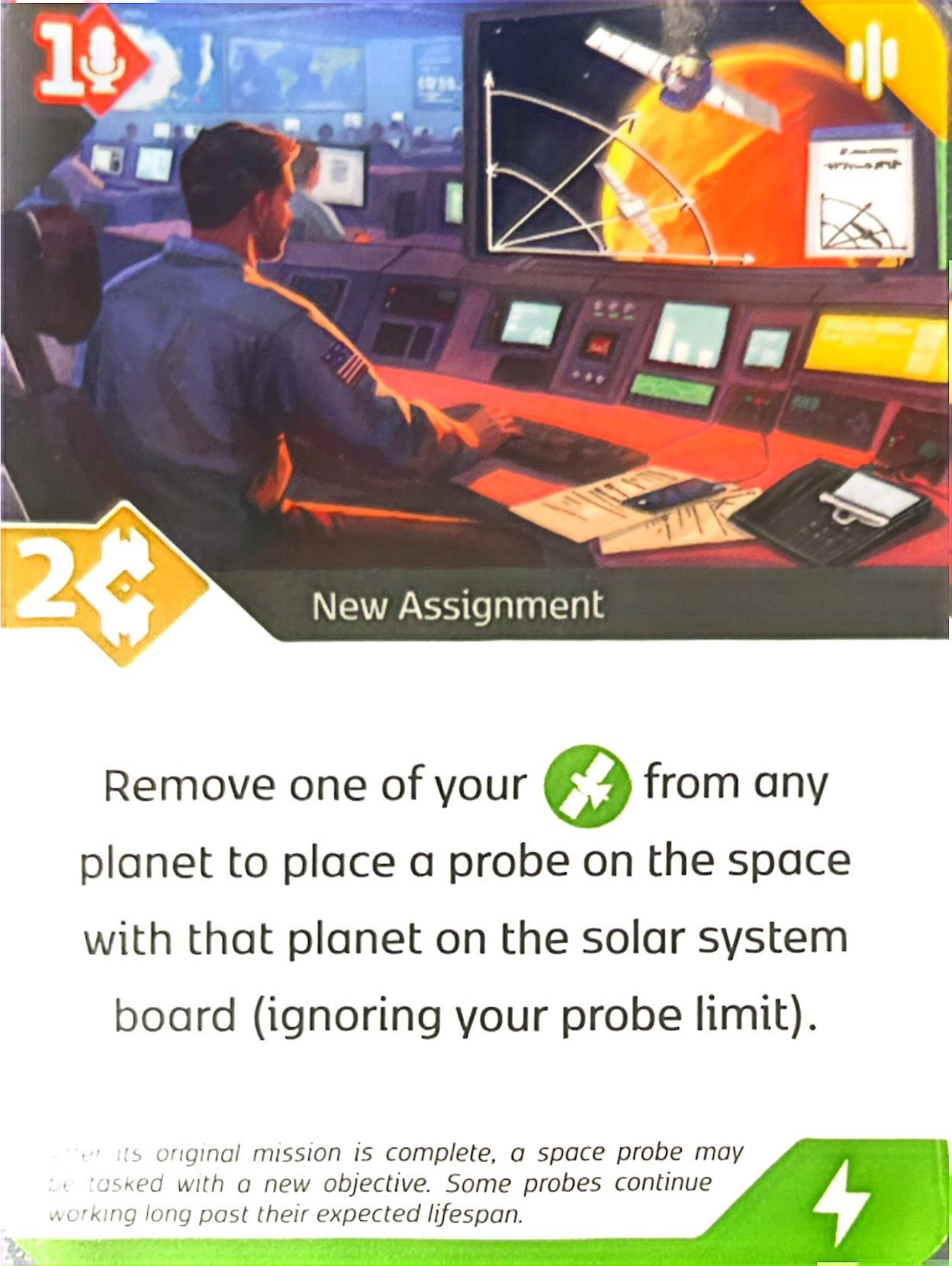
New Assignment
2
Remove one of your from any
planet to place a probe on the space
with that planet on the solar system
board (ignoring your probe limit).
SA.19
Planets outside the Solar System are hard to find. They are easiest to observe when they transit their parent star. These observations are the task of the TESS satellite.
Not For Commercial Use
1
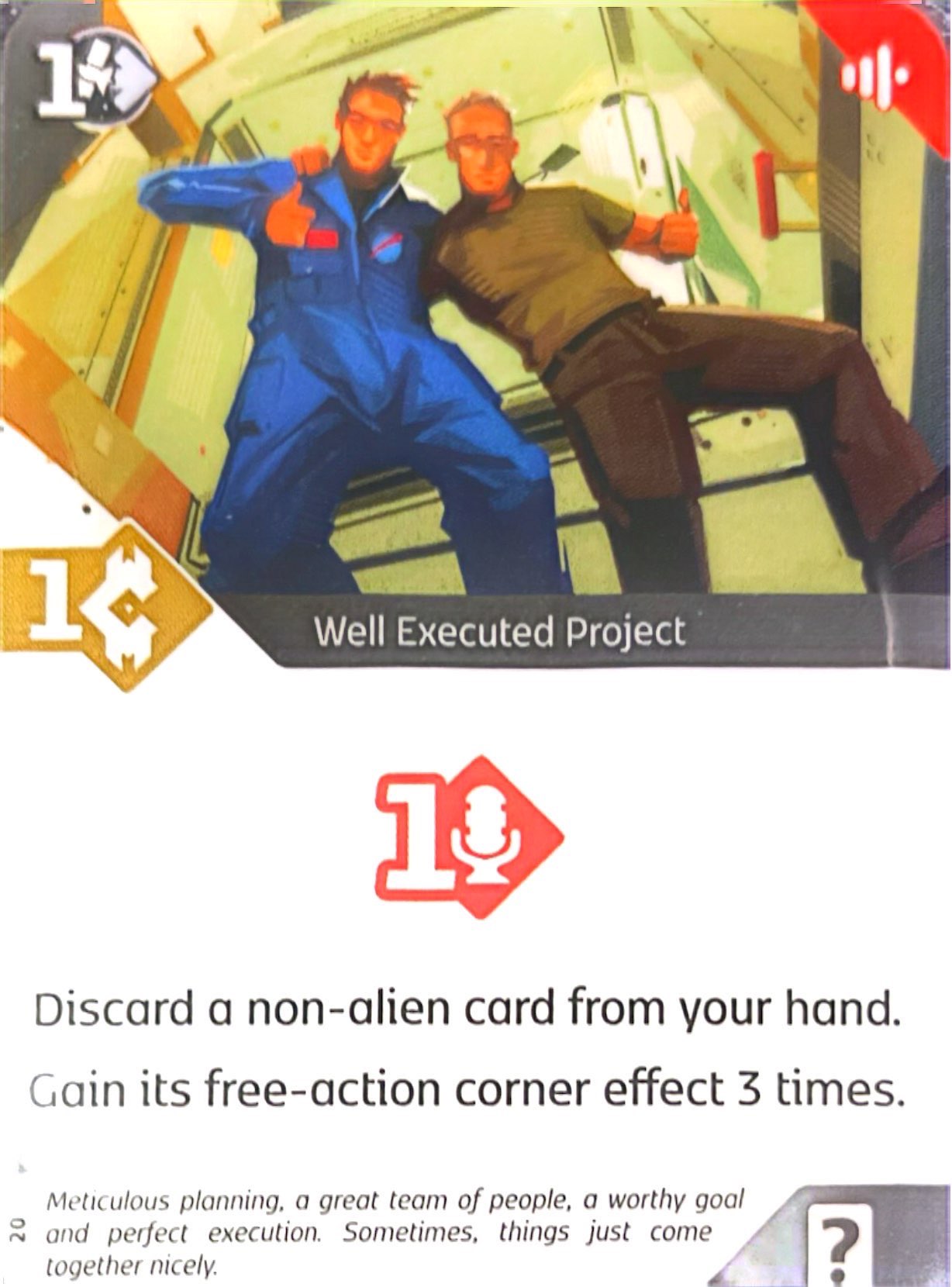
Well Executed Project
1
1
Discard a non-alien card from your hand.
Gain its free-action corner effect 3 times.
SA.20
Meticulous planning, a great team of people, a worthy goal and perfect execution. Sometimes, things just come together nicely.
Not For Commercial Use
1
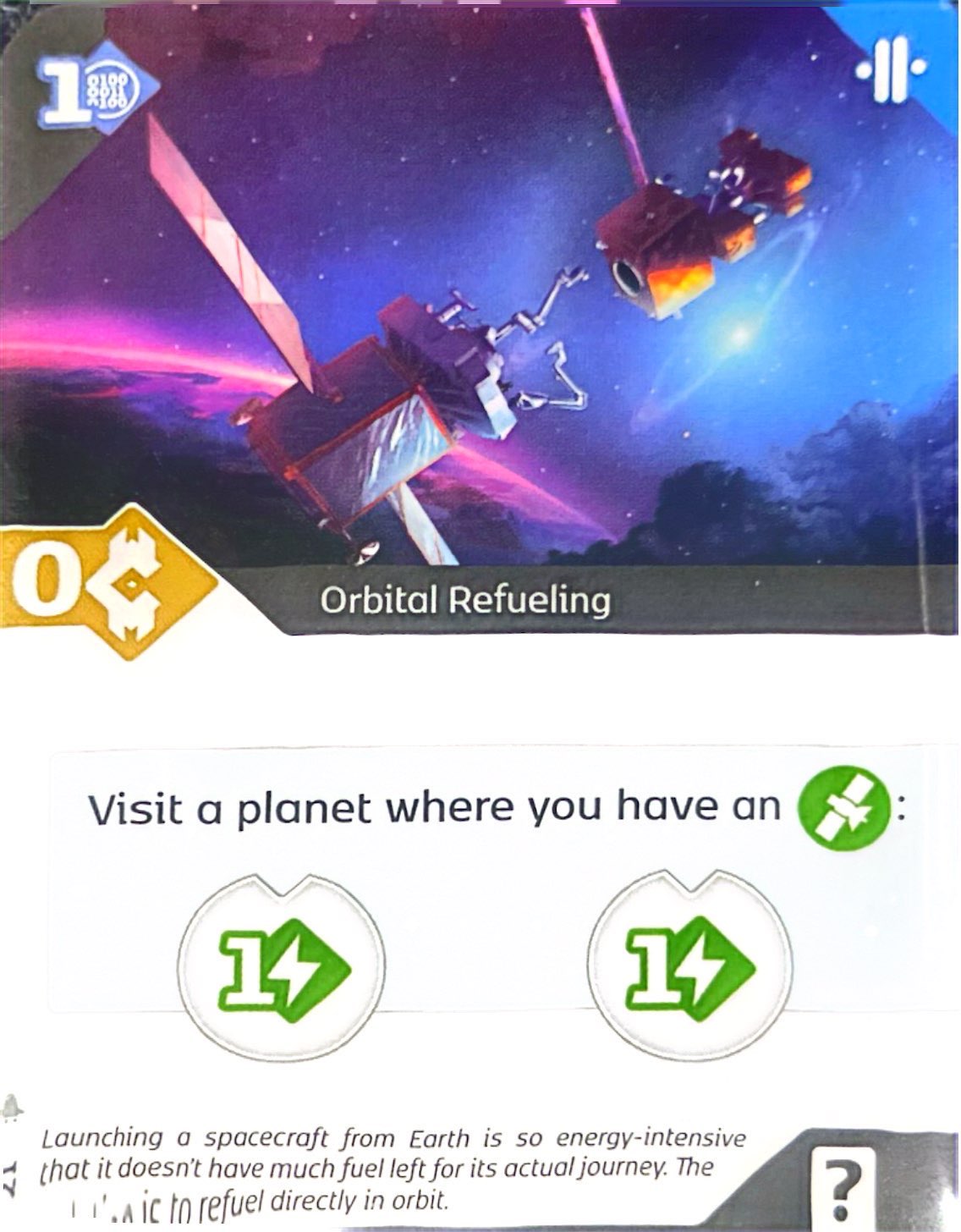
Orbital Refueling
0
Visit a planet
where you have an :
1
1
SA.21
Launching a space craft from Earth is so energy-intensive that it doesn't have much fuel left for its actual journey. The [待补充,看不清] refuel directly in orbit.
Not For Commercial Use
1
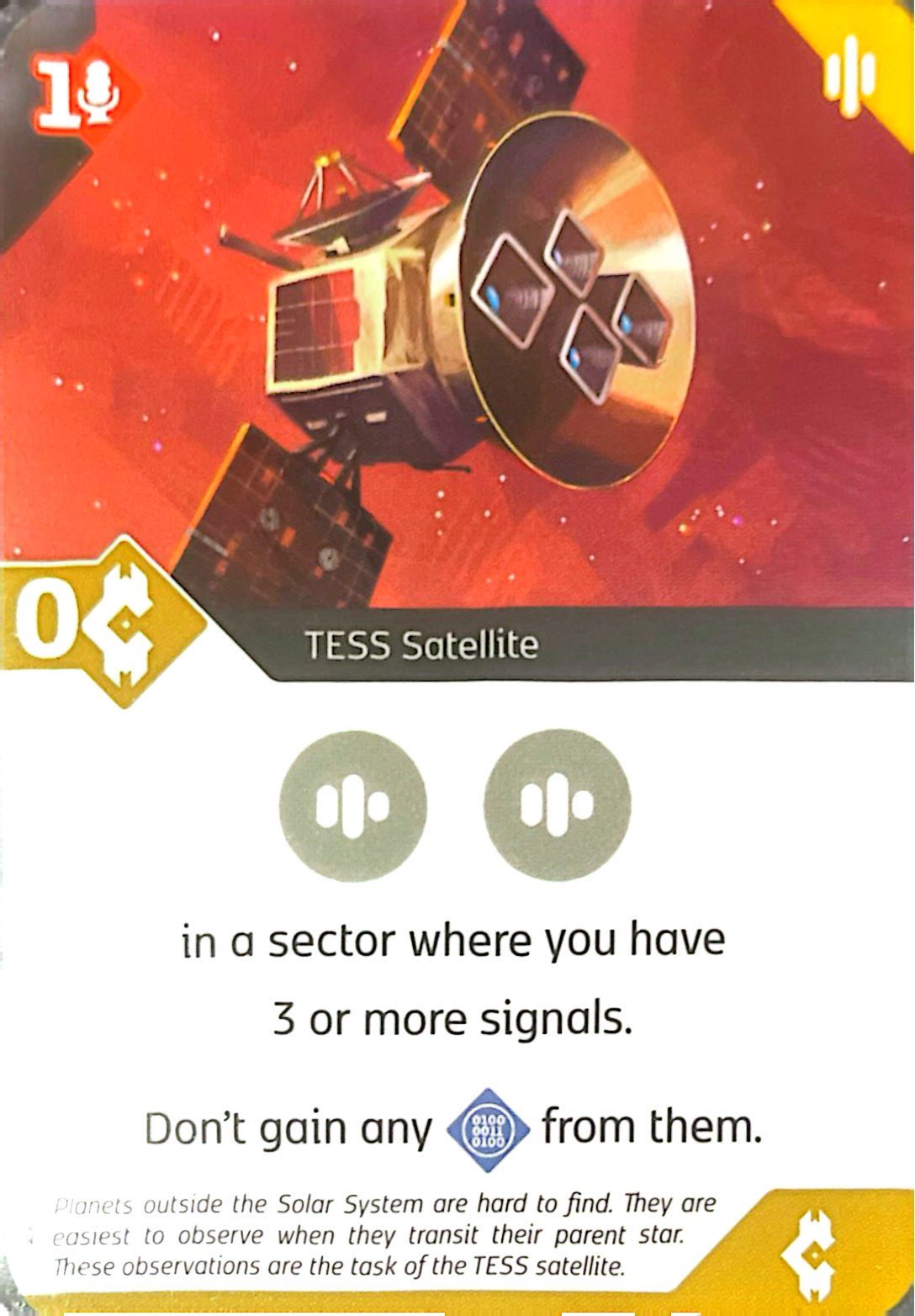
TESS Satellite
0
in a sector where you have
3 or more signals.
Don't gain any from them.
SA.22
The metallic asteroid Psyche could be the future embryo of a planet. A probe of the same name is expected to find out more when it visits the asteroid in 2029.
Not For Commercial Use
1
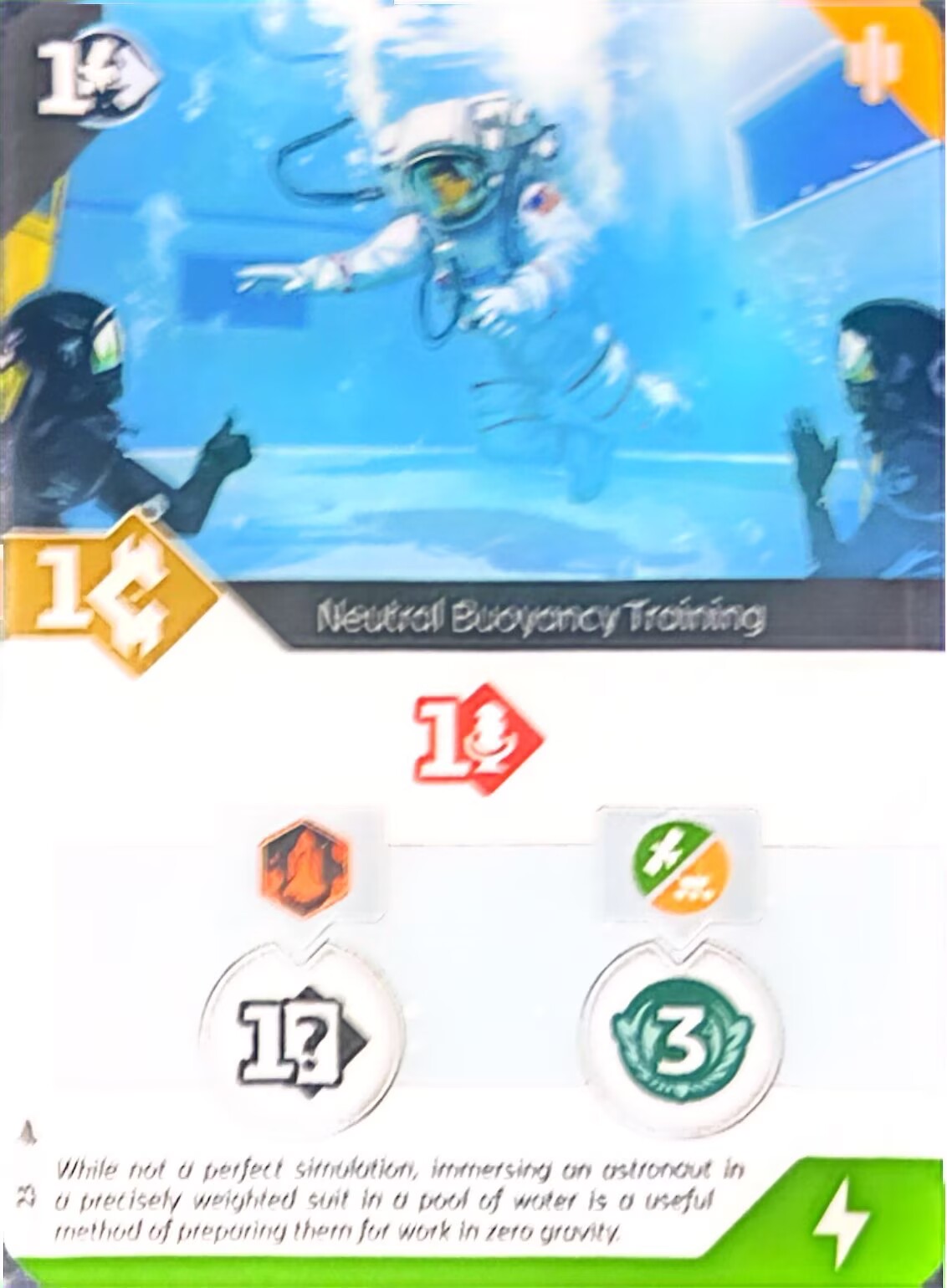
Neutral Buoyancy Training
1
1
1
3
SA.23
While not a perfect simulation, immersing an astronaut in a precisely weighted suit in a pool of water is a useful method of preparing them for work in zero gravity.
Not For Commercial Use
1
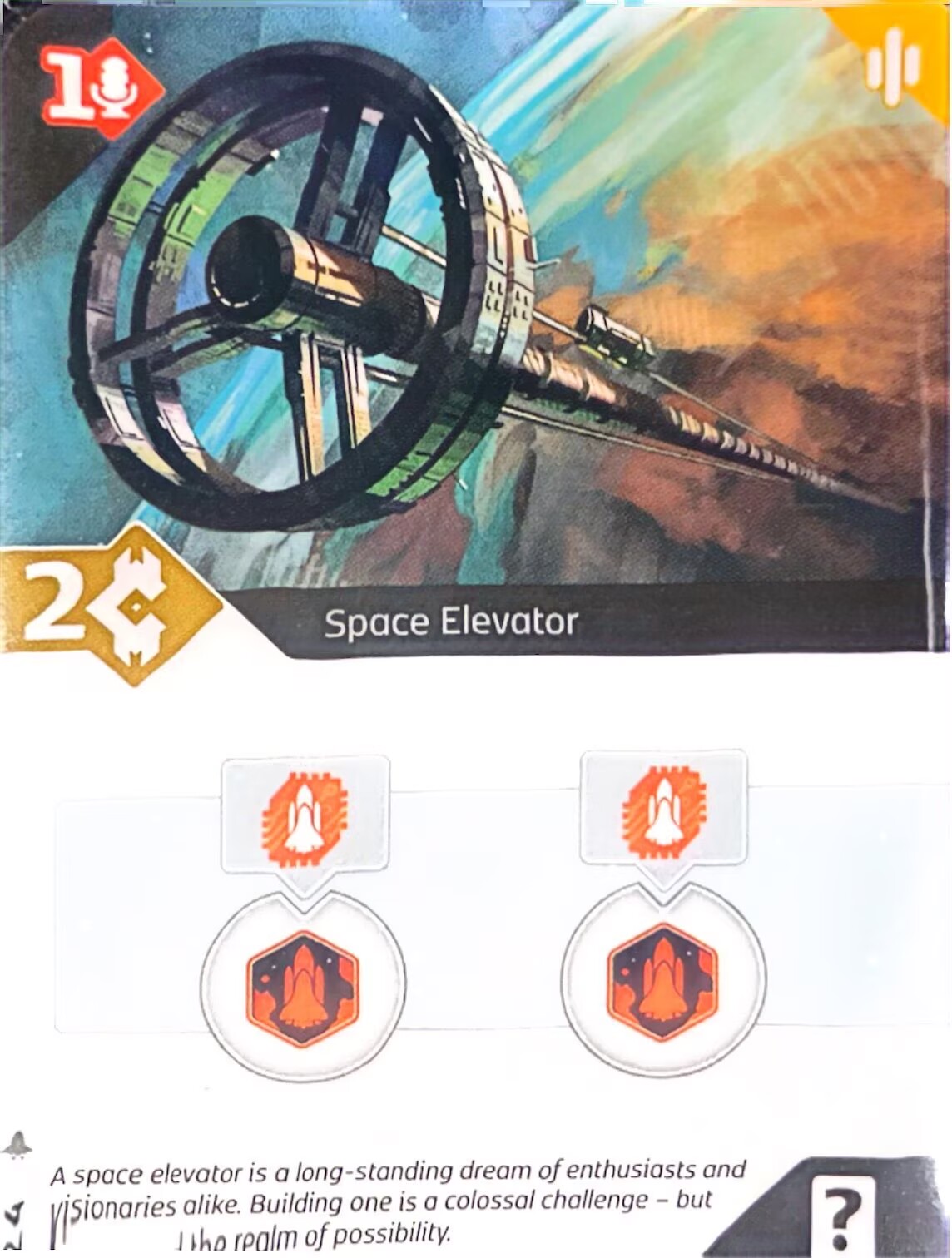
Space Elevator
2
SA.24
A space elevator is a long-standing dream of enthusiasts and visionaries alike. Building one is a colossal challenge - but [待补充,看不清] the realm of possibility.
Not For Commercial Use
1
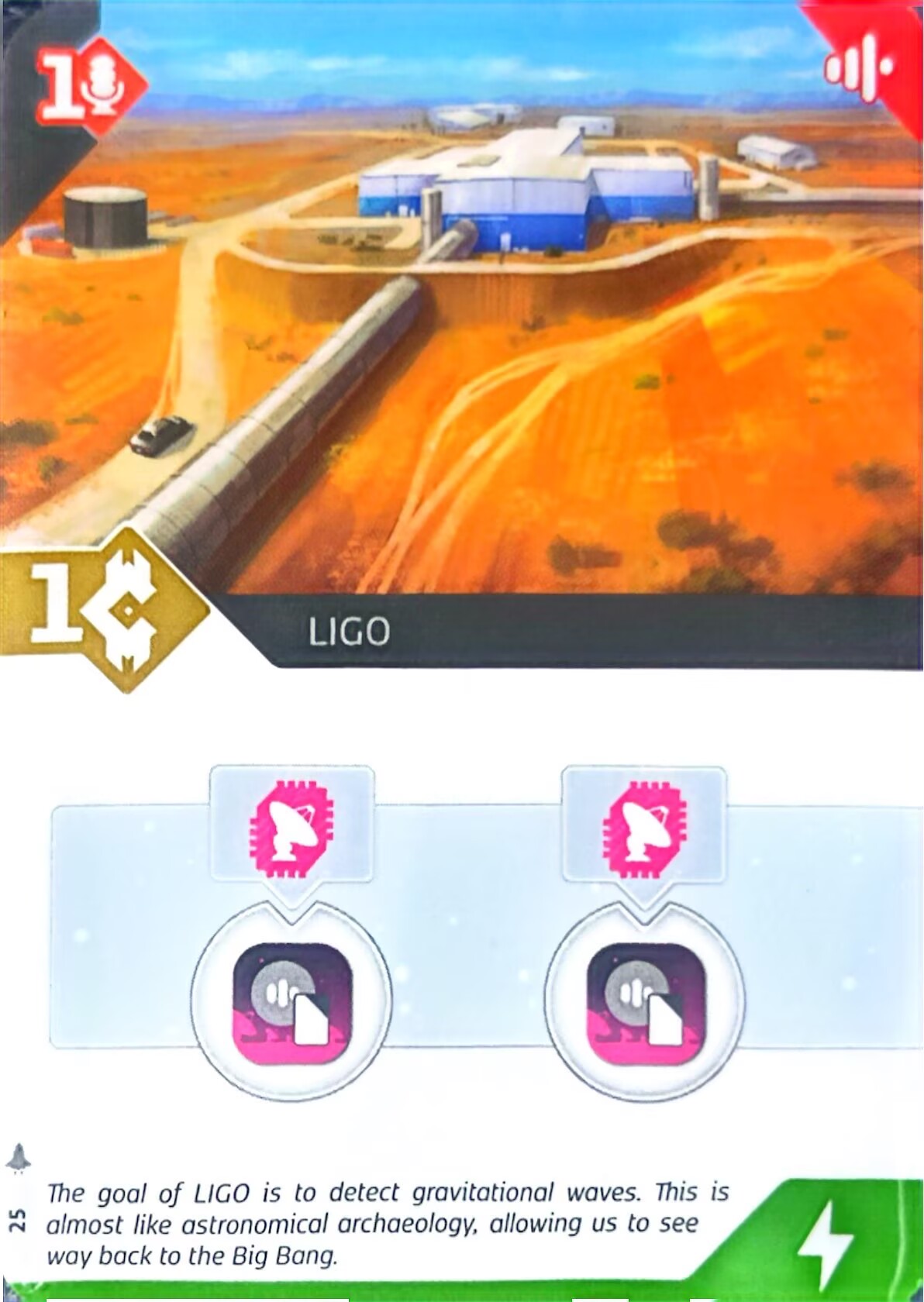
LIGO
1
SA.25
The goal of LIGO is to detect gravitational waves. This is almost like astronomical archaeology, allowing us to see way back to the Big Bang.
Not For Commercial Use
1
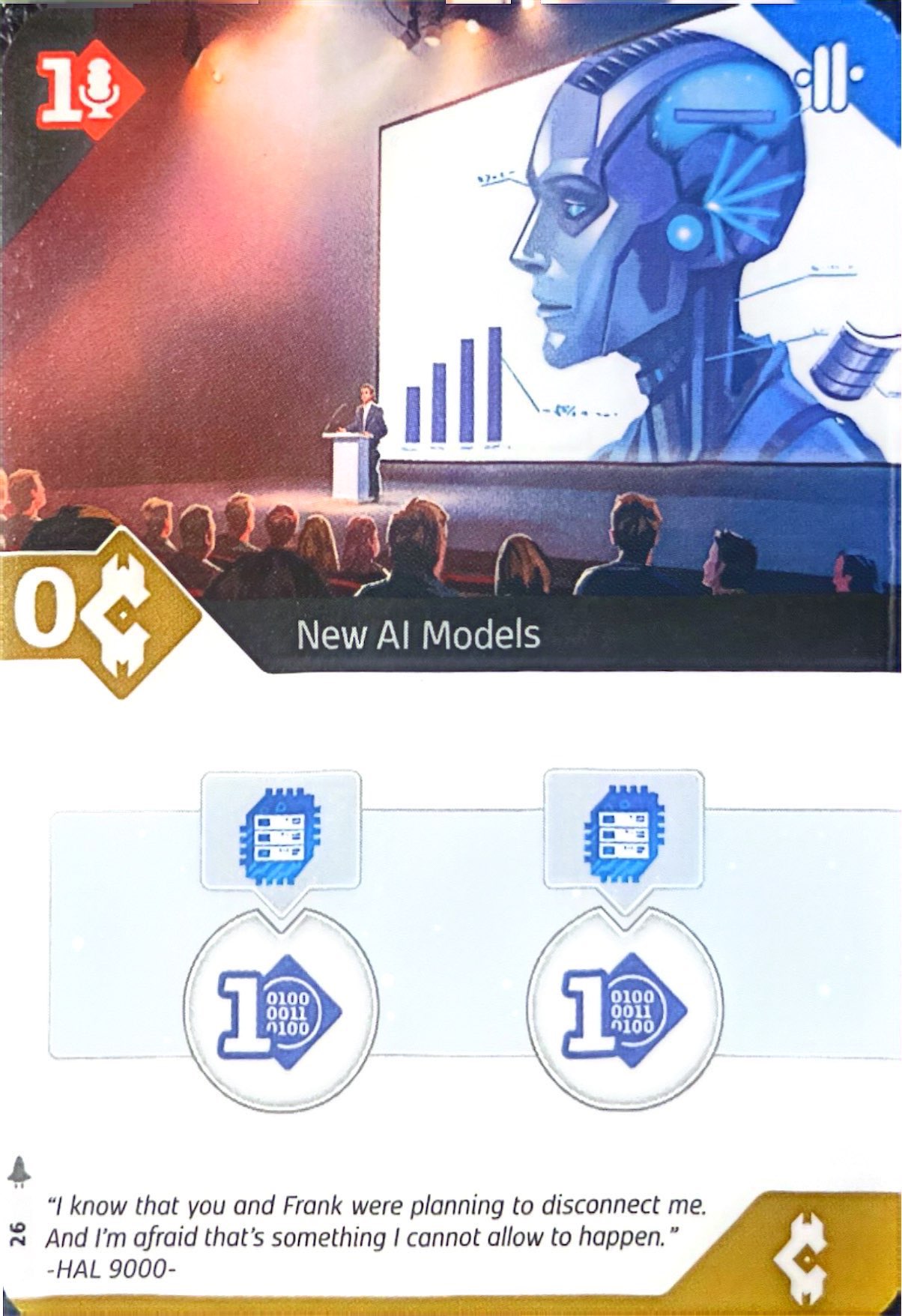
New AI Models
0
1
1
SA.26
"I know that you and Frank were planning to disconnect me. And I'm afraid that's something I cannot allow to happen." -HAL 9000-
Not For Commercial Use
1
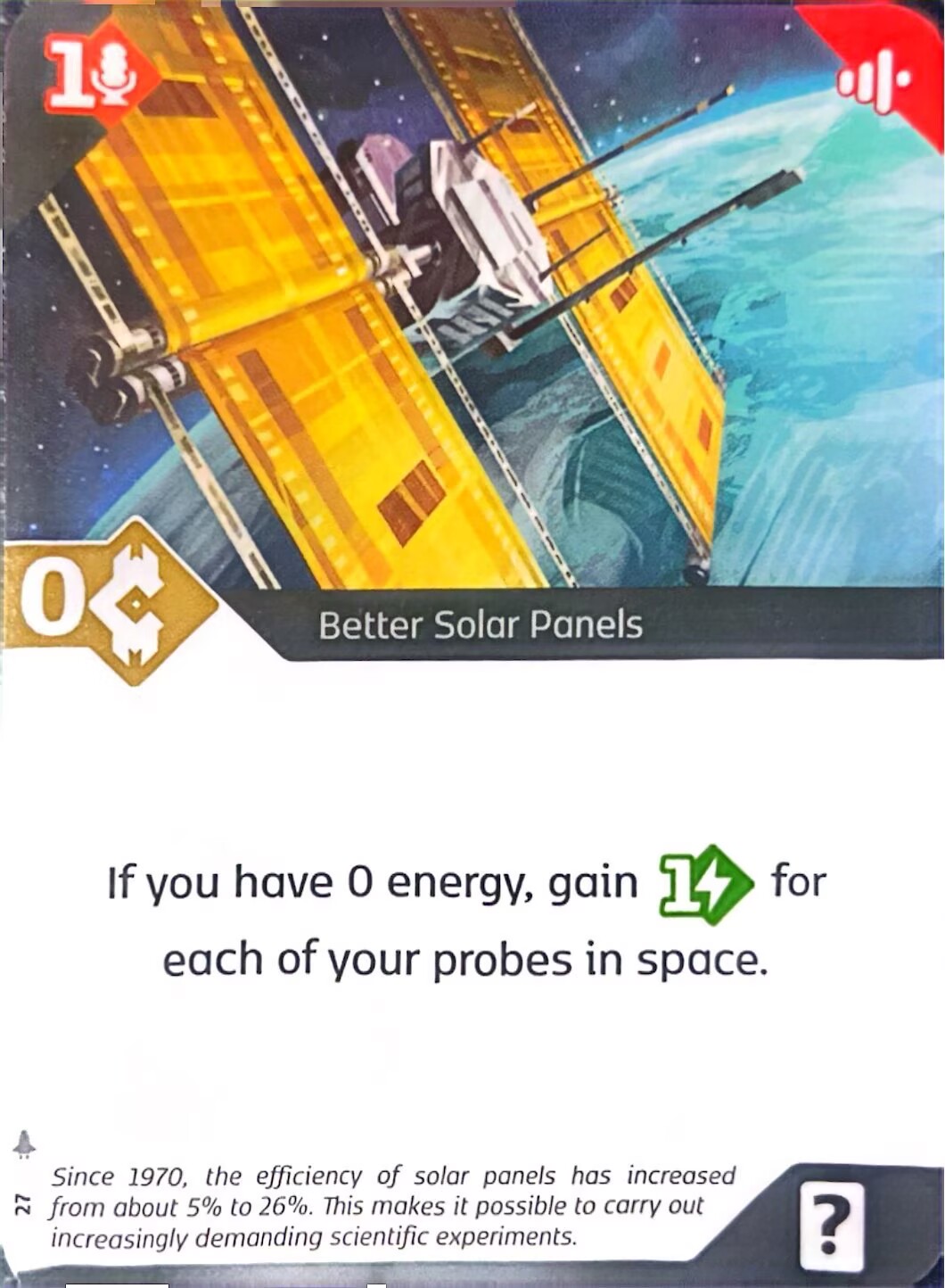
Better Solar Panels
0
If you have 0 energy, gain for
1
each of your probes in space.
SA.27
Since 1970, the efficiency of solar panels has increased from about 5% to 26%. This makes it possible to carry out increasingly demanding scientific experiments.
Not For Commercial Use
1
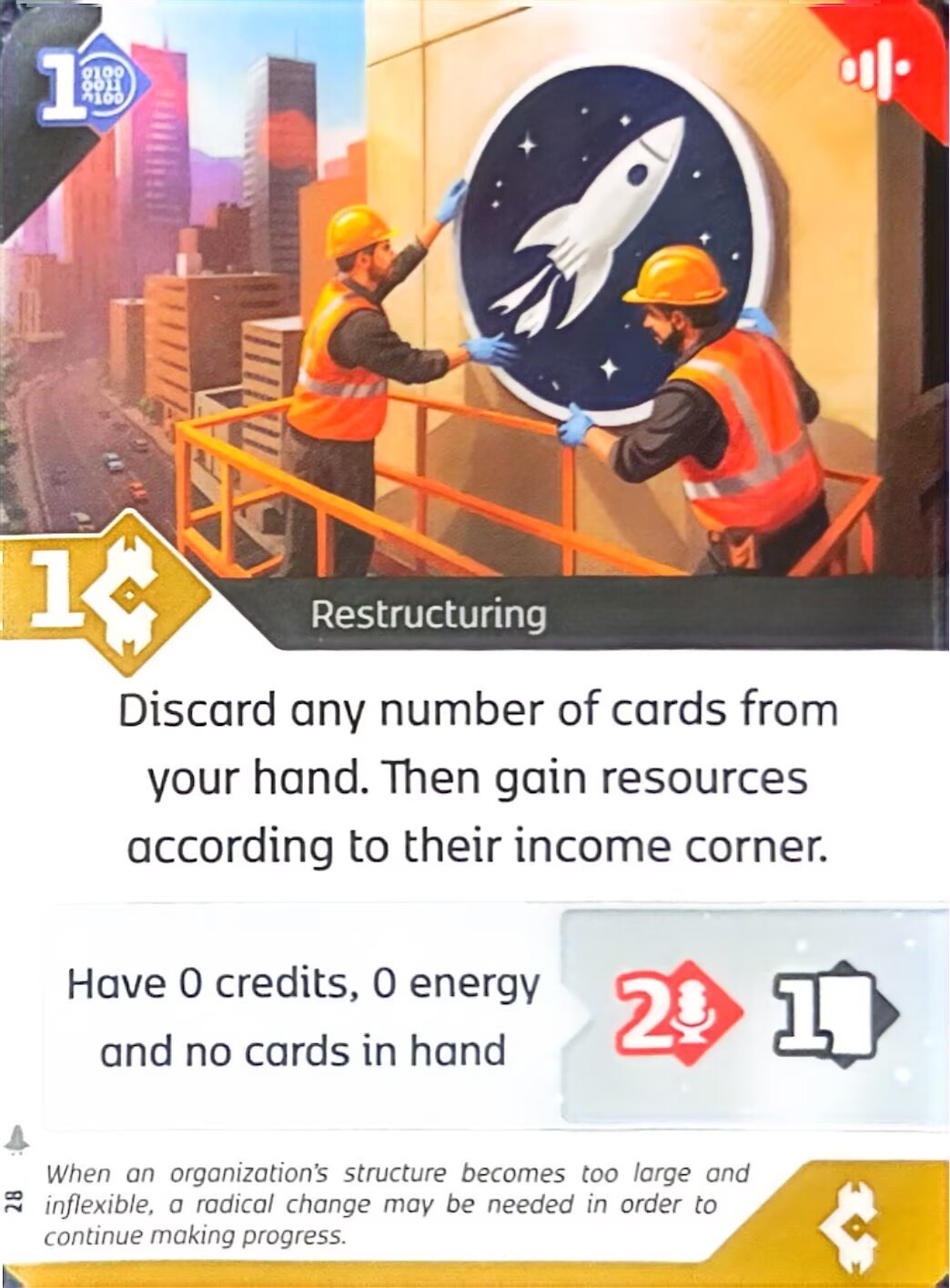
Restructuring
1
Discard any number of cards from
your hand. Then gain resources
according to their income corner.
Have 0 credits, 0 energy and no cards in hand
2
1
SA.28
When an organization's structure becomes too large and inflexible, a radical change may be needed in order to continue making progress.
Not For Commercial Use
1
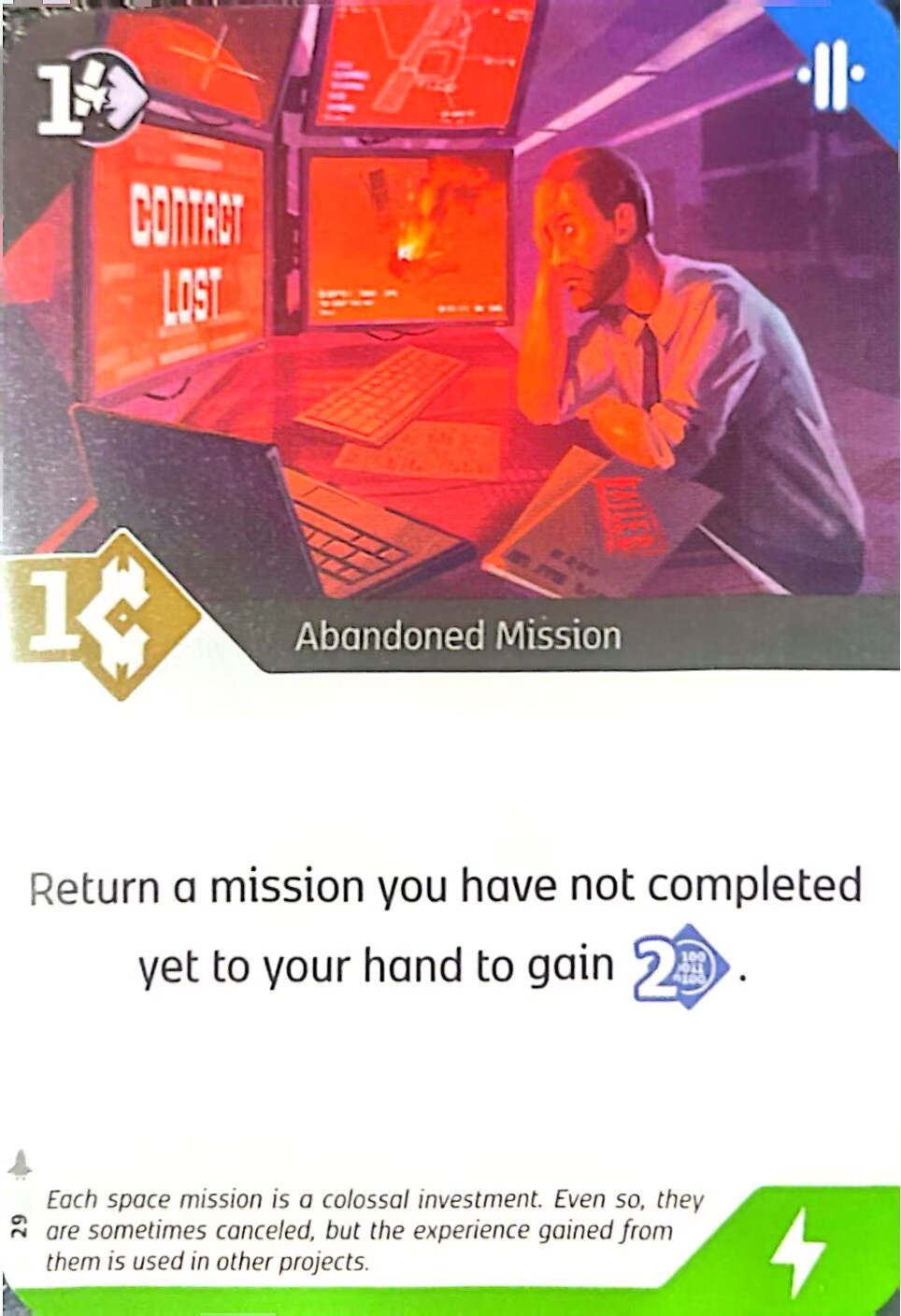
Abandoned Mission
1
Return a mission you have not completed yet to your hand to gain .
2
SA.29
Each space mission is a colossal investment. Even so, they are sometimes canceled, but the experience gained from them is used in other projects.
Not For Commercial Use
1
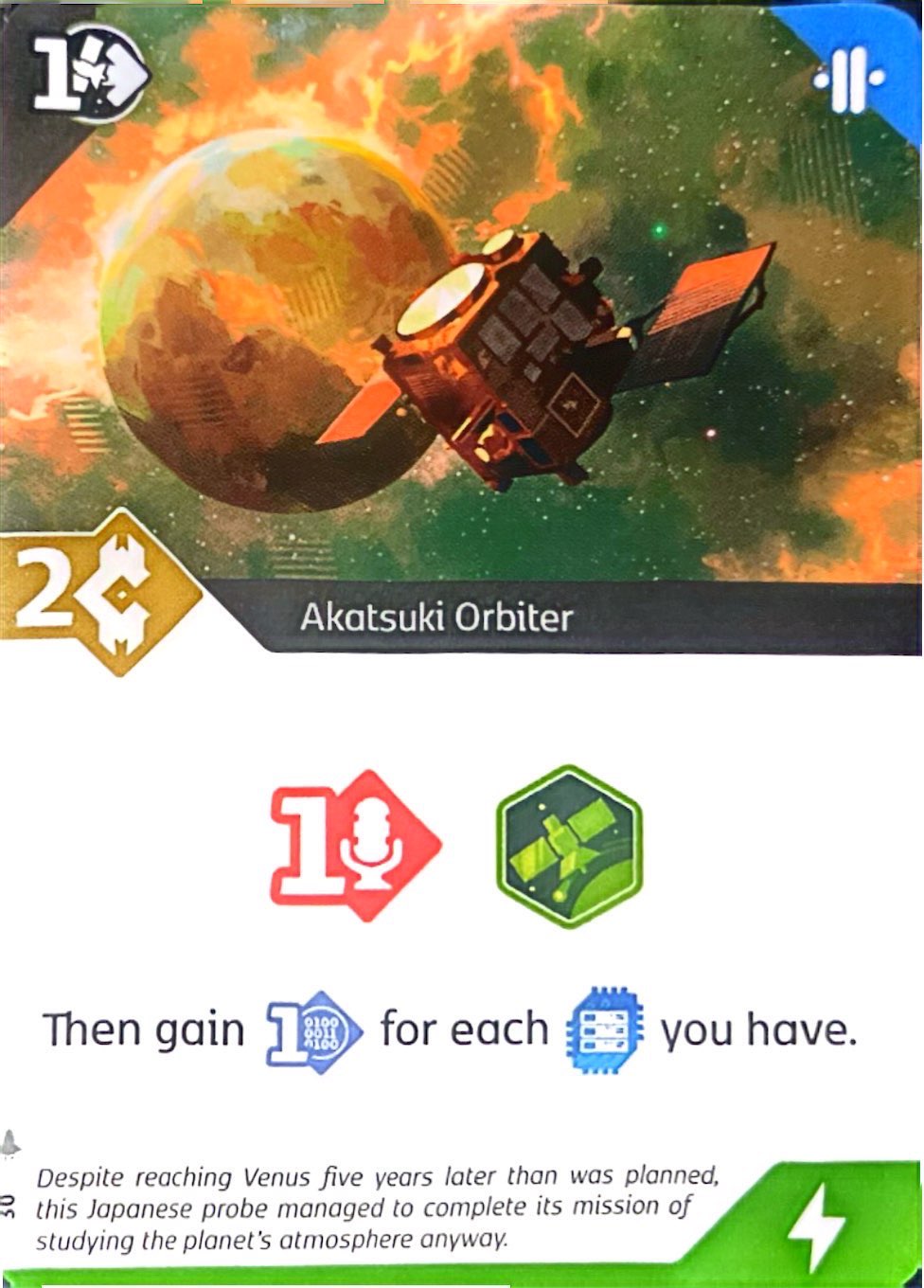
Akatsuku Orbiter
2
1
Then gain for each you have.
1
SA.30
Despite reaching Venus five years later than was planned, this Japanese probe managed to complete its mission of studying the planet's atmosphere anyway.
Not For Commercial Use
1
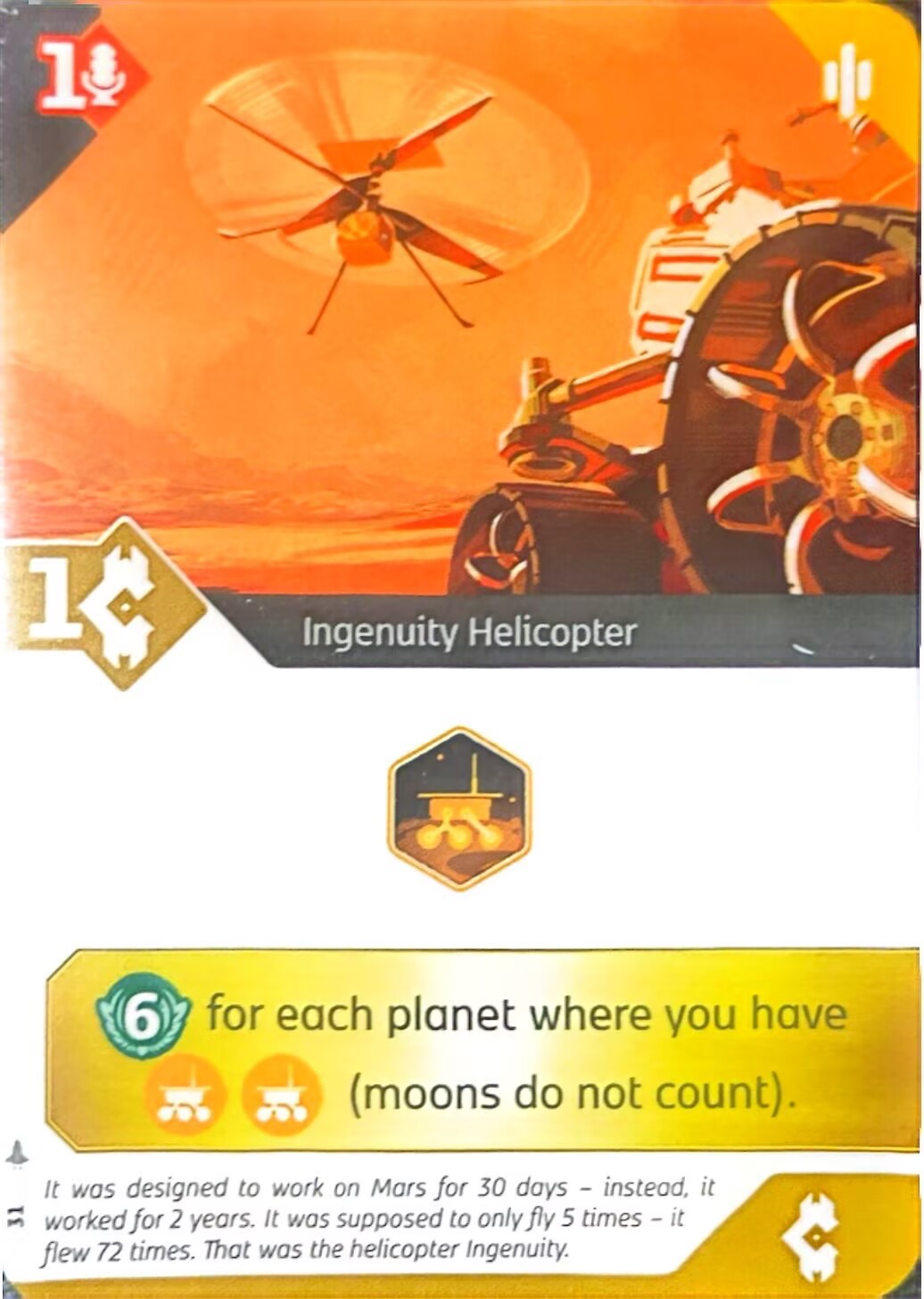
Ingenuity Helicopter
1
6
SA.31
It was designed to work on Mars for 30 days - instead, it worked for 2 years. It was supposed to only fly 5 times - it flew 72 times. That was the helicopter ingenuity.
Not For Commercial Use
1
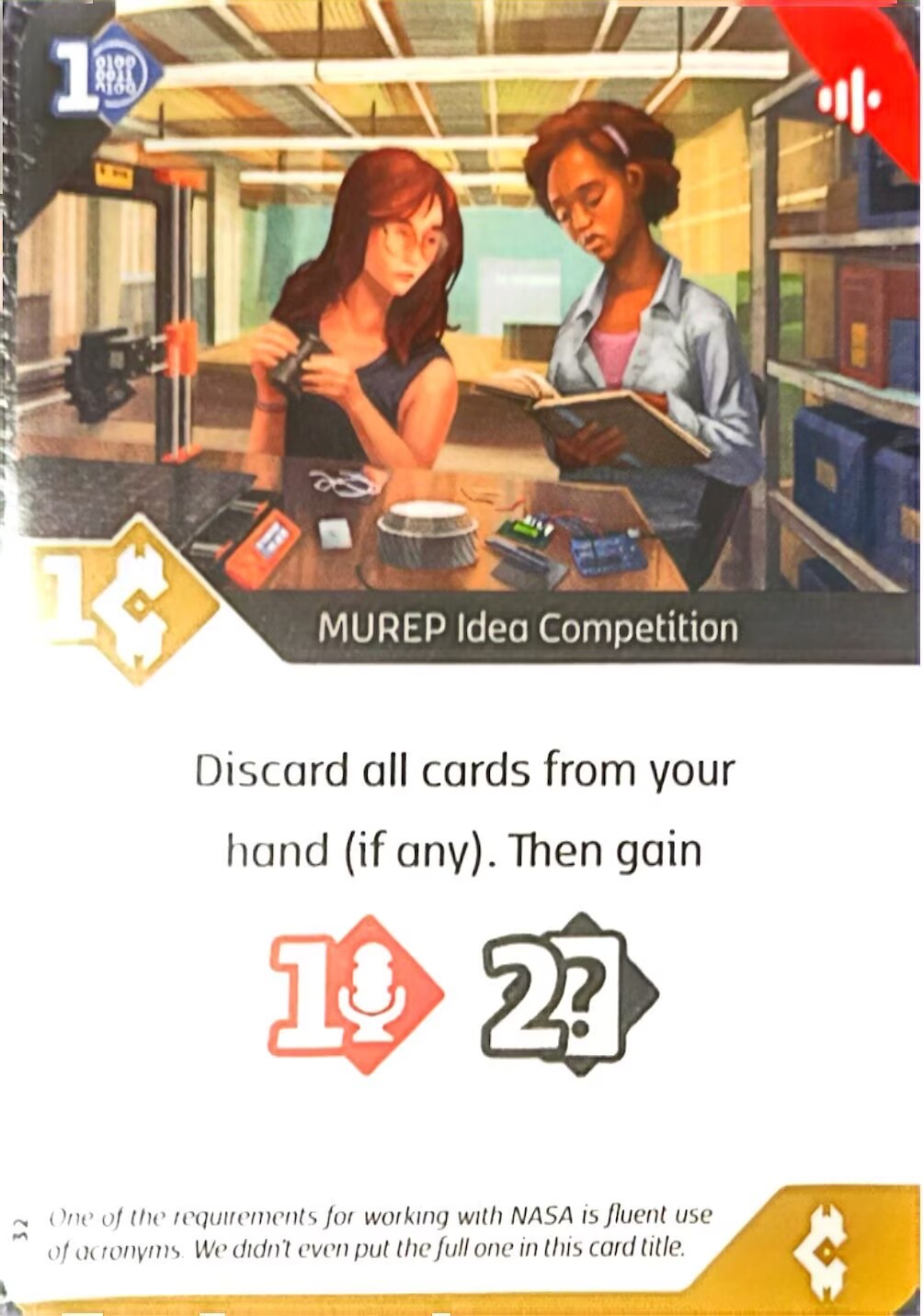
MUREP Idea Competition
1
Discard all cards from your hand (if any).
Then gain
1
2
SA.32
One of the requirements for working with NASA is fluent use of acronyms. We didn't even put the full one in this card title.
Not For Commercial Use
1
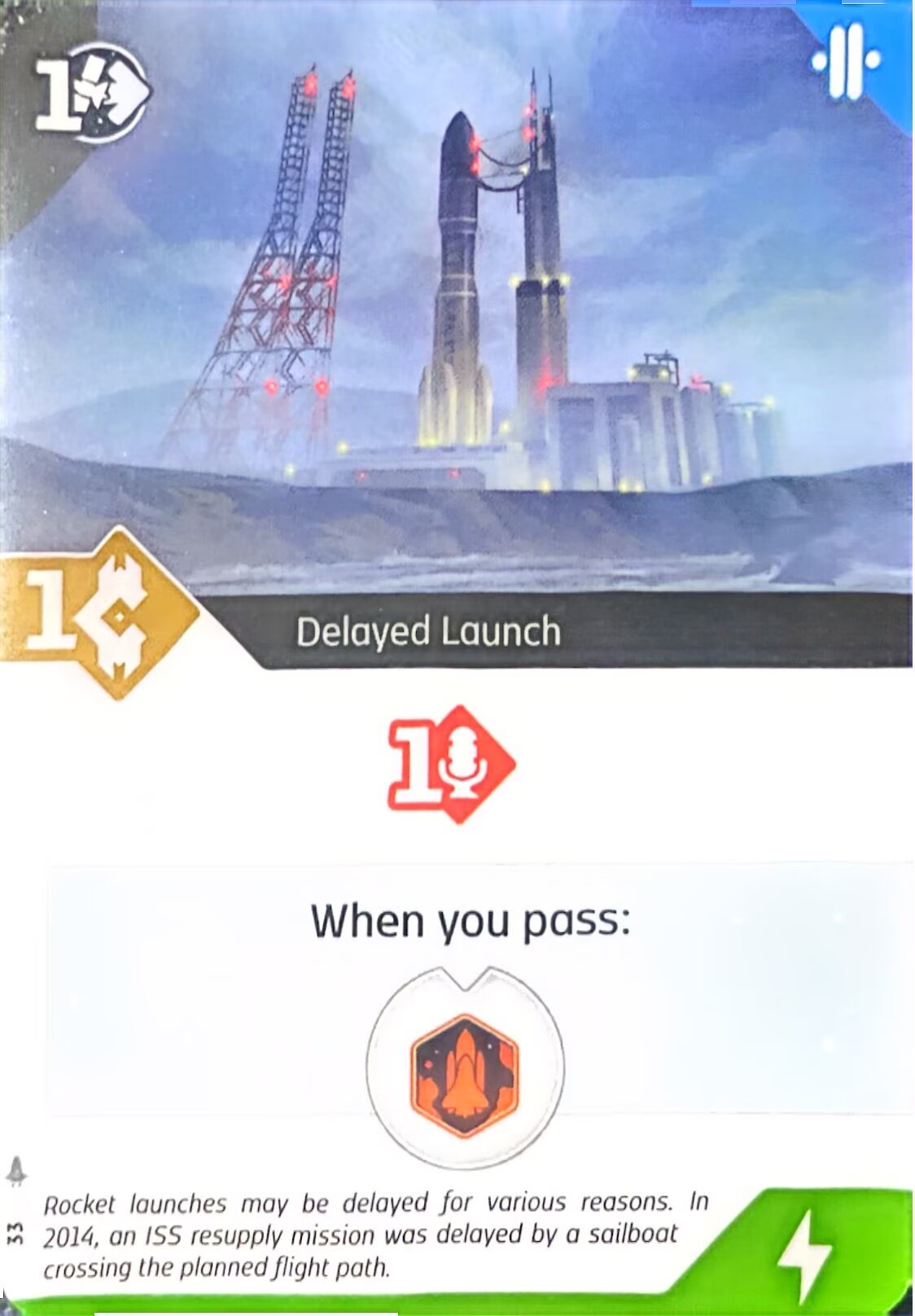
Delayed Launch
1
1
When you pass:
SA.33
Rocket launches may be delayed for various reasons. In 2014, an ISS resupply mission was delayed by a sailboat crossing the planned flight path.
Not For Commercial Use
1
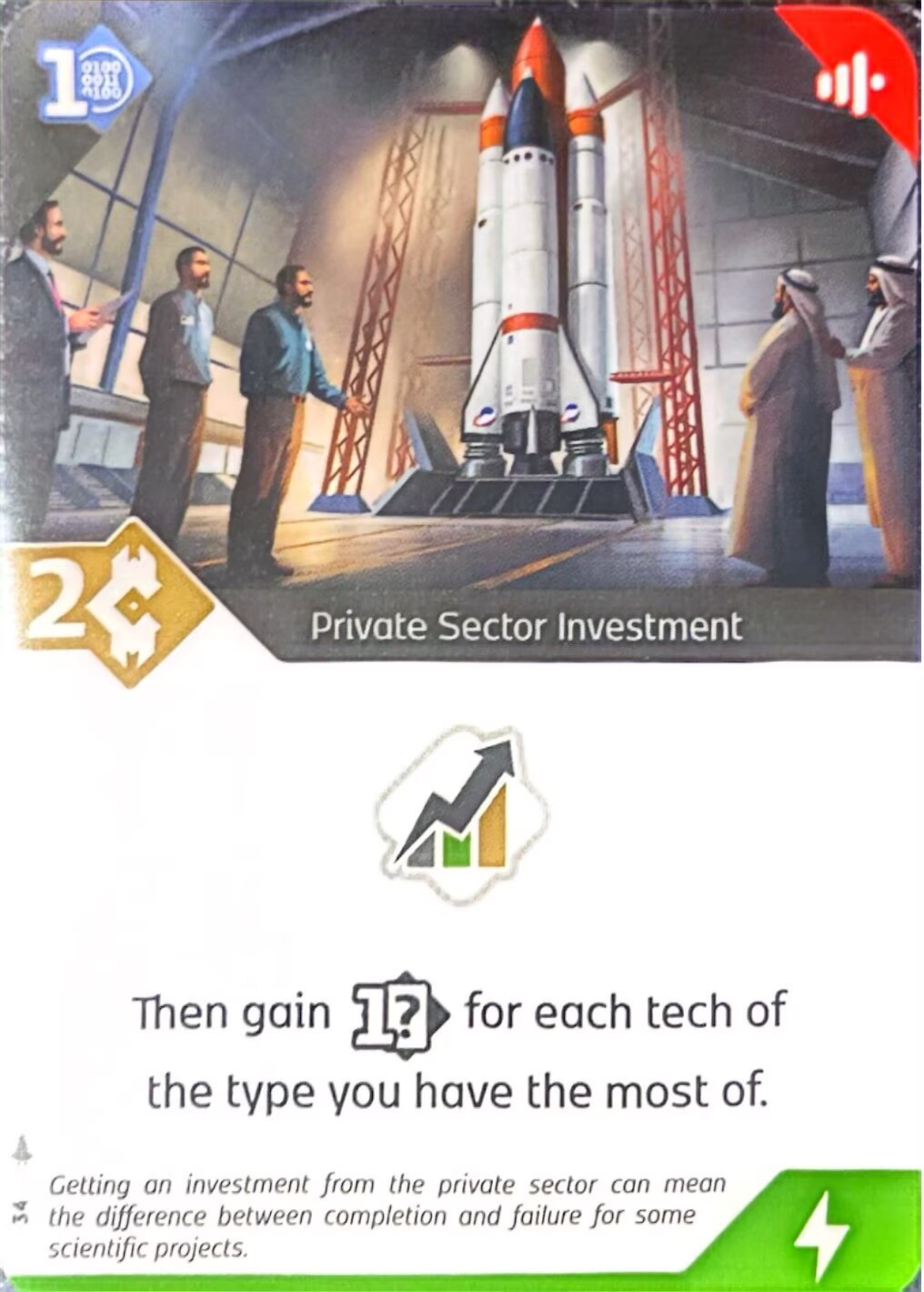
Private Sector Investment
2
Then gain for each tech of
1
the type you have the most of.
SA.34
Getting an investment from the private sector can mean the difference between completion and failure for some scientific projects.
Not For Commercial Use
1
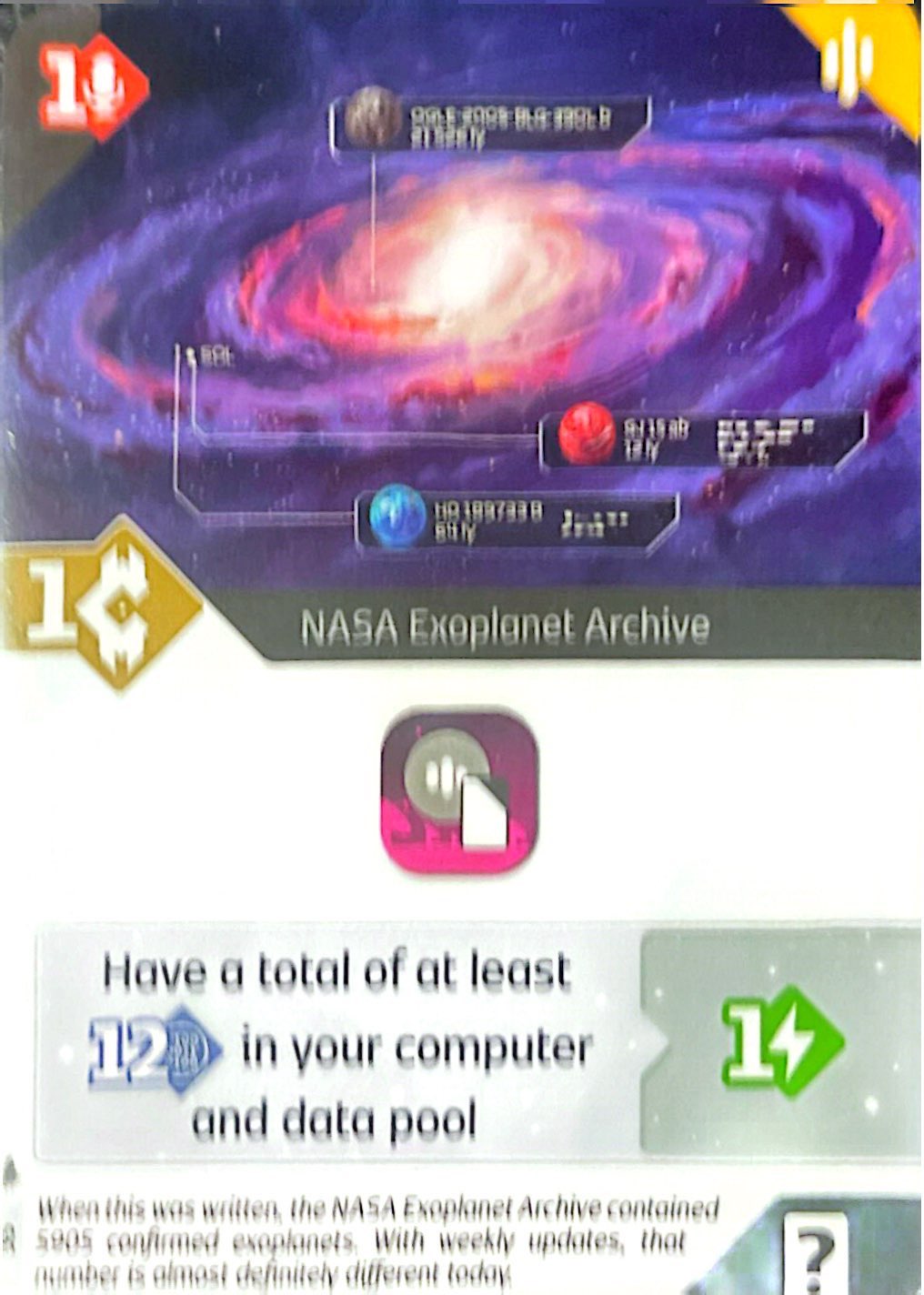
NASA Exoplanet Archive
1
Have a total of at least in
12
your computer and data pool
1
SA.35
When this was written, the NASA Exoplanet Archive contained 5905 confirmed exoplanets. With weekly updates, that number is almost definitely different today.
Not For Commercial Use
1
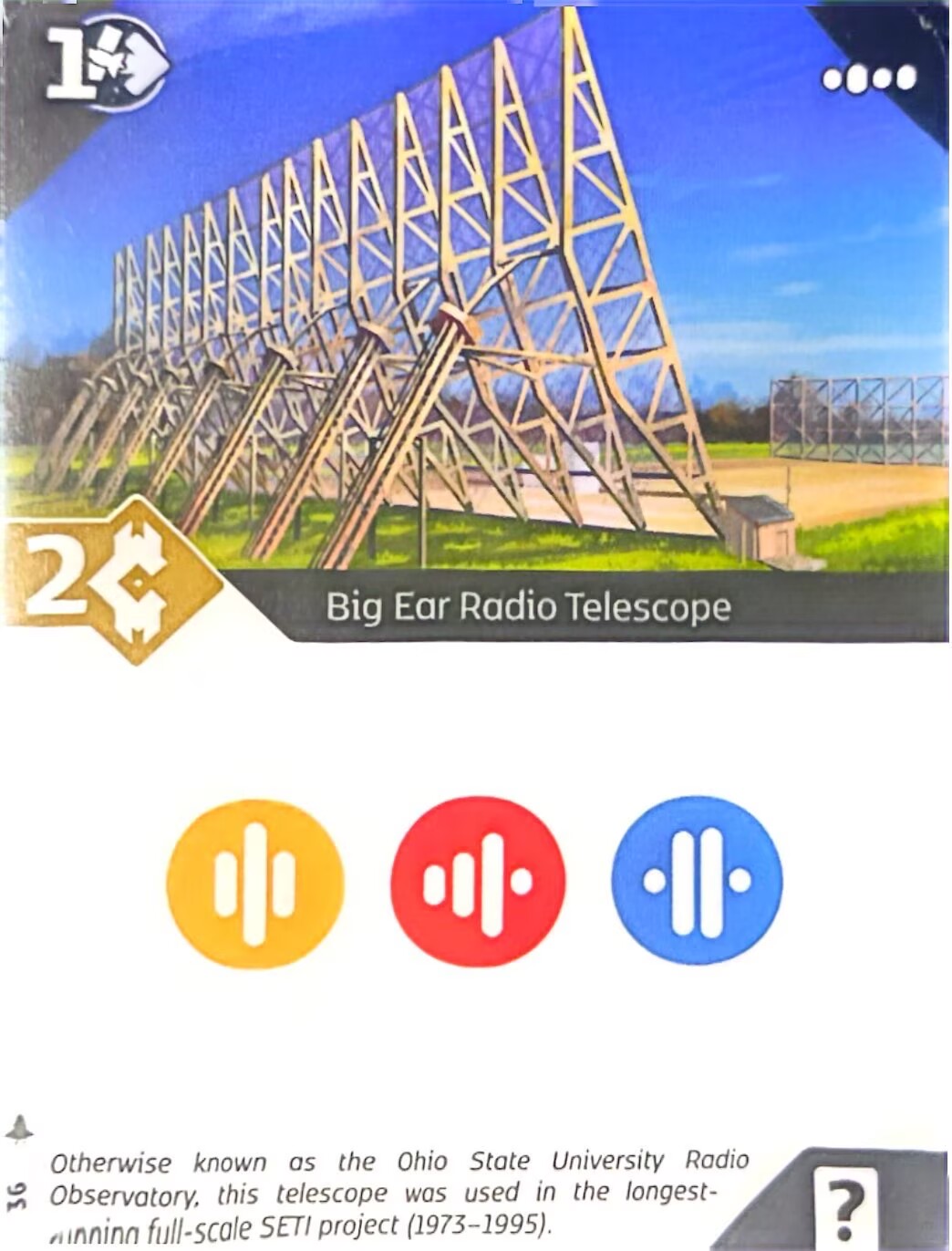
Big Ear Radio Telescope
2
SA.36
Otherwise known as the Ohio State University Radio Observatory, this telescope was used in the longest-running full-scale SETI project (1973-1995).
Not For Commercial Use
1
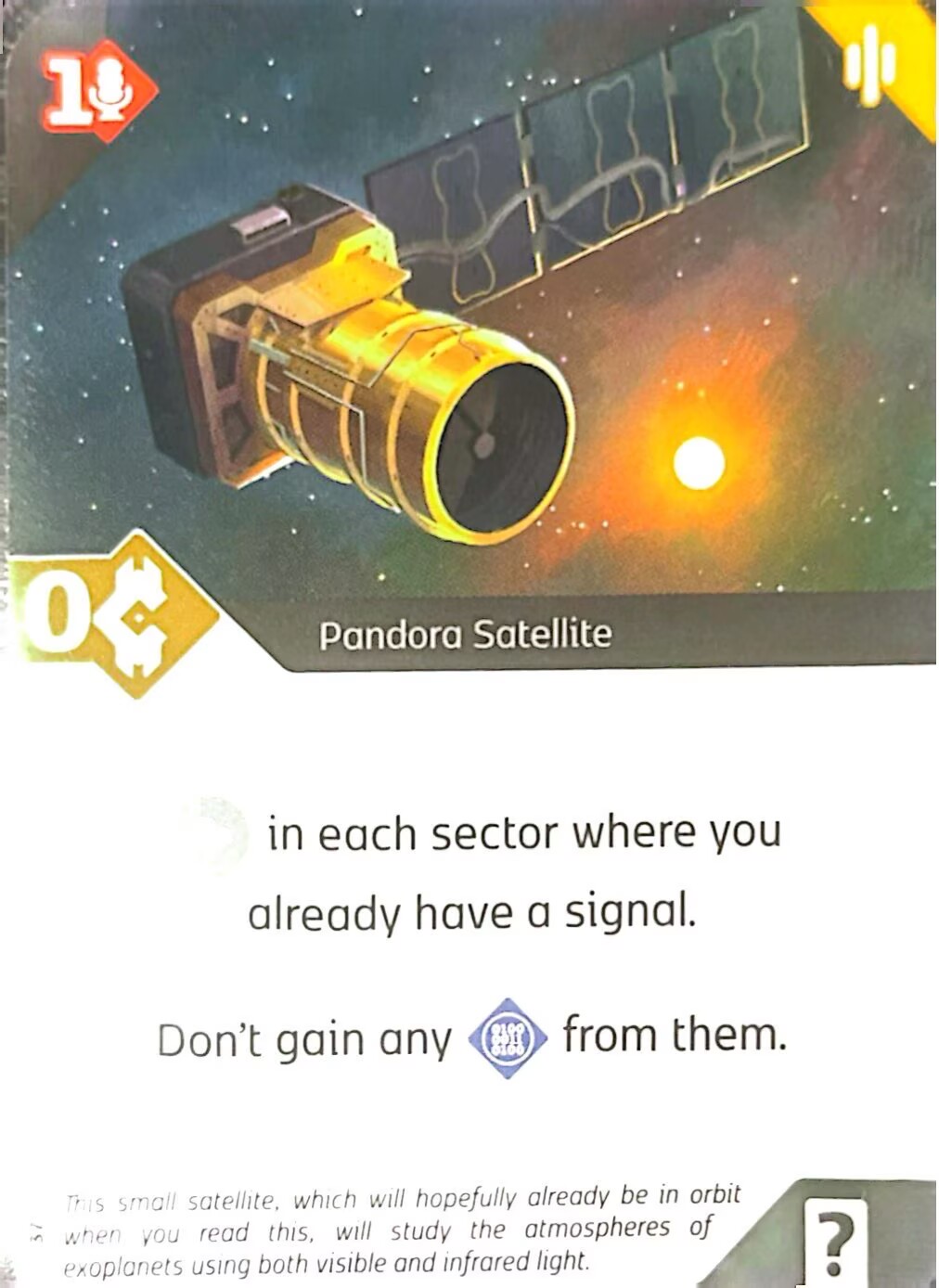
Pandora Satellite
0
in each sector where you already have a signal.
Don't gain any from them.
SA.37
This small satellite, which will hopefully already be in orbit when you read this, will study the atmospheres of exoplanets using both visible and infrared light.
Not For Commercial Use
1
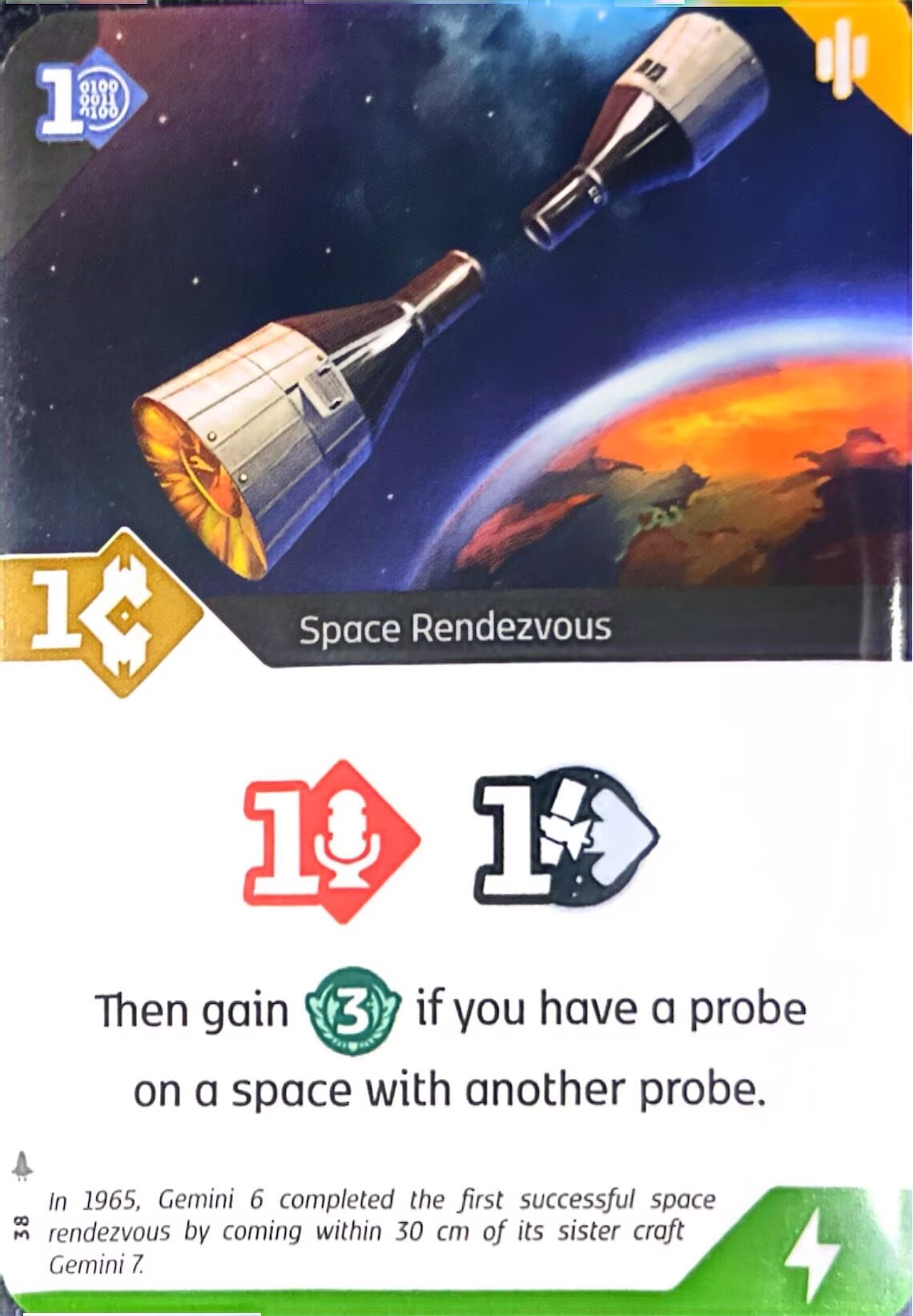
Space Rendezvous
1
1
1
Then gain if you have a probe
3
on a space with another probe.
SA.38
In 1965, Gemini 6 completed the first successful space rendezvous by coming within 30 cm of its sister craft Gemini 7.
Not For Commercial Use
1
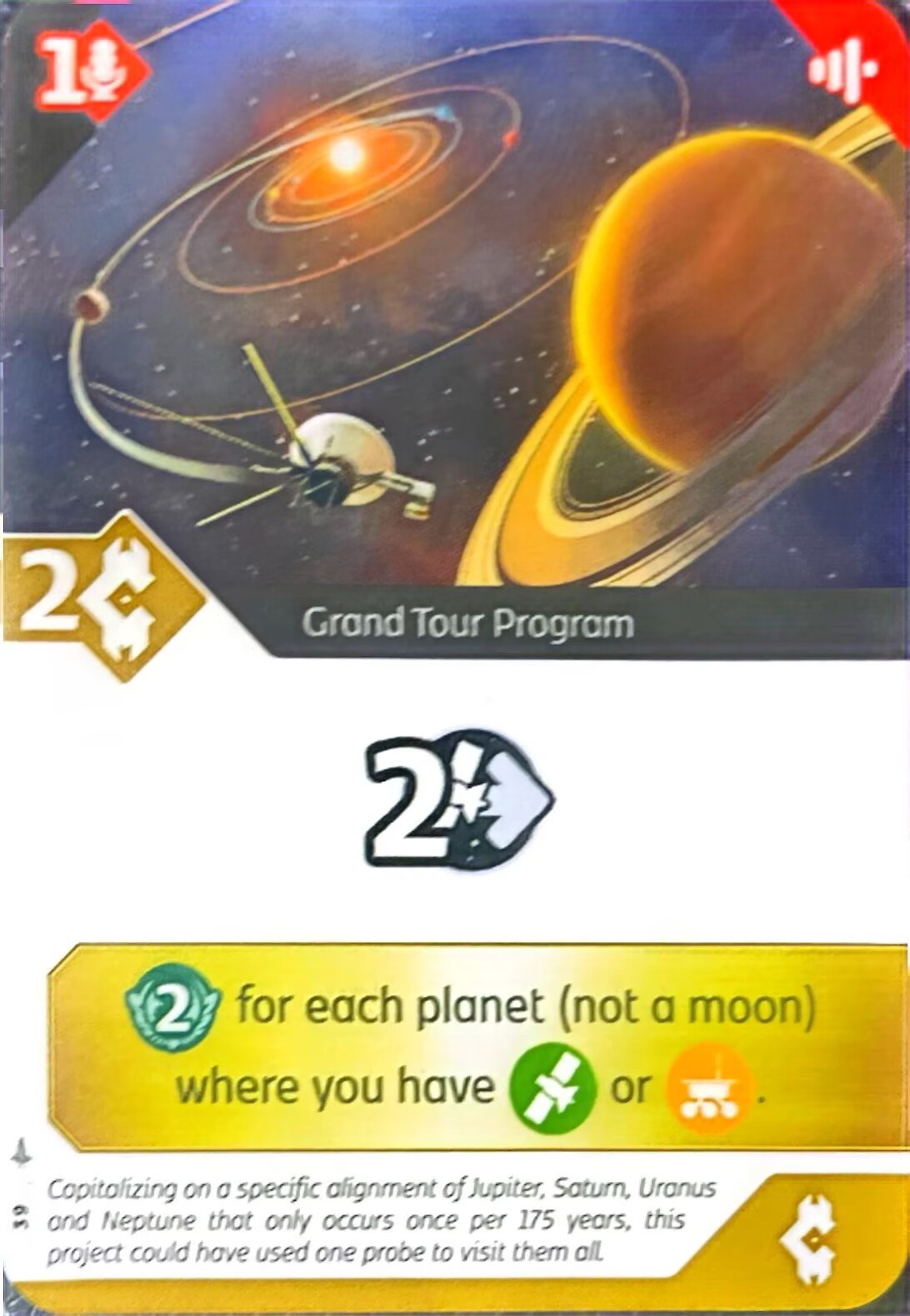
Grand Tour Program
2
2
2
where you have or .
SA.39
Capitalizing on a specific alignment of Jupiter, Saturn, Uranus and Neptune that only occurs once per 175 years, this project could have used one probe to visit them all.
Not For Commercial Use
1
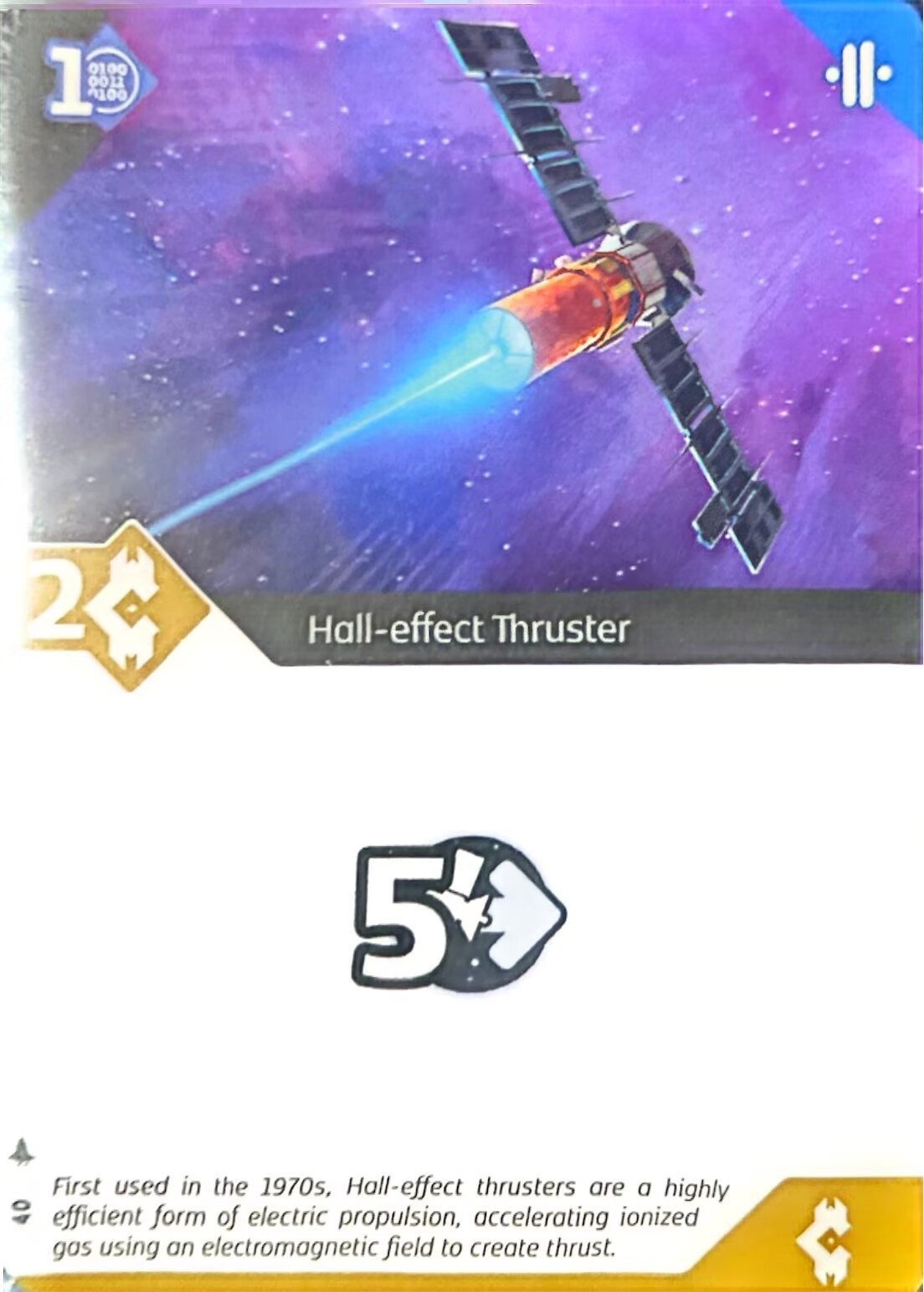
Hall-effect Thruster
2
5
SA.40
First used in the 1970s, Hall-effect thrusters are a highly efficient form of electric propulsion, accelerating ionized gas using an electromagnetic field to create thrust.
Not For Commercial Use
1
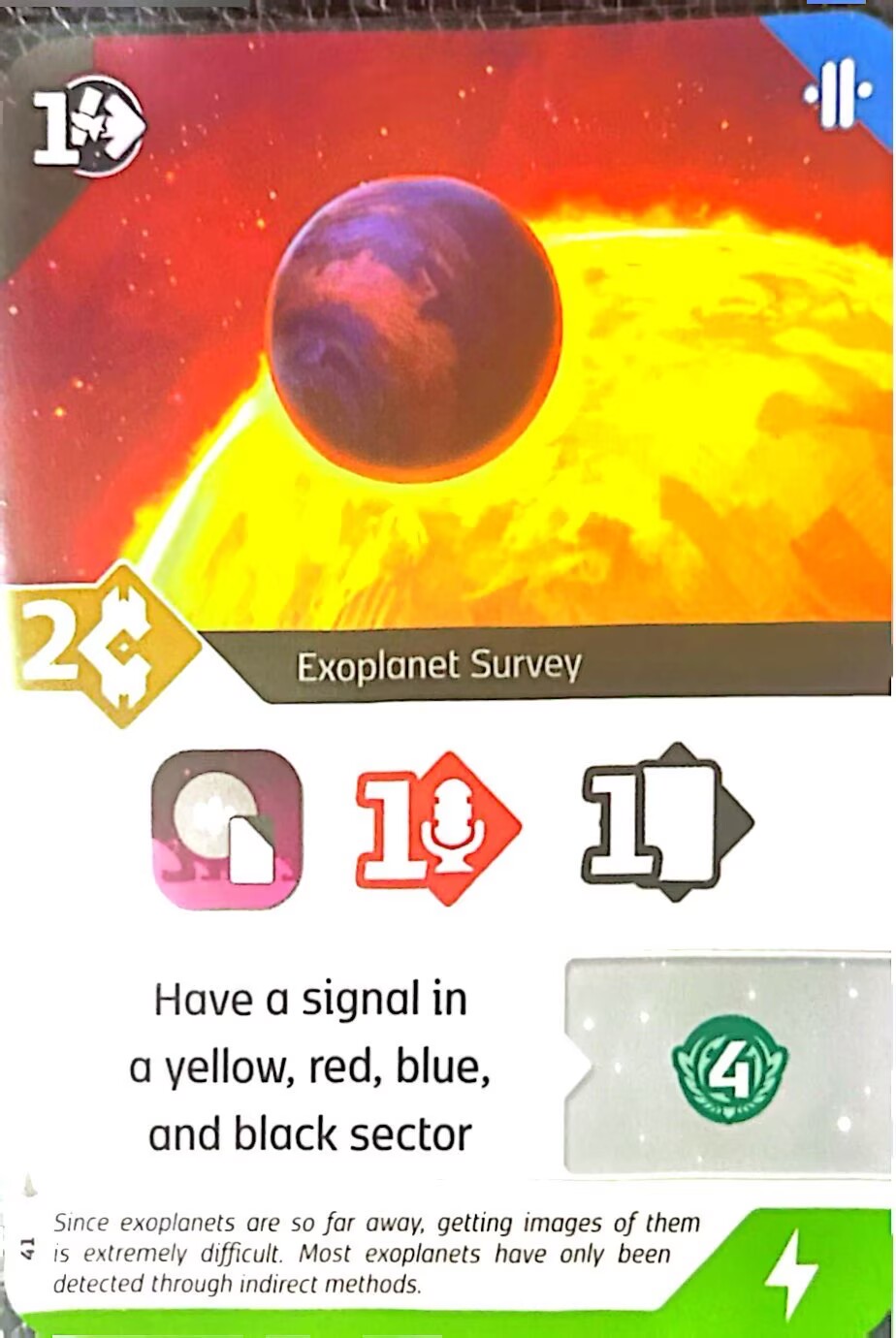
Exoplanet Survey
2
1
1
Have a signal in a yellow, red, blue, and black sector
4
SA.41
Since exoplanets are so far away, getting images of them is extremely difficult. Most exoplanets have only been detected through indirect methods.
Not For Commercial Use
1
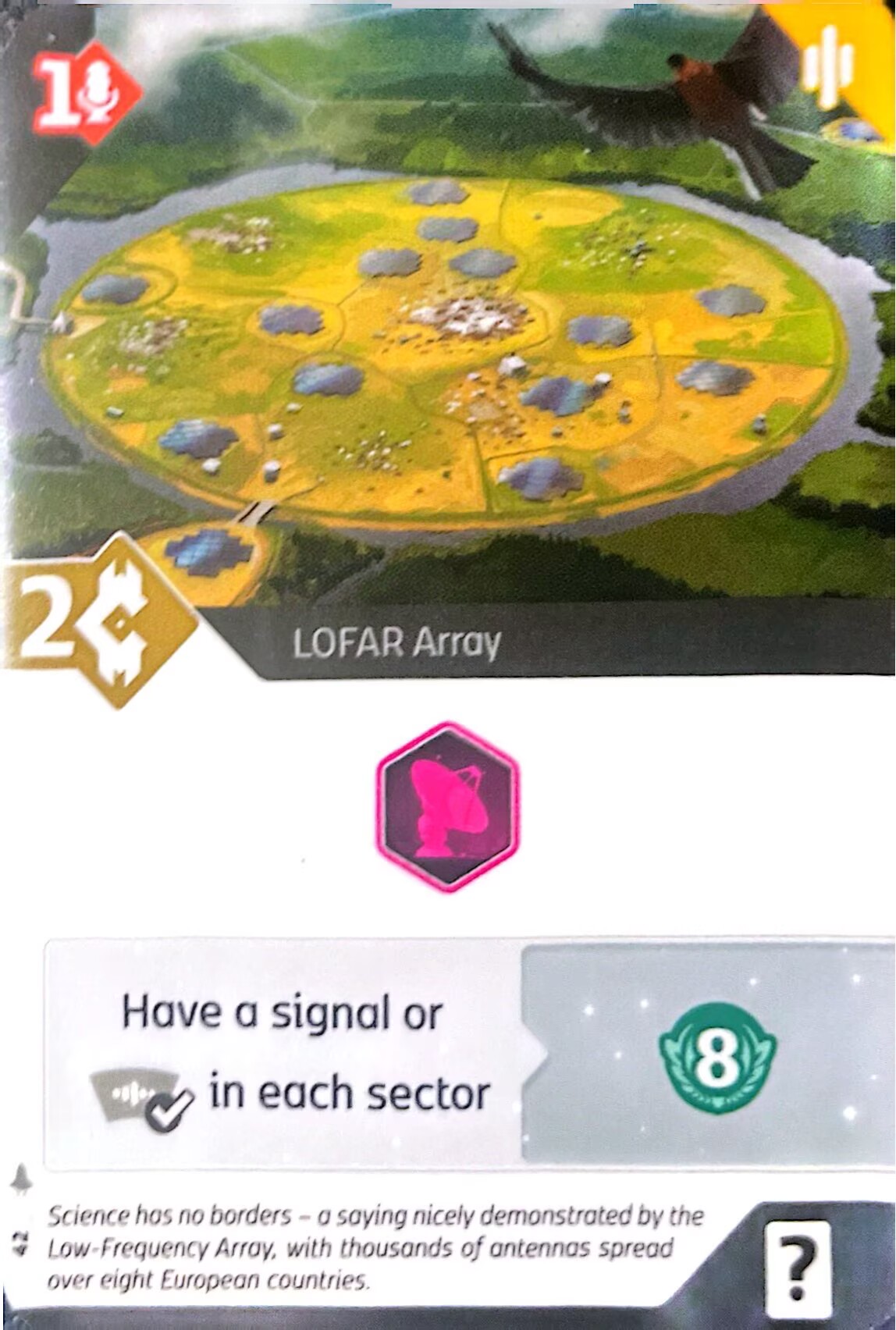
LOFAR Array
2
Have a signal or in each sector
8
SA.42
Science has no borders - a saying nicely demonstrated by the Low-Frequency Array, with thousands of antennas spread over eight European countries.
Not For Commercial Use