
Icon Asset Override
上传 seti-icon / seti-icon-2 / seti-icon-3 图片以本地替换图标精灵图(仅本机生效,刷新即恢复)。
seti-icon
seti-icon
未替换
seti-icon-2
seti-icon-2
未替换
seti-icon-3
seti-icon-3
未替换
Card Art Offsets
Tune each card’s v2 art with the sliders under the card (v2 icons only), then save back to cardArtOffsets.json.110 card(s) tuned
SETI Database
SETI Card
Explorer
Search cards by source, action icons, income, sector, type, text, and credit cost.
Signal Index
Base Cards
0
All
Base Cards
0
Pioneer 11 Mission

When you visit:

Jupiter

Saturn
1
The first manmade object to visit the planet Saturn was on a trajectory to leave our solar system. In 4 million years, it will reach stars from the Aquila constellation.
Mariner 10 Mission
When you visit:
Mercury
Venus
2
This probe mission was the first to explore Mercury. Using many instruments, it revealed the planet's thin atmosphere. magnetic field, ond iron core.
Voyager 2 Mission
When you visit:
Uranus
Neptune
3
Since 1977, this probe has been sending data back to Earth. It has now entered the farthest corners of our solar system, reaching Uranus and Neptune.
Galileo Mission
When you visit:
Venus
Jupiter
4
Galileo Galilei first observed Jupiter and its moons with his telescope in 1610. He could not have imagined that several centuries later a probe mission would visit them.
Venera Probe

at Venus
5
Overcoming a legacy of fire, this Soviet program became the first to land a probe on Venus and the first to send images of another planet's surface to Earth.
Juno Probe
at Jupiter (incl. moons)
6
To learn more about the composition of Jupiter's atmosphere, this 2011 NASA probe observed every longitude of the planet from its polar orbit.
MESSENGER Probe
1
at Mercury
7
The MESSENGER probe orbited Mercury for 4 years. In that time, it completed 4000 orbits and sent hundreds of photographs of the planet's surface back to Earth.
Cassini Probe
at Saturn (incl. moons)
8
The Cassini probe spent 7 years traveling to Saturn and its moons. Its discoveries significantly changed our knowledge of Saturn and its atmosphere.
Falcon Heavy
Ignore the limit of probes in space for those launches.
9
One of the most powerful rockets in existence, this partially reusable spacecraft from SpaceX is capable of carrying 63 tons of cargo into low orbit.
ODINUS Mission
and at Uranus
(incl. their moons)
10
This Norse-inspired ESA mission would send two probes, Freyr and Freyja, to study Uranus and Neptune, the least explored planets in our solar system.
Grant
Reveal the card you drew, and gain its free-action corner effect.
11
Many projects end before they even start. Without financial support from governments or private organizations, many successful projects would not exist.
Europa Clipper
on a planet or a moon,
even without the required tech.

12
Arthur C. Clarke believed that Europa had the potential to sustain human life. The Europa Clipper probe honors Clarke's ambition by studying the moon's surface.
Perseverance Rover
If you land on Mars, Mercury, or any moon with this action,
gain .
13
Since 2021, this car-sized rover has been traveling the surface of Mars. Time will tell whether the rock and soil samples it collects will reveal signs of life.
Mars Science Laboratory
14
Could life survive in the inhospitable atmosphere on Mars? By recreating the environment of Mars in a lab on Earth, scientists hope to find an answer.
Atmospheric Entry
Remove one of your from any planet to gain:
15
Despite returning valuable data, the Galileo mission's atmospheric probe only lasted 58 minutes against the 28,000-degree heat it reached in Jupiter's atmosphere.
Dragonfly
You may land on a space that is already occupied and still get the covered reward.
16
Taking advantage of Titan's low gravity, the planned Dragonfly rotorcraft will look for any signs of life hidden under the moon's thick atmosphere.
OSIRIS-REx
Choose 1 of your probes.
Gain if it is on asteroids.
Gain for each adjacent asteroid
17
By collecting samples from the ancient Bennu asteroid, the OSIRIS-REx probe may help us understand more about the origins of life in our solar system.
Hayabusa
If you have a probe on asteroids, mark a .
18
Using a mini-lander, this probe collected 1500 dust grains from the asteroid Itokawa. That's a pretty impressive interstellar vacuum cleaner.
Gravitational Slingshot
2
Each time you visit a planet this turn,
you may gain instead of .
1
19
A maneuver made famous by its appearance in the novel 2001: A Space Odyssey, the gravity slingshot is utilized to save fuel across space missions.
Mercury Flyby
2
If you visit Mercury this turn, gain .
20
Thanks to the power of the Sun's gravitational pull accelerating the probe, the Mariner 10 was able to complete three deceleration flybys past Mercury in a single voyage.
Venus Flyby
2
If you visit Venus this turn, gain .
21
The first successful mission to another planet in history was the Mariner 2's Venus flyby in 1962. It took the probe 110 days to reach Venus after its launch.
Mars Flyby
2
If you visit Mars this turn, gain .
22
The exploration of Mars's surface was preceded by several flyby missions. The first was the Mariner 4, which flew by the planet in 1965.
Jupiter Flyby
2
If you visit Jupiter this turn, gain .
23
The gravitational slingshot is used by many probes that conduct Jupiter flybys. Pioneer 10 was the first mission to send photos of the planet to Earth.
Saturn Flyby
3
If you visit Saturn this turn, gain .
24
Humanity first visited Saturn during the Pioneer 11 flyby mission, which flew through the rings of Saturn in 1979.
Lightsail
4
Gain for each unique planet you visit this turn (incl. Earth).
25
The slow but steady pressure of sunlight on these enormous solar sails will allow probes equipped with them to travel great distances without any fuel involved.
Through the Asteroid Belt
2
Ignore move restrictions from asteroids this turn.
26
The stones in the asteroid belt range from a few millimeters to thousands of kilometers in size. Probes require precise navigation in order to safely pass through.
Hubble Space Telescope
1
27
Seeing beyond the smog and light pollution of Earth's atmosphere, the striking images that Hubble transmits have challenged the limits of our scientific knowledge.
Kepler Space Telescope
1
28
The Kepler telescope discovered thousands of exoplanets orbiting distant stars in our galaxy, including planets where life could exist.
James Webb Space Telescope
1
29
The largest and most powerful telescope ever created, this complex instrument has allowed us to peer into the deepest corners of the universe.
Great Observatories Project
Choose up to 3 probes (yours or other players'). For each probe, mark a in its sector.
30
Using a combination of four telescopes, the entire electromagnetic spectrum over the world studies what this project reveals.
Space Launch System
1
Do not count moons.
31
NASA's Space Launch System is capable of getting humanity back to the Moon and beyond. This modular system can carry a range of equipment in a single rocket.
Mercury Exploration Program
in the sector with Mercury.
at Mercury
32
Extreme heat and radiation make Mercury difficult to explore. Progress was made in 2008 when the MESSENGER probe mapped the planet's surface.
Venus Exploration Program
in the sector with Venus.
at Venus
33
Venus's acidic atmosphere and extreme pressure make surface exploration very difficult. The probes that have landed on the planet survived for only a few minutes.
Mars Exploration Program
in the sector with Mars.
at Mars (incl. moons)
34
The relative proximity and thin atmosphere of Mars make it an ideal candidate for exploration by ground probes. Several of them roam its surface today.
Jupiter Exploration Program
in the sector with Jupiter.
at Jupiter (incl. moons)
35
Jupiter's enormous size has allowed humans to explore the planet remotely since the Middle Ages. In present times, the Juno probe orbits the planet and its moons.
Saturn Exploration Program
in the sector with Saturn.
at Saturn (incl. moons)
36
Over 95% of Saturn's volume is hydrogen. This makes its average density less than that of water. Despite this, 145 moons have been confirmed to orbit the planet.
Proxima Centauri Observation
at Proxima Centauri.
37
This red dwarf is the closest star to our Sun, only 4 light years away. It's possible that one of the planets orbiting this star may contain liquid water.
Barnard's Star Observation
at Barnard's Star.
38
A planet slightly larger than Earth apparently orbits this famous red dwarf. The star is located in the Ophiuchus Constellation, 6 light years from Earth.
61 Virginis Observation
at 61 Virginis.
39
Located in the constellation Virgo, 61 Virginis shares several properties with our own Sun. The star is orbited by two planets, one of which may support life.
Kepler 22 Observation
at Kepler 22.
40
587 light years away from Earth, Kepler 22 is orbited by the first discovered exoplanet to exist in a habitable zone. This means that it may contain life.
Sirius A Observation
at Sirius A.
41
This binary star is the brightest in our night sky. Its luminosity makes the star ideal for observing any exoplanets that orbit it.
Procyon Observation
at Procyon.
42
Located in the constellation Canis Minor, this star is 12 light years away from Earth. Although no exoplanets have been confirmed in Procyon's orbit, research continues.
Beta Pictoris Observation
at Beta Pictoris.
43
This star, located in the Pictor constellation, is orbited by a very dense cloud of dust. It is possible that new planets could form within this cloud.
Vega Observation
at Vega.
44
Vega is a young, rapidly rotating star that fluctuates in brightness. If there is a planet orbiting it, any life on it would exist in a completely different form from life on Earth.
Allen Telescope Array
If you complete at least one sector this turn, gain .
45
Historically, SETI relied on the intermittent use of existing equipment. Private funding allowed the institute to construct this dedicated array for 24/7 observation.
ALMA Observatory
If you complete at least one sector this turn, gain .
46
By watching the coldest parts of the universe, this telescope array is designed to observe the birth of new stars. Its findings could be the key to discovering life.
Very Large Array
If you complete at least one sector this turn, gain .
47
If a single antenna were to match the power of this 27-telescope array in New Mexico, it would have to be 36 kilometers in diameter.
Breakthrough Starshot
1
48
The Breakthrough Starshot project may allow us to finally reach Alpha Centauri. Doing so would take a fleet of light-equipped probes 20-30 years.
Breakthrough Watch
1
49
Using the NEAR coronagraph, this Breakthrough initiative hopes to find rocky planets around stars up to 20 light years away from Earth.
Square Kilometre Array
in which you mark a signal.
50
From a central hub, this array will extend out to a distance of 2,300 kilometers. Its physical expanse is matched by the planned scope of its observations.
Lovell Telescope
Have at least
51
Even after decades of operation, this radio telescope is not ready to retire. Astronomers still use the Lovell to track the movements of interstellar objects.
Parkes Observatory
52
Shielded from electromagnetic waves by the Australian hills, the Parkes Observatory has received radio signals from distant stars and from NASA missions.
Deep Synoptic Array
53
Short but powerful radio signals coming from space are very difficult to detect. Their exact origin remains unknown.
VERITAS Telescopes
54
These four telescopes are used to capture exotic bursts of gamma rays, which traveled billions of light years before reaching this Arizona-based observatory.
Arecibo Observatory
In addition, mark a in any sector.
55
For 5 years, this radio telescope searched for pulsars, enemy missiles, and alien signals. It also served as an iconic shooting location for many Hollywood movies.
Breakthrough Listen
1
56
Based at the SETI research center, Breakthrough Listen represents a comprehensive search for signs of life. Data from signals will be processed over 10 years.
Effelsberg Telescope Construction
57
As a result of its precise and ambitious construction, this telescope and its 100-meter antenna is one of the most advanced telescopes in operation today.
Uranus Orbiter and Probe
at Uranus (incl. moons)
58
The extreme distance between Earth and Uranus has made exploration difficult. Newly developed rockets should make future missions to the planet more possible.
Ion Propulsion System
59
In a vacuum, even a short thrust can provide acceleration to a small spacecraft. Ion propulsion systems offer incredible fuel efficiency for probes on long journeys.
Trident Probe
at Neptune (incl. moons)
60
Triton, Neptune's largest moon, has begun to attract attention due to its unusual retrograde orbit. The Trident probe mission is designed to solve Triton's mysteries.
Quantum Computer
Have at least
61
A quantum computer only takes minutes to handle calculations that would take your computer years. And no, you can't play games on one.
Onsala Telescope Construction
62
This pair of Swedish telescopes has been studying the sky since 1949 with a particular focus on observing the birth and death of stars.
SHERLOC
63
Located at the end of the Perseverance rover's robotic arm, SHERLOC is the rover's onboard detective. It analyzes clues left in rock and soil samples, searching for life.
ALICE
on each species
64
One of the detectors housed inside the Large Hadron Collider, ALICE studies quark-gluon plasma, the matter that was created just a few minutes after the Big Bang.
FAST Telescope Construction
65
With a diameter of half a kilometer, the antenna of the Chinese FAST radio telescope is the largest in the world. Capturing distant signals is one of its primary goals.
GMRT Telescope Construction
on each species
66
This telescope is designed to capture radio waves which are formed by stars, quasars, and exoplanets. It has received from up to 12 billion light years away.
Yevpatoria Telescope Construction
Then you can discard a card for a signal from your hand.
67
Located in Crimea, this Ukrainian telescope provided significant contributions to Soviet space missions. It was designed for interstellar radio communication.
DUNE
68
Neutrinos are the most common particles in the universe but are among the most difficult to detect. Deep underground, DUNE seeks to study these elusive particles.
Large Hadron Collider
69
27 kilometers in circumference, this complex collides particles at the speed of light. To reveal the secrets of the universe, 30 million collisions are attempted per second.
ATLAS
70
The Higgs boson helped scientists theoretically explain mass. The existence of this particle was confirmed by the Large Hadron Collider's ATLAS detector.
Focused Research
Then gain for each tech of that type you have.
71
Eureka moments are very rare in research. Scientific discoveries are typically found through rigorous experimentation, repetition, and evaluation.
Scientific Cooperation
If you take the tech that someone else has researched,
gain .
72
The creation of the ISS, the particle physics research done at CERN, and the photographing of a black hole have only been possible through cooperation.
Clean Space Initiative
Discard all 3 cards from the card row for their free-action corner effect.
73
Debris left in Earth's orbit from past launches can cause considerable problems for future space exploration. ESA initiative seeks to keep Earth's orbit clean.
Pre-launch Testing
1
74
While the launch of a rocket only takes a few minutes, it is made possible by months of preparation. Ultimately, you only have one attempt to get it right.
Extremophiles Study
Then for each you have in that color, gain .
75
Studying survival in extreme conditions on Earth could provide clues to finding life in other places in the universe.
NASA Research Center
76
NASA's Kennedy Research Center at Cape Canaveral took mankind to the Moon. Someday a NASA research center may take us to Mars.
NASA Astrobiology Institute
77
If there are life forms in space, they may not be anything like those on Earth. Astrobiologists create models that imagine life's most bizarre forms and possibilities.
SETI Institute
78
Humanity's belief in the existence of extraterrestrial life has given rise to SETI. The institute deciphers signals from the depths of space, searching for signs of life.
ISS
79
We don't have to look very far beyond Earth to find life. The first and only permanent human settlement in space orbits only 400 kilometers above.
Cape Canaveral SFS
1
1
1
80
In the distant future, when children on other worlds learn about humanity's journey to the stars, the story will begin at Cape Canaveral.
International Collaboration
that someone else has
already researched.
Do not advance the solar system.
Do not gain the / / /
bonus printed on the tile.
81
Few things can bring different cultures together like science. If humanity wants to pursue visionary ideas, rivalries must give way to a common goal.
Johnson Space Center
82
"Ah, Houston, we've had a problem" - Jim Lovell, on board Apollo 13
Wow! Signal
in the sector with Earth.
83
On August 15, 1977, Ohio State's Big Ear telescope captured a mysterious signal from Sagittarius. Astronomer Jerry Ehman marked it with 'Wow!
Sample Return
Remove one of your from any planet or moon to mark a .
84
The Perseverance rover will leave the samples it collects in pods on the surface of Mars. The ESA will have to transport these back to Earth for study.
Starship
85
This ambitious and reusable rocket is designed to enable space tourism, the human settlement of Mars, and 20-minute travel to any place on Earth.
Giant Magellan Telescope
where you have a signal.
86
With a minor diameter of 24.5 meters, this telescope at Chile's Los Campanas Observatory will be 200 times more powerful than any other.
Project Longshot
have a probe at least 5 spaces from Earth
87
Using current technology, a flight from Earth to the nearest star would take thousands of years. Project Longshot's ambition was to shorten the travel time to 100 years.
Chandra Space Observatory
in a sector with one of your probes.
Have a signal in 4 different sectors
88
X-rays could be a method through which unknown civilizations communicate. The Chandra observatory captures and studies incoming rays from Earth's orbit.
NIAC Program
Have no cards in your hand
89
Projects that sound like science fiction are given life by NASA's NIAC program, which seeks to make genius ideas a reality.
Fuel Tanks Construction
Gain for each card with
income you show from your hand.
90
Before his Apollo flight, a reporter asked Neil Armstrong what personal item he would like to take to the Moon. He answered if he had a choice, he'd take more fuel.
Fusion Reactor
Gain for each card with
tucked income.
Then increase your with this card.
91
If we are to explore the stars, we must preserve the future of Earth. Fusion represents an unlimited source of renewable energy, ending our dependence on fossil fuels.
NASA Image of the Day
Gain for each card with
tucked income.
Then increase your with this card.
92
Each day NASA publishes one image that they believe advances scientific knowledge. Images created by both professionals and amateurs have been featured.
Government Funding
Gain for each card with
tucked income.
Then increase your with this card.
93
Space research is an expensive enterprise, the results of which are inherently uncertain. Only forward-looking governments are willing to undertake such risk.
Popularization of Science
94
We live in a society exquisitely dependent on science and technology, in which hardly anyone knows anything about science and technology. - Carl Sagan
Near-Earth Asteroids Survey
Have a probe on asteroids adjacent to Earth
95
Many scientists believe that the molecules that began life on Earth were brought to the planet by asteroids. The truth can only be found through studying them.
Tardigrades Study
96
They survive almost anything: radiation, vacuum, and years without nutrient intake. Humanity can learn a lot about the conditions of life from this microscopic animal.
Apollo 11 Mission
on each species
97
One small step for man, one giant leap for mankind. Neil Armstrong after setting foot on the Moon.
Coronal Spectrograph
Mark a for a species
for which you have already marked a .
98
Eruptions from the solar corona have affected life on Earth. Through spectrography, we can learn more about phenomena that are impossible to observe otherwise.
Electron Microscope
Mark a for a species
for which you have already marked a .
99
When using a microscope, our perception is limited by the wavelengths of visible light. We can use a beam of electrons to observe wavelengths that light cannot see.
Exascale Supercomputer
Mark a for a species
for which you have already marked a .
100
As computing technology continues expanding, it has become likely that a computer will observe and identify signs of extraterrestrial life before a human does.
Telescope Time Allocation
101
A photo taken by your phone is created in a millisecond. A photo of distant galaxies takes several days. This makes time a precious resource when using telescopes.
Linguistic Analysis
for a single species
for that species
102
If intelligent life uses a system of language, that system must have rules and patterns that can be deciphered. Astronomers turn to linguistics to find answers.
Westerbork Synthesis Radio Telescope
in the same sector
103
Built on the site of a former Nazi detention camp, this radio telescope receives signals from nearby galaxies.
Rosetta Probe
Have a probe on a comet
104
Jules Verne imagined landing on a comet in 1877. The Rosetta mission made the dream a reality in 2014.
Green Bank Telescope
105
Imagine the energy released by a grain of rice when it hits the ground. This amount of energy can be captured by the Green Bank radio telescope in West Virginia.
Strategic Planning
When you pay the indicated cost to play a card as your main action:
106
Space missions cost billions of dollars to prepare and take years or even decades to complete. With stakes this high, strategic planning is the key to success.
First Black Hole Photo
107
Black holes had long been imagined before they were observed. When a black hole was photographed, the biggest surprise was that it turned out exactly as expected.
SETI@Home
If you have at least , mark a .
108
Anyone con help search for alien ife. All you need to do is connect to https://setiathome.berkeley.edu .
Low-Power Microprocessors
109
In the distant cosmos, energy is scarce. Low-energy microprocessors ensure the operation of probe devices on long journeys where solar energy is in short supply.
Press Statement
110
A complex scientific breakthrough may be important to a research team, but a press statement can make these breakthroughs important to the entire world.
Roman Space Telescope
111
Using its unparalleled ability to observe the curvature of spacetime, this telescope should be able to detect exoplanets in our galaxy when it launches in 2026.
Planetary Geologic Mapping
112
The history of a planet is best learned by studying its geological composition. If life has existed on other planets, its imprints will be found in planetary sediment.
Solvay Conference
Resolve the rightmost space on a gold scoring tile you did not mark.
113
Attendees of the Solvay Conference have included 17 Nobel Prize winners. Ideas put forward at this conference have influenced the scientific community for decades.
Planet Hunters
Then you can discard up to 3 cards for signals from your hand.
114
Thanks to the open data provided by NASA, anyone can participate in the search for new planets. All you need is a computer and a little luck.
Canadian Hydrogen Telescope
in any sector.
115
Since 2017, this radio telescope has been mapping the magnetic field of the Milky Way galaxy. It also captures radio waves that come from neutron stars.
Control Center
When vou mark a signal in a sector of the indicated color:
1
1
1
116
A space mission consists of countless systems, operations, and processes. Without control centers, it would be impossible to coordinate successful missions.
Lunar Gateway
117
"From now on we live in a world where man has walked on the Moon. Its not a miracle; we just decided to go." - Jim Lovell
PLATO
in a sector with one of your probes. Don't gain any from them.
118
This ESA space telescope is designed to observe stars similar to our Sun. In doing so, it may be able to find the other Earths that orbit them.
PIXL
Then gain for each you have.
119
If there was ever life on Mars, the PIXL spectrometer on the Perseverance rover could discover it. It will study the chemical composition of samples that the rover collects.
Orbiting Lagrange Point
120
Lagrange points are positions where the gravity of two bodies creates an equilibrium. A probe can use these points to maintain its place without burning fuel.
Future Circular Collider
121
This 100-kilometer-long collider could be operational by 2040. It will be 3 times the length of the Large Hadron Collider and will unite experts from 150 universities.
Amateur Astronomers
Do this 3 times:
Discard the top card of the deck for its signal.
122
Many comets, asteroids, and other celestial phenomena are only known today because of the contributions made by amateur astronomers.
Asteroids Flyby
1
If you visit asteroids this turn, gain .
123
Taking advantage of simple flight profiles, missions can study several cosmic bodies in a single flight, but only for a limited window while the probe passes by.
Cometary Encounter
2
If you visit a comet this turn, gain .
124
In ancient history, humans believed that the arrival of comets heralded great changes. Now probes flying to them herald great scientific discoveries.
Trajectory Correction
1
If you move within the same ring at least once this turn, gain .
125
Without the ability to remotely control probes, they would not be able to reach their destination. Engines and correction nozzles are used to keep probes on target.
Euclid Telescope Construction
OR
126
A quarter of the universe could be made of dark matter, which has never been observed. This ambitious ESA telescope will study the existence of this mysterious substance.
NEAR Shoemaker
If you have a probe on asteroids,
gain .
127
This probe landed on the asteroid Eros in 2001 despite never being designed as a lander. It survived touchdown and managed to return valuable data to Earth.
Advanced Navigation System
When you visit a planet (except Earth):
1
128
Many variables can affect the flight path of probes. Thanks to modern computers, probe trajectories can be simulated and calculated much more precisely.
Asteroids Research
When you visit asteroids on your turn:
129
Asteroids are the most common bodies in our Solar System. Rich in metals and secrets, asteroids may help us understand the origins of life on Earth.
Low-Cost Space Launch
130
New technologies and 3D printing will make it possible to build cheaper rockets. This opens up new possibilities even for smaller private companies.
Telescope Modernization
131
Many astronomical observatories are decades old. By undergoing modernization, these observatories can continue to participate in cutting-edge research.
Space Shuttle
Have 5
132
The launch of a space shuttle can still make you weep with amazement and wonder if you happen to be watching it. - Hanna Rosin
Optimal Launch Window
Then for each other planet or a comet in the same sector as Earth.
1
133
Timing is everything when planning a probe launch. If the launch fails, you have to wait days or sometimes even years for the next attempt.
Herschel Space Observatory
in a sector with one or your probes
Have a signal in 4 different sectors
134
This observatory studied the chemical composition of cosmic bodies and the formation of galaxies among other goals before it ceased operations in 2013.
Noto Radio Observatory
135
This Sicilian radio observatory has been used since 1988 to investigate distant galaxies, study binary stars, and connect other European radio telescopes.
Algonquin Radio Observatory
Don't gain any from them.
136
Built to avoid interference from other signals, this 46-meter radio telescope monitors pulsars and fast radio bursts all from the safety of Earth's wilderness.
SETI Data Archive
137
As a publicly funded project, SETI has an enormous open archive that everyone can access. It is analyzed by scientists and amateurs from all over the world.
Cornell University
When you discard a card from your hand for this free action:
1
1
138
Founded in 1865, Cornell has educated Nobel Prize winners and American astronauts. Its faculty members have also been involved in many NASA missions.
Not a planet since 2006
Keep this card in front of you.
If vou have a probe in the outermost ring,
you may use an or action to place that probe on Pluto.
SE EN 01
At a 2006 conference in Prague, the international Astronomical Union relegated Pluto to the status of a dwarf planet. Still, it manages to remain big in our hearts!
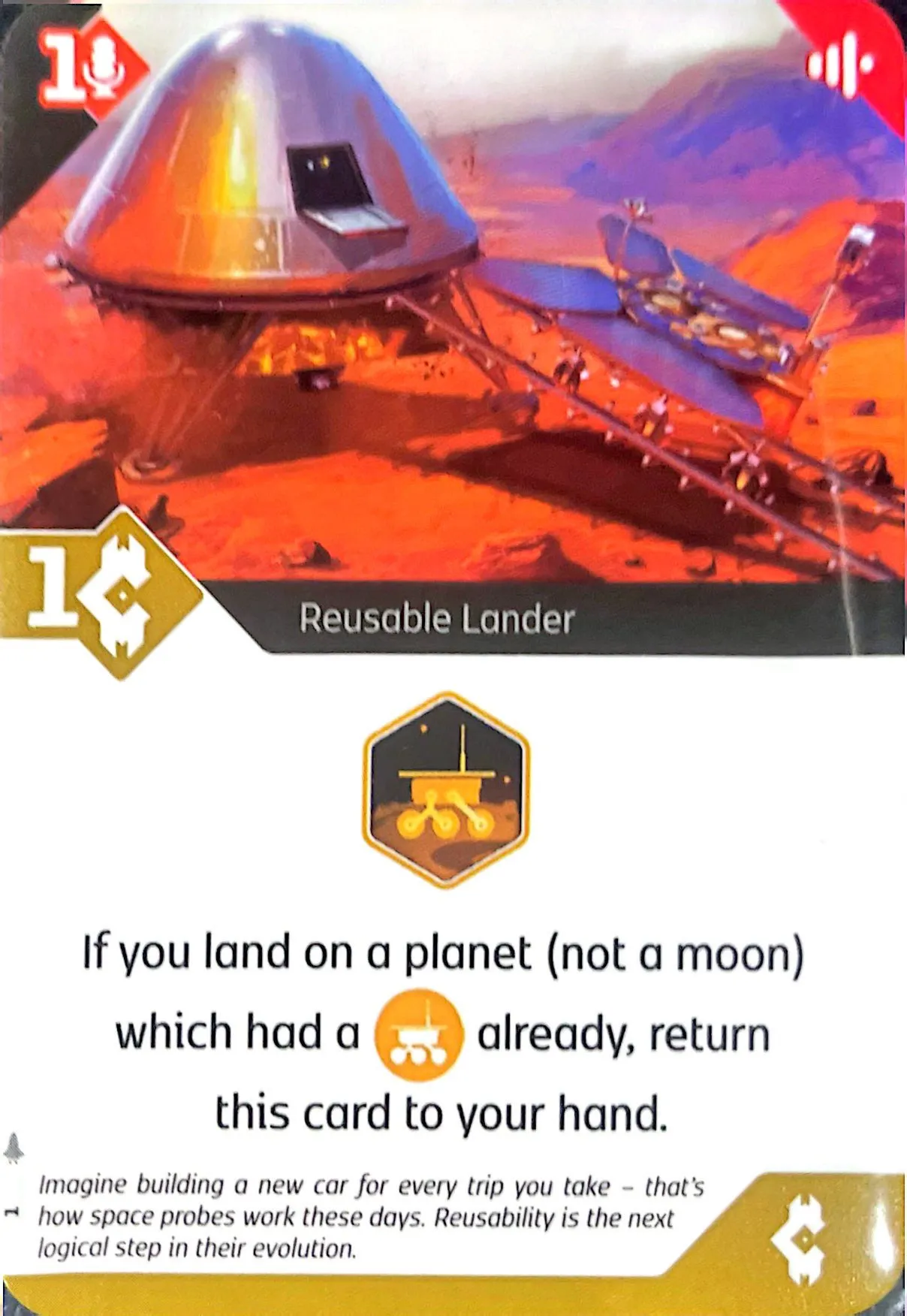
Reusable Lander
If you land on a planet (not a moon)
which had a already,
return this card to your hand.
SA.1
Imagine building a new car for every trip you take - that's how space probes work these days. Reusability is the next logical step in their evolution.
Gateway to Mars
When you at Mars (or its moons)
or when you play a card mentioning "Mars" in its flavor text:
SE EN 02
For man to reach Mars, we require the coordinated development of new propulsion systems, iife support systems, radiation protection, and other key technologies.
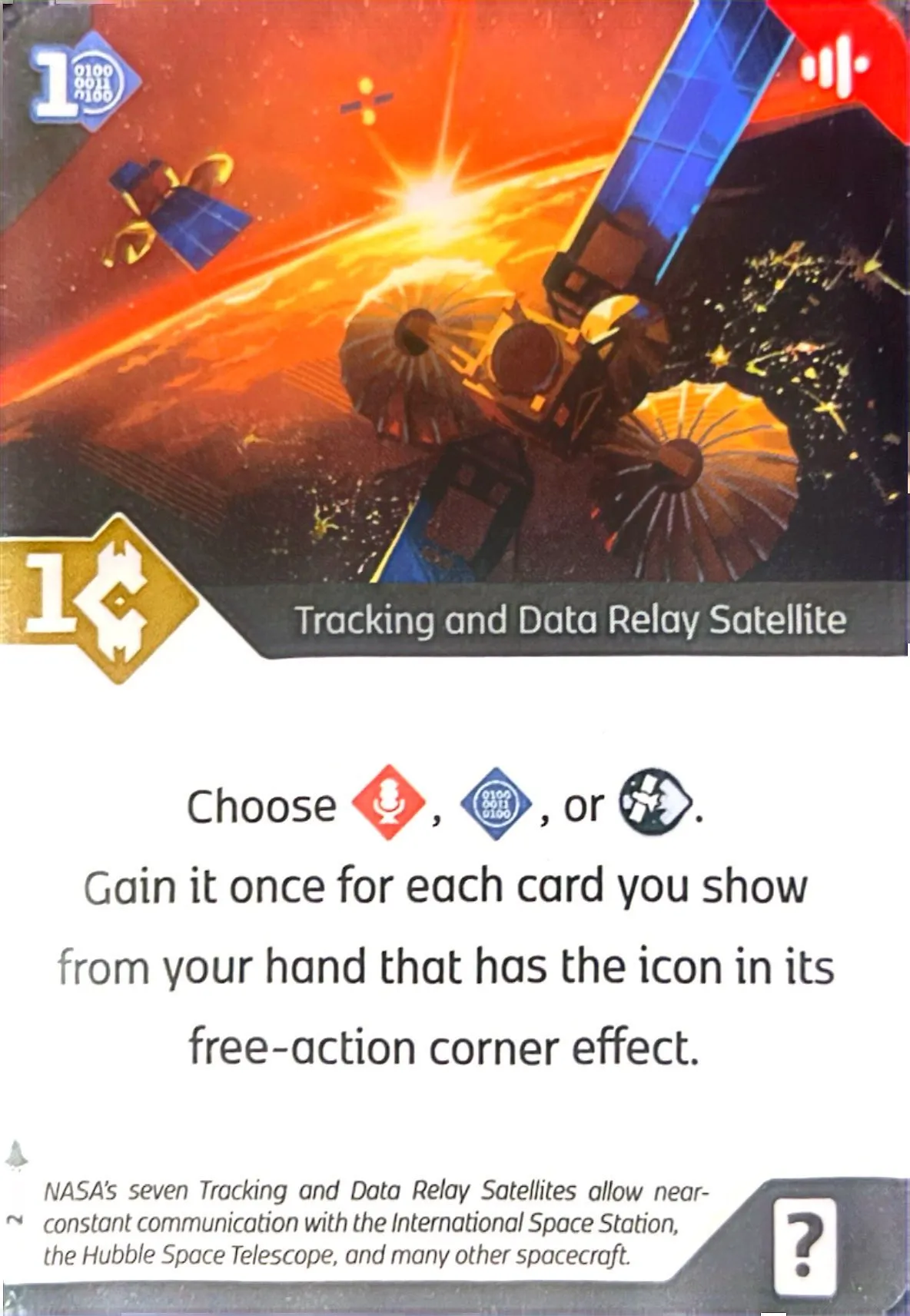
Tracking and Data Relay Satellite
Choose , , or
Gain it once for each card you show
from your hand that has the icon
in its free-action corner effect.
SA.2
NASA's seven Tracking and Data Relay Satellites allow near-constant communication with the International Space Station, the Hubble Space Telescope, and many other spacecraft.
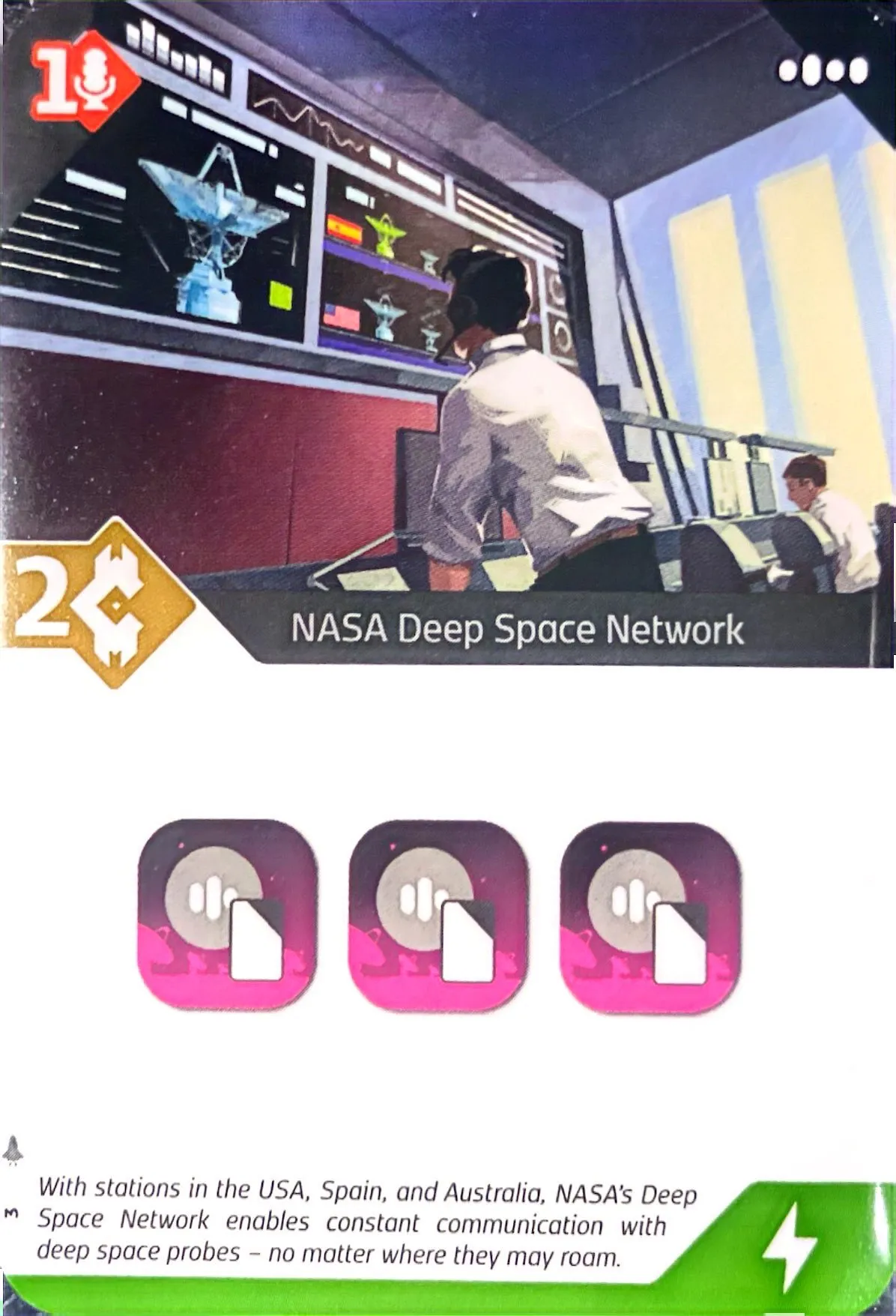
NASA Deep Space Network
SA.3
With stations in the USA, Spain, and Australia, NASA's Deep Space Network enables constant communication with deep space probes - no matter where they may roam.
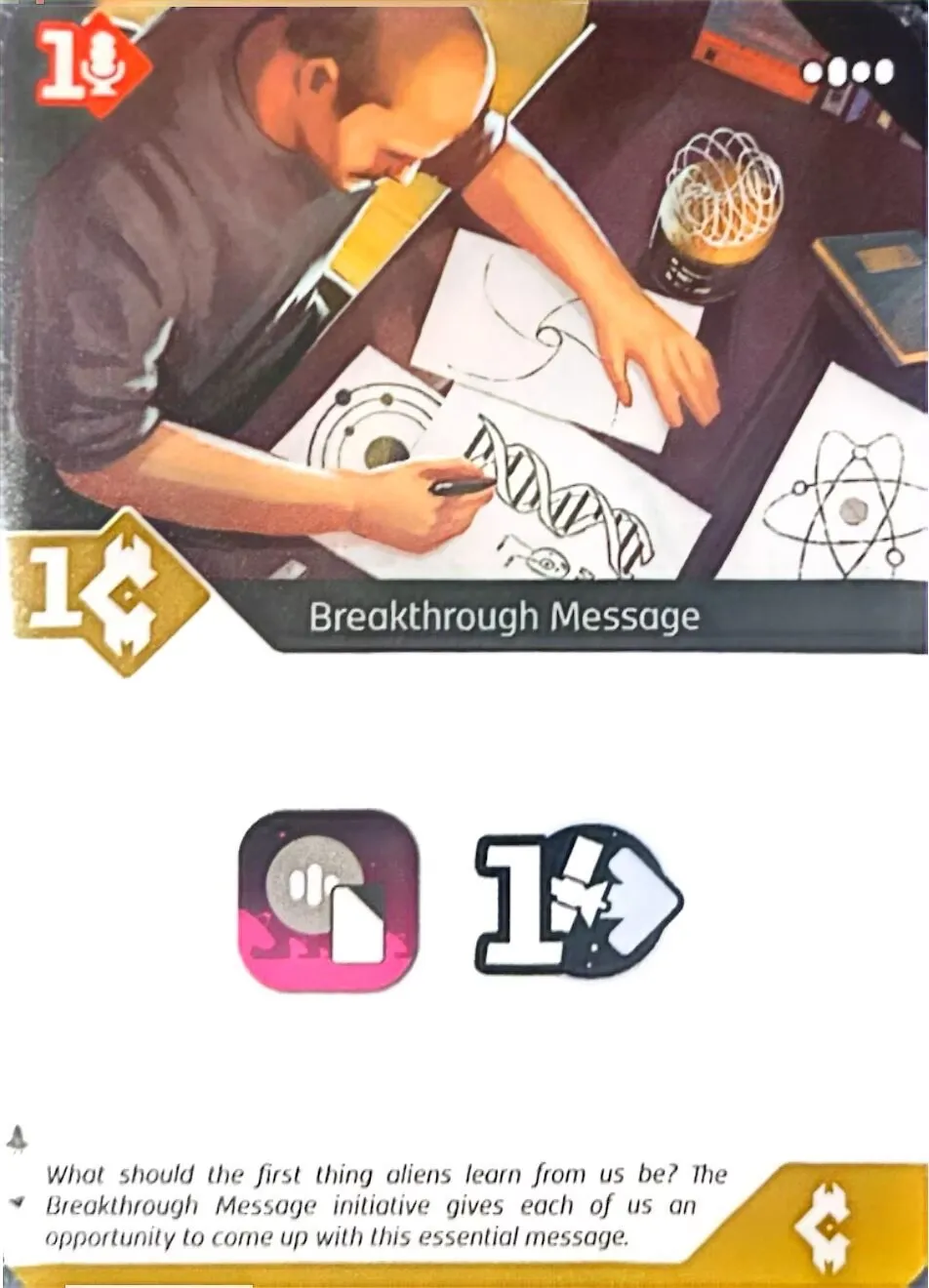
Breakthrough Message
1
SA.4
What should the first thing aliens learn from us be? The Breakthrough Message initiative gives each of us an opportunity to come up with this essential message.
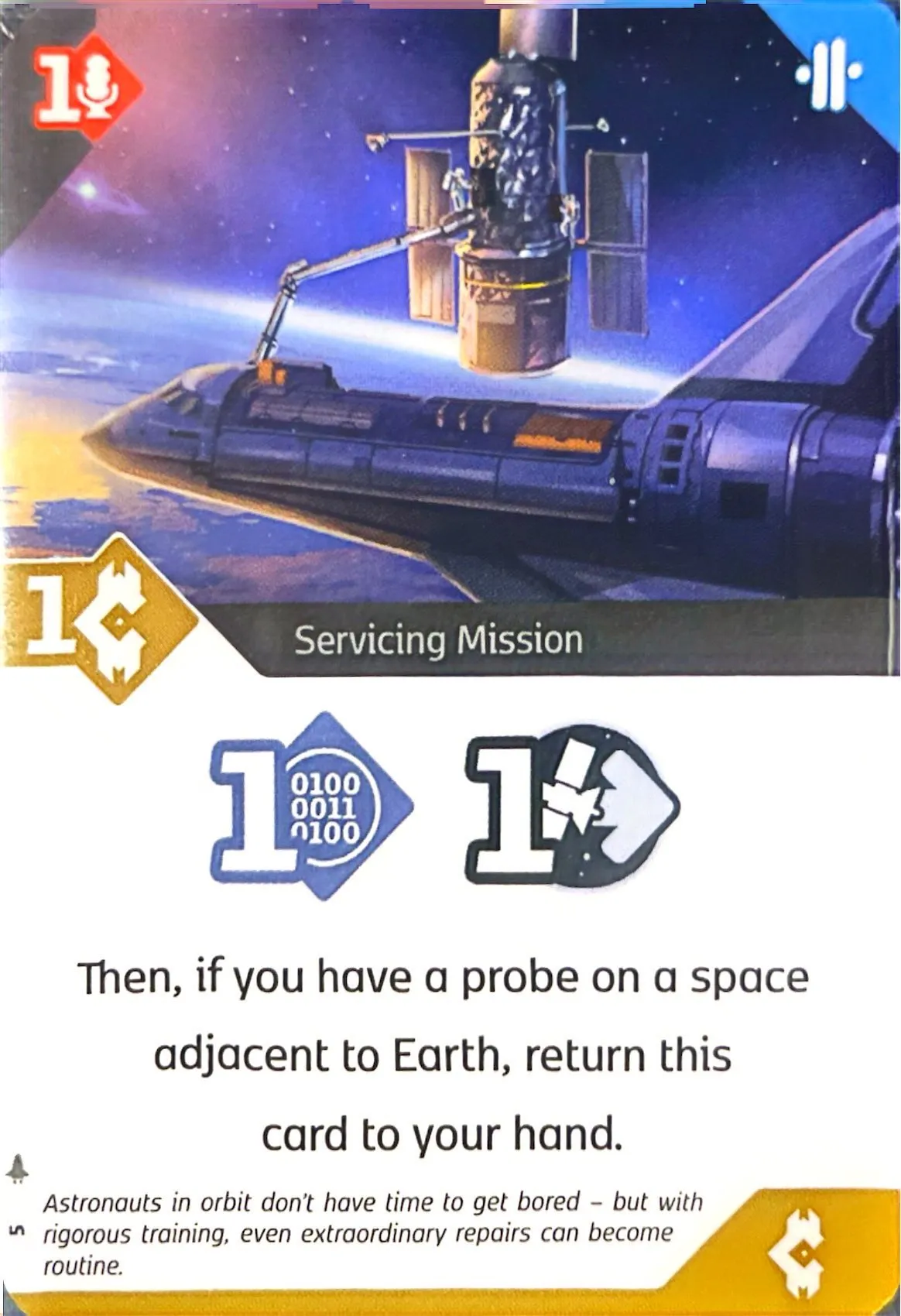
Servicing Mission
1
Then, if you have a probe on a space adjacent to Earth, return this card to your hand.
SA.5
Astronauts in orbit don't have time to get bored - but with rigorous training, even extraordinary repairs can become routine.
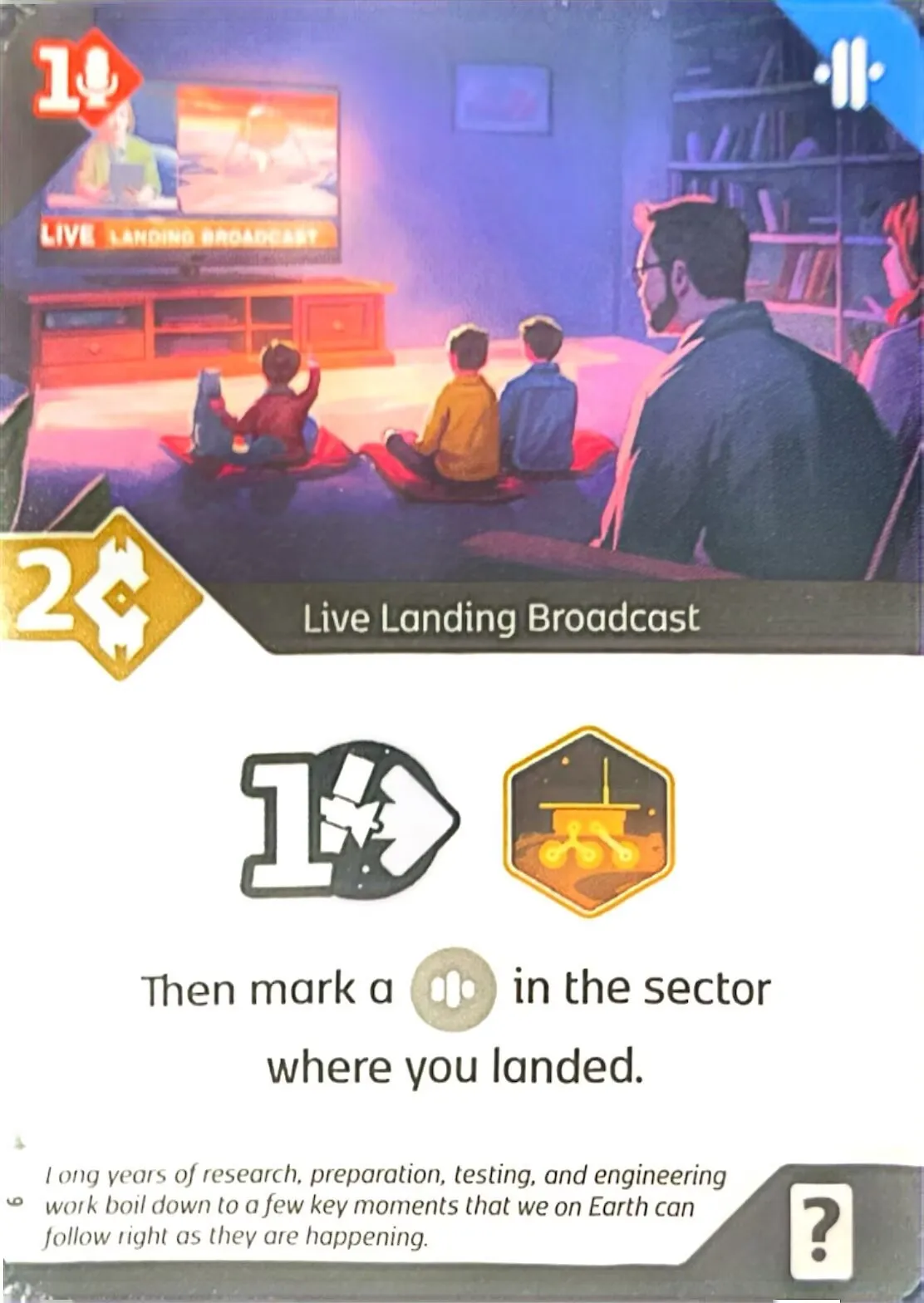
Live Landing Broadcast
1
Then mark a in the sector where you landed.
SA.6
Long years of research, preparation, testing, and engineering work boil down to a few key moments that we on Earth can follow right as they are happening.
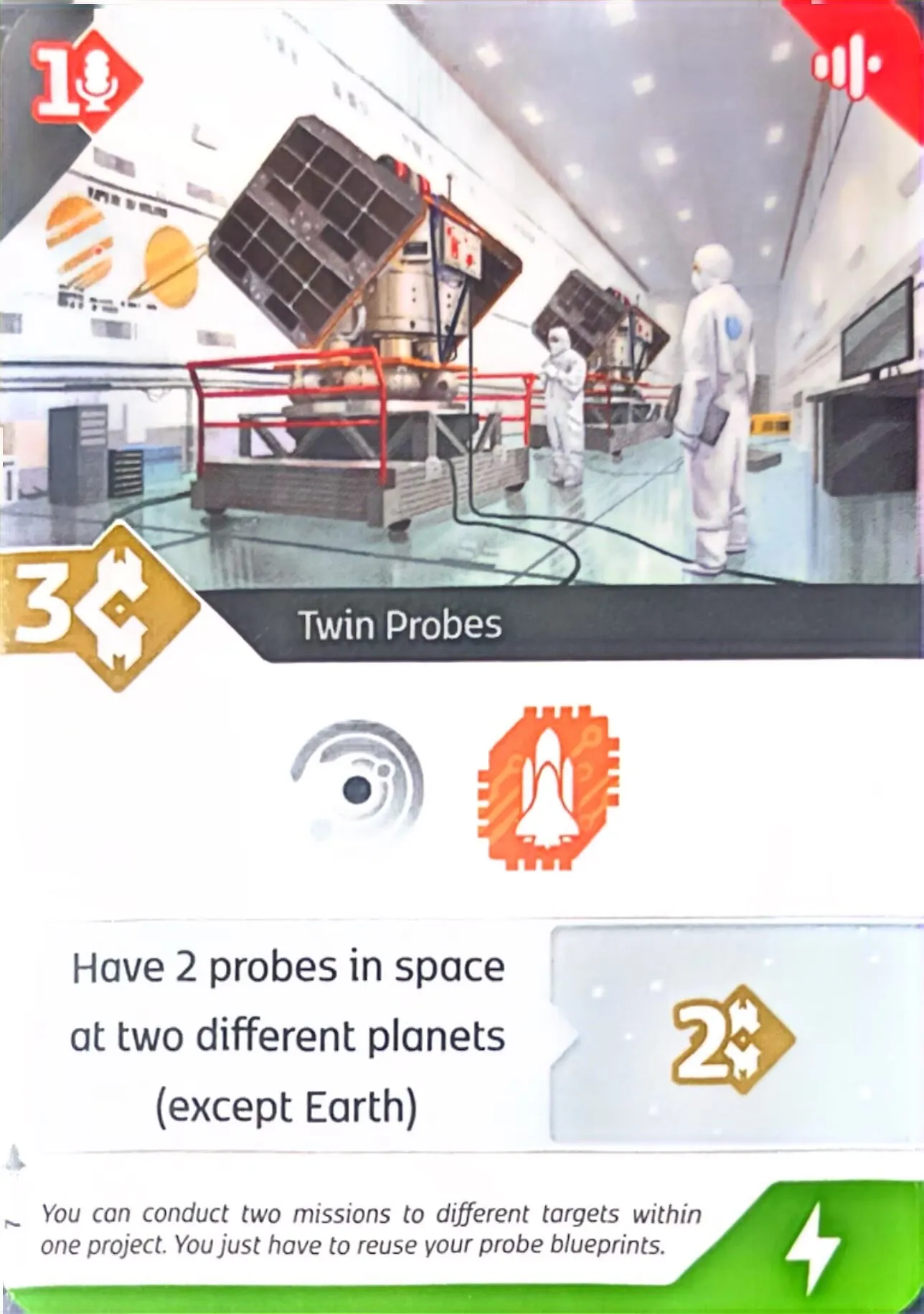
Twin Probes
Have 2 probes in space
at two different planets
(except Earth)
SA.7
You can conduct two missions to different targets within one project. You just have to reuse your probe blueprints.
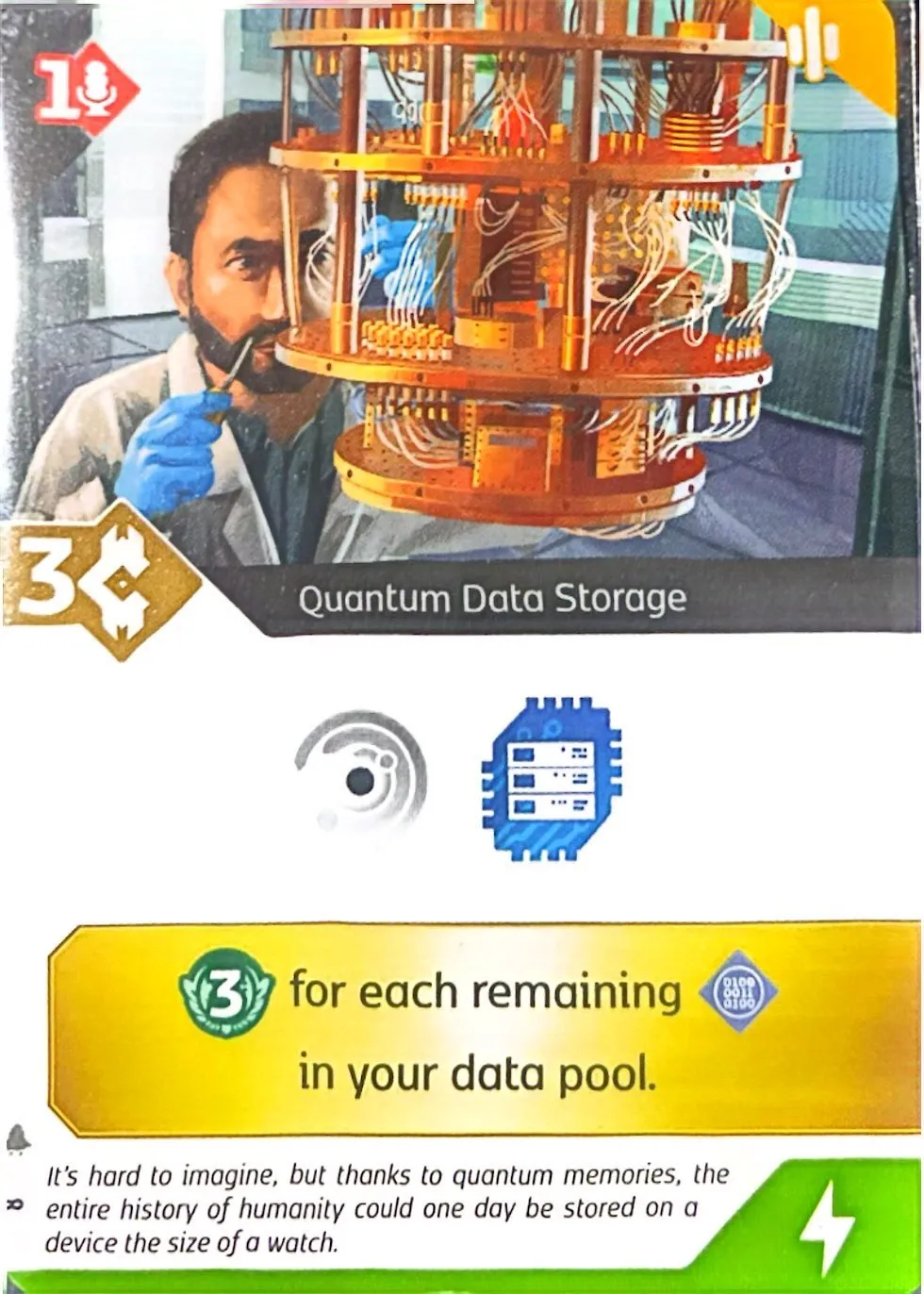
Quantum Data Storage
SA.8
It's hard to imagine, but thanks to quantum memories, the entire history of humanity could one day be stored on a device the size of a watch.
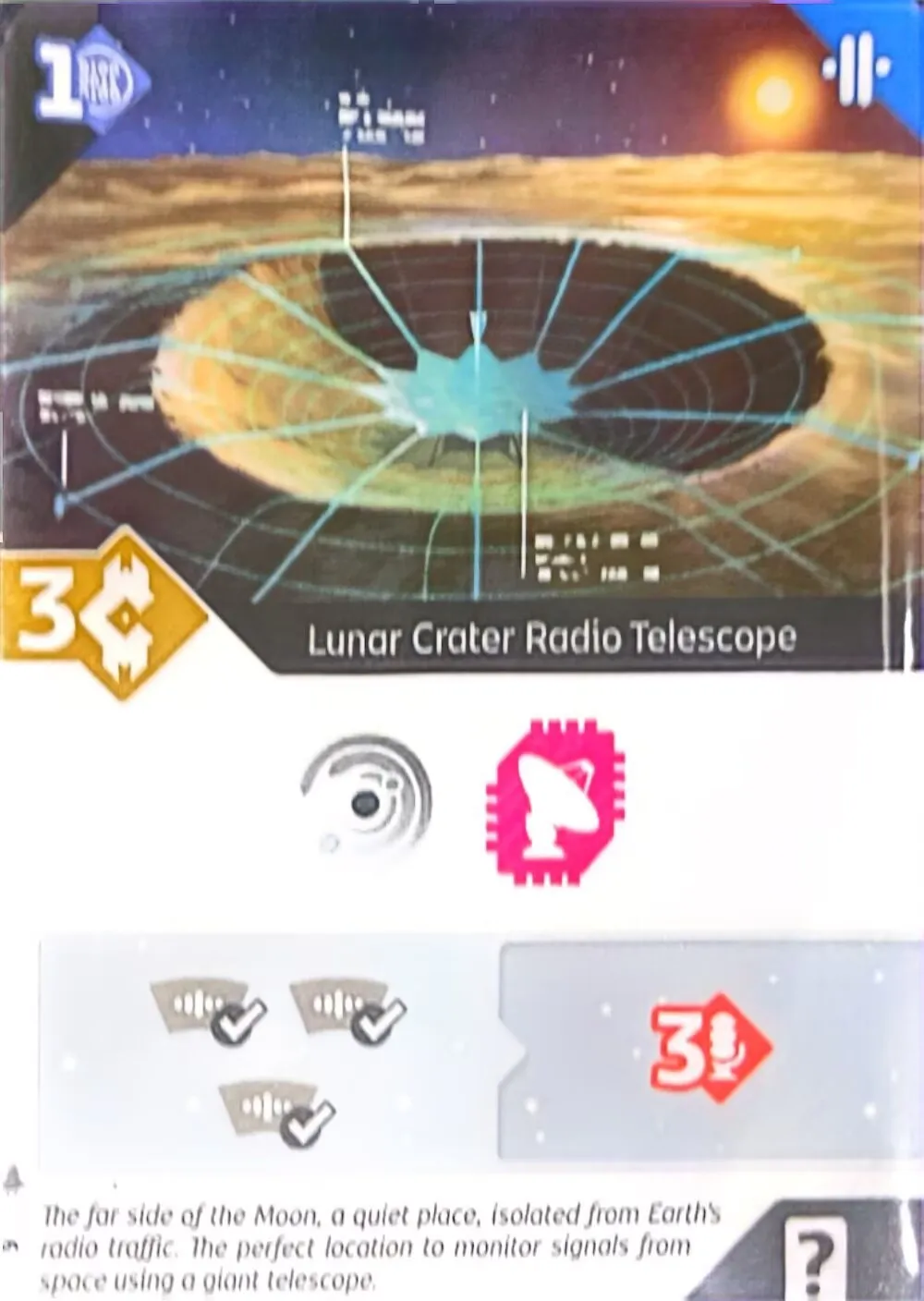
Lunar Crater Radio Telescope
SA.9
The far side of the Moon, a quiet place, isolated from Earth's radio traffic. The perfect location to monitor signals from space using a giant telescope.
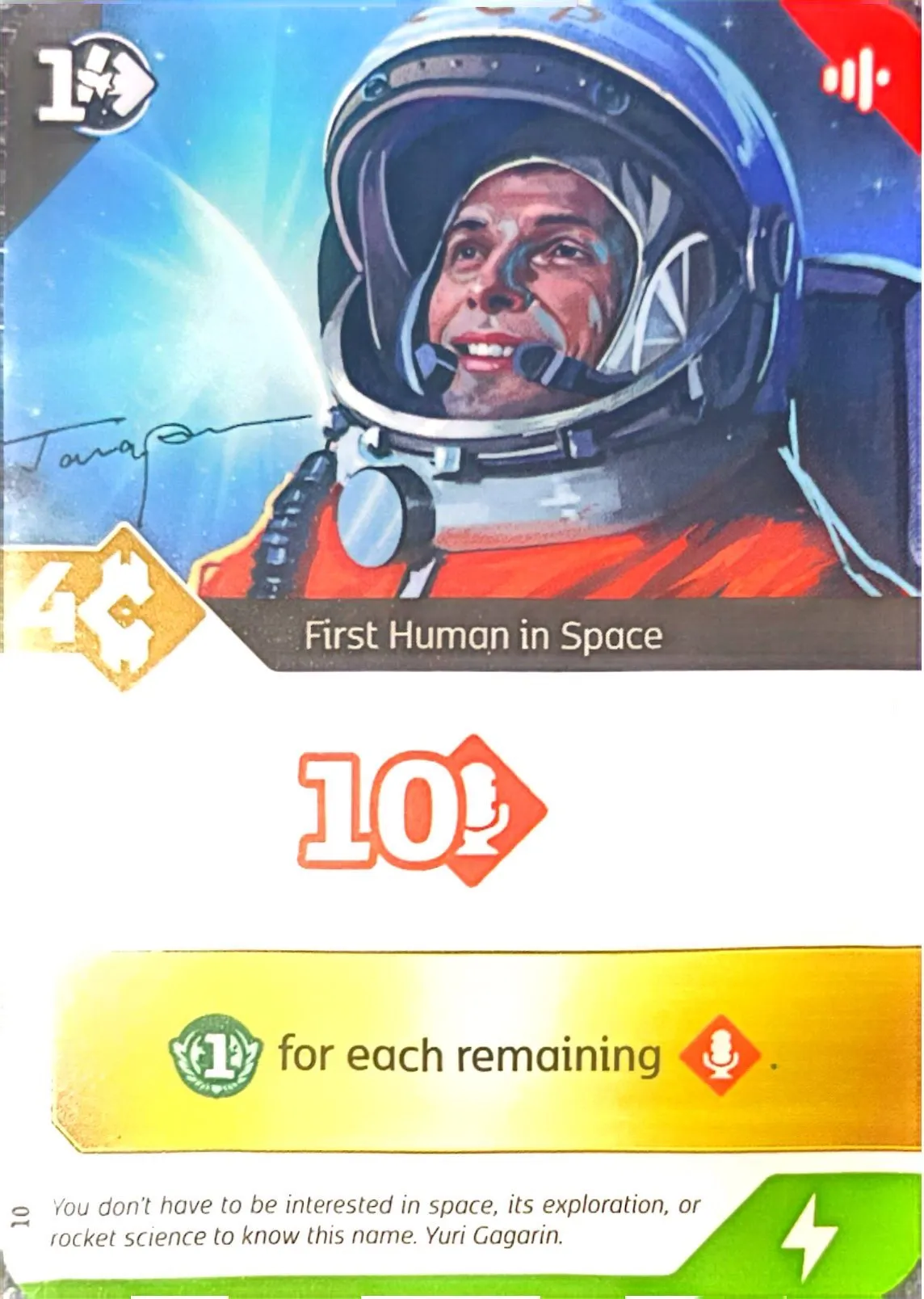
First Human in Space
SA.10
You don't have to be interested in space, its exploration, or rocket science to know this name. Yuri Gagarin.
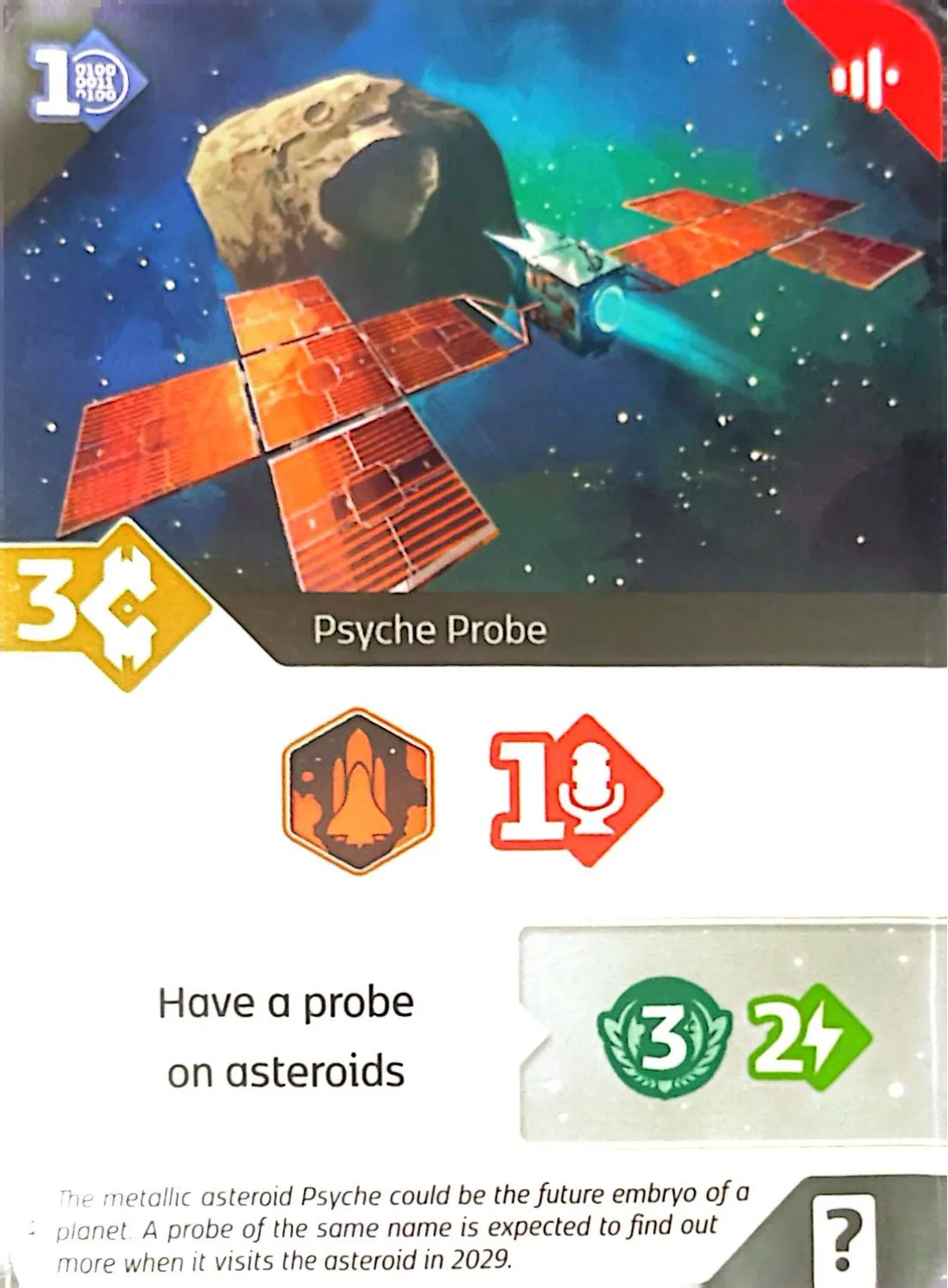
Psyche Probe
Have a probe on asteroids
SA.11
[待补充,看不清] its original mission is complete, a space probe may be tasked with a new objective. Some probes continue working long past their expected lifespan.
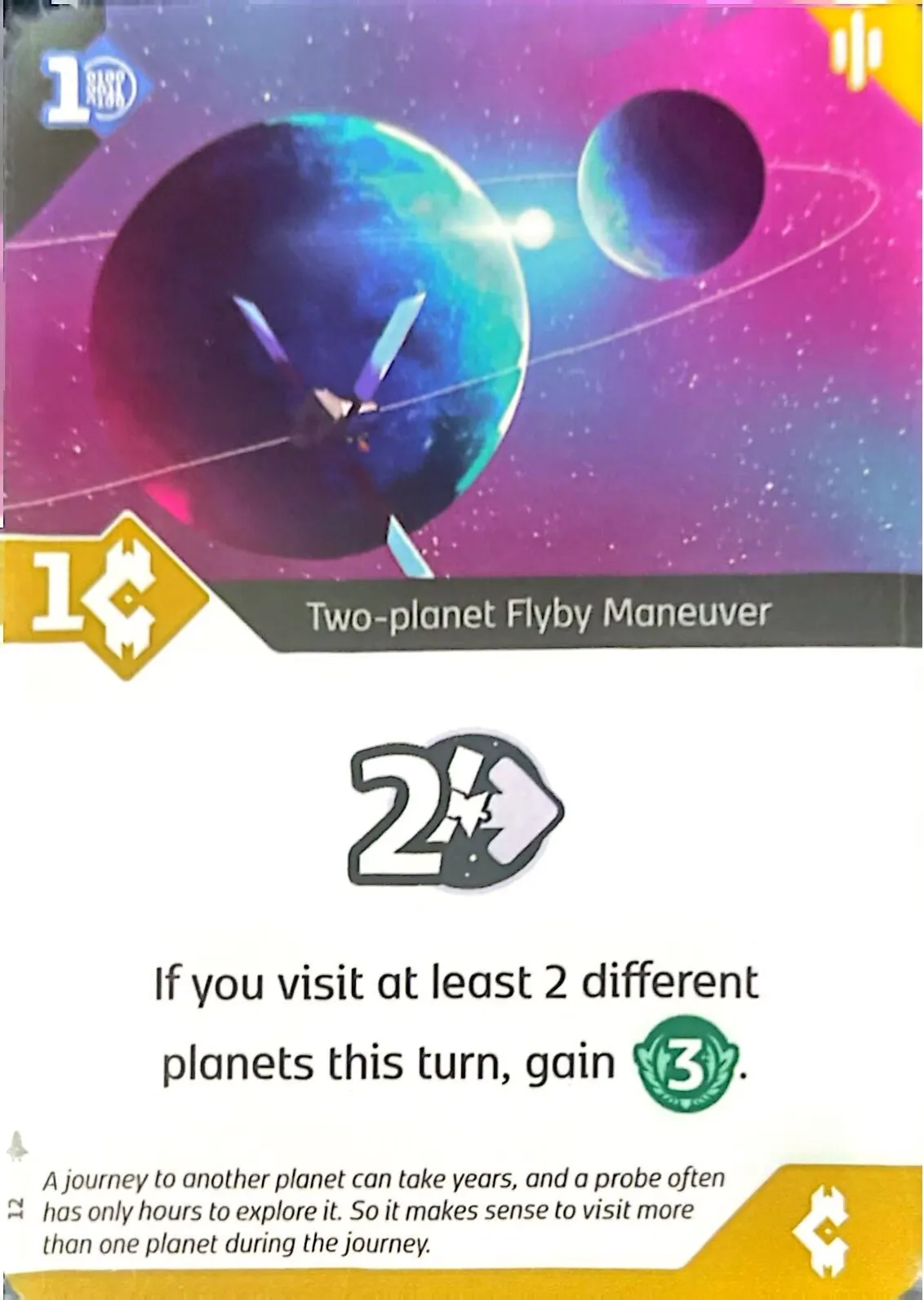
Two-planet Flyby Maneuver
2
If you visit at least 2 different
planets this turn, gain .
SA.12
A journey to another planet can take years, and a probe often has only hours to explore it. So it makes sense to visit more than one planet during the journey.
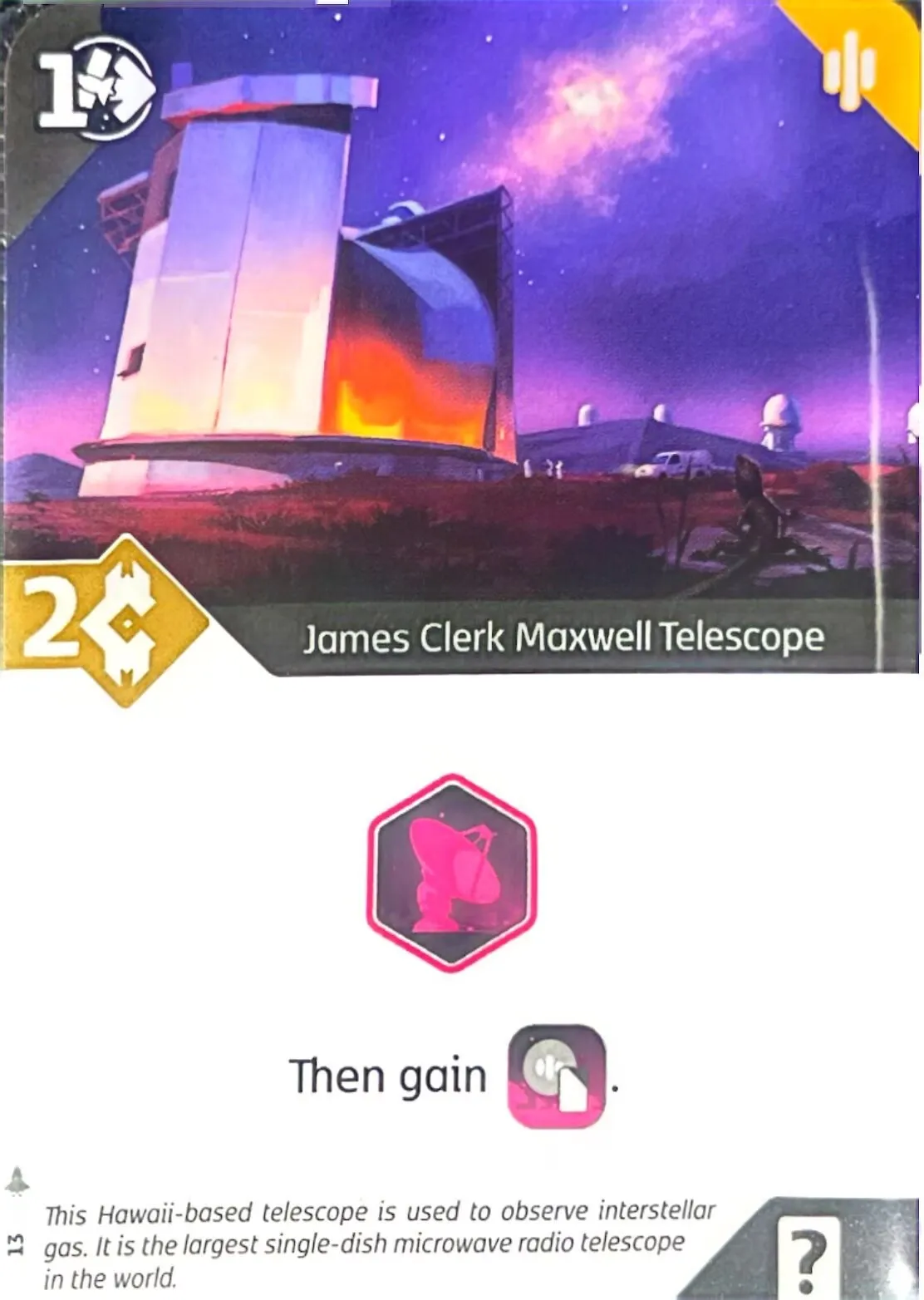
James Clerk Maxwell Telescope
Then gain .
SA.13
This Hawaii-based telescope is used to observe interstellar gas. It is the largest single-dish microwave radio telescope in the world.
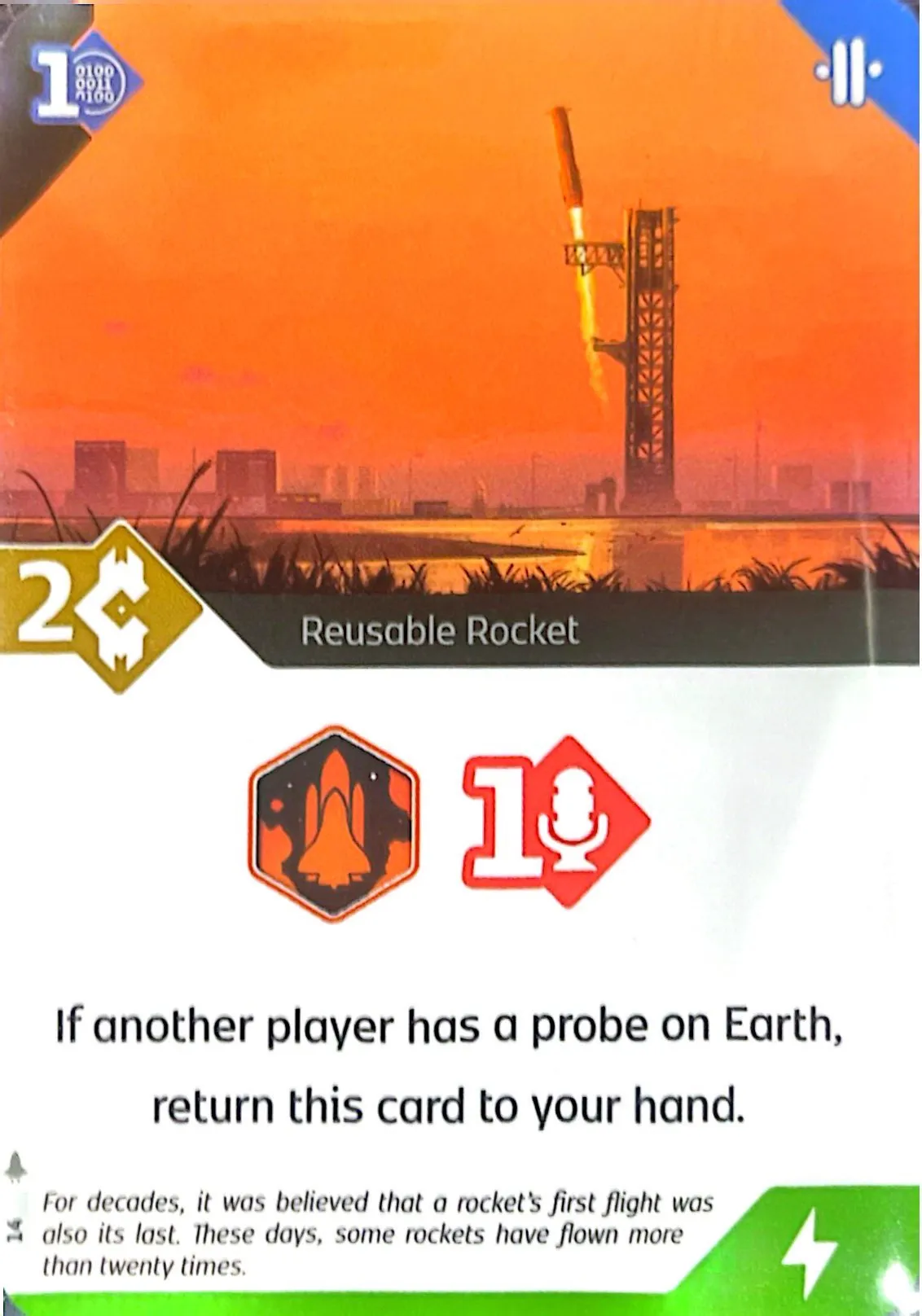
Reusable Rocket
If another player has a probe on Earth, return this card to your hand.
SA.14
For decades, it was believed that a rocket's first flight was also its last. These days, some rockets have flown more than twenty times.
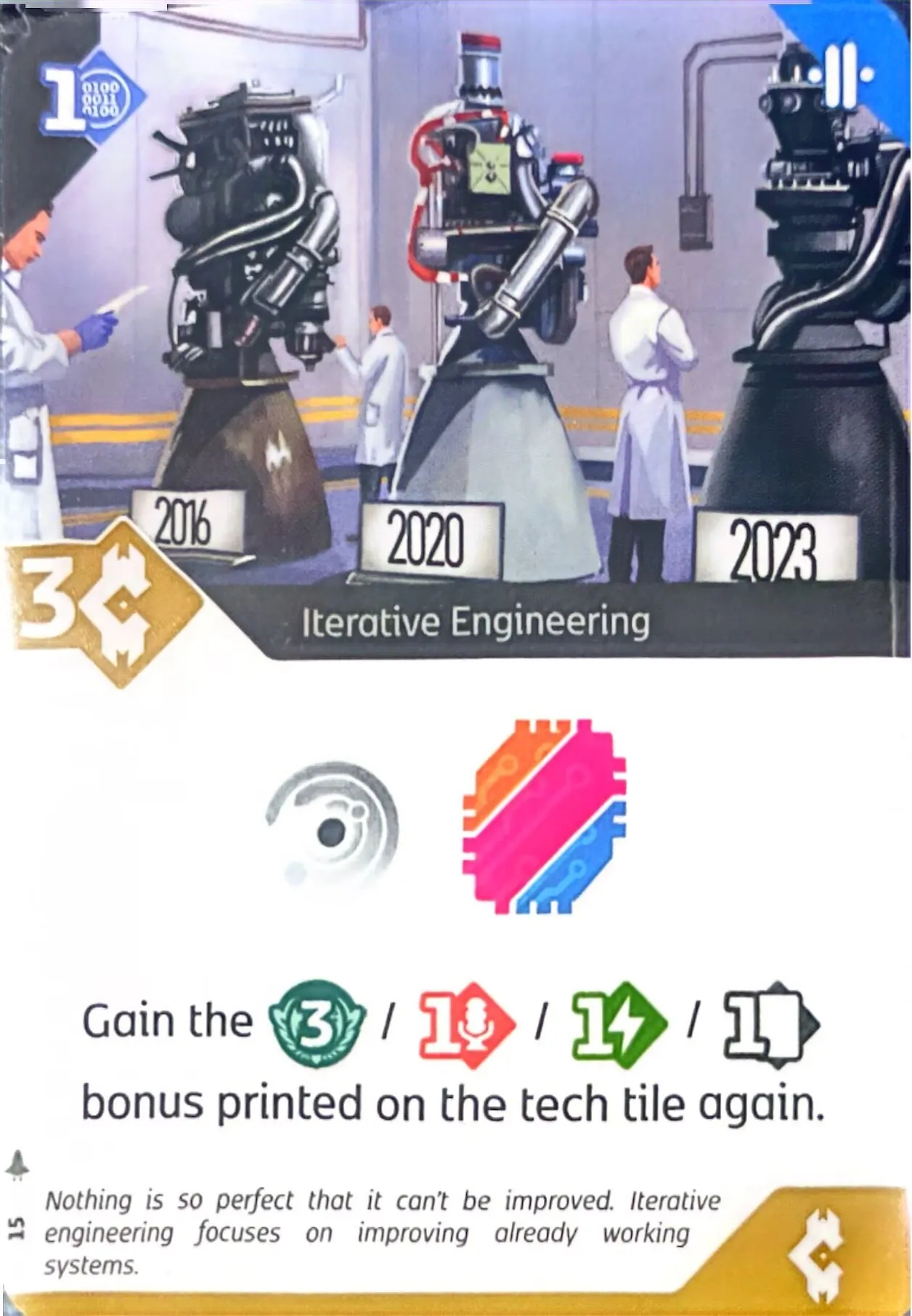
Iterative Engineering
Gain the / / / bonus printed on the tech tile again.
SA.15
Nothing is so perfect that it can't be improved. Iterative engineering focuses on improving already working systems.
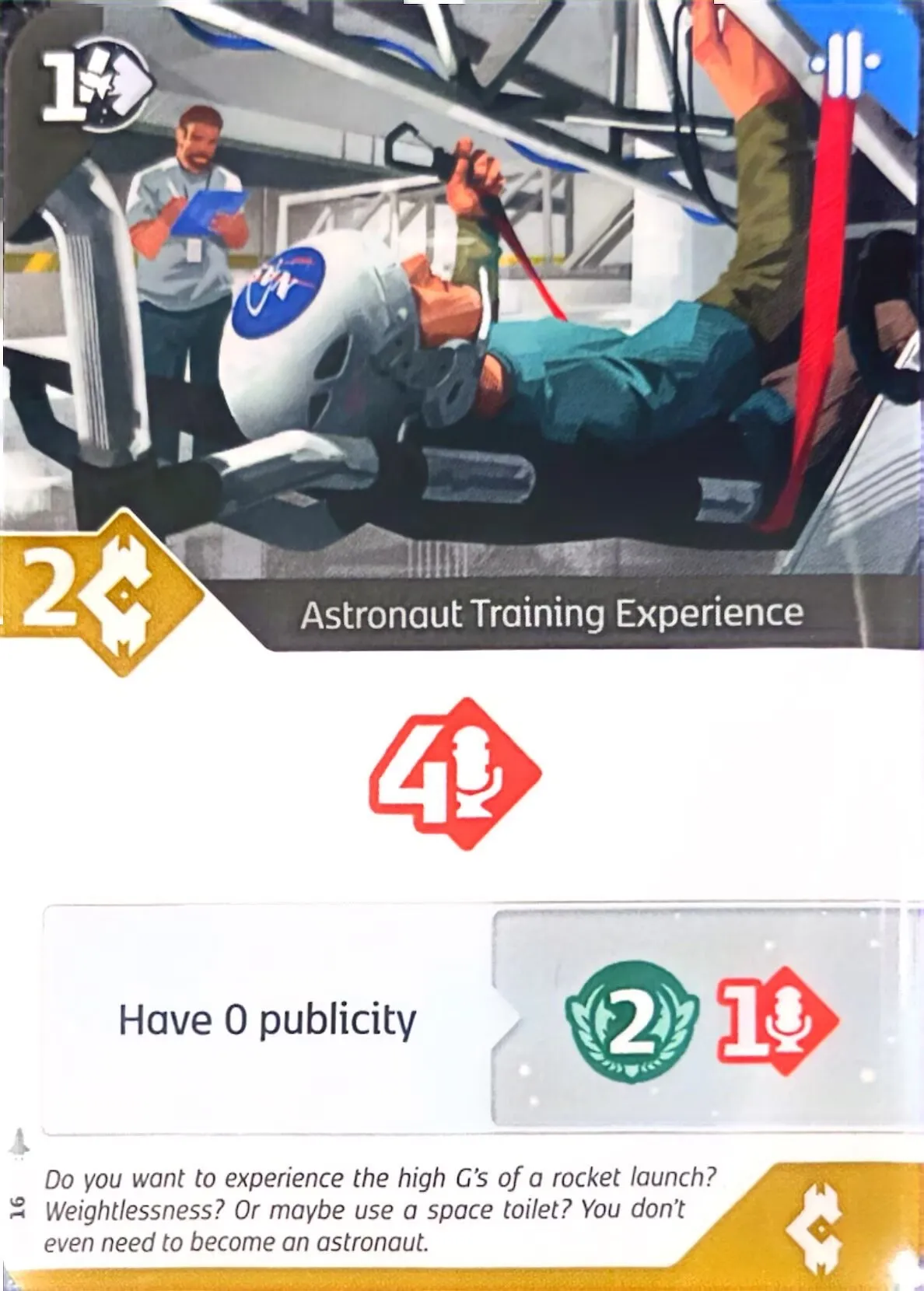
Astronaut Training Experience
Have no publicity
SA.16
Do you want to experience the high G's of a rocket launch? Weightlessness? Or maybe use a space toilet? You don't even need to become an astronaut.
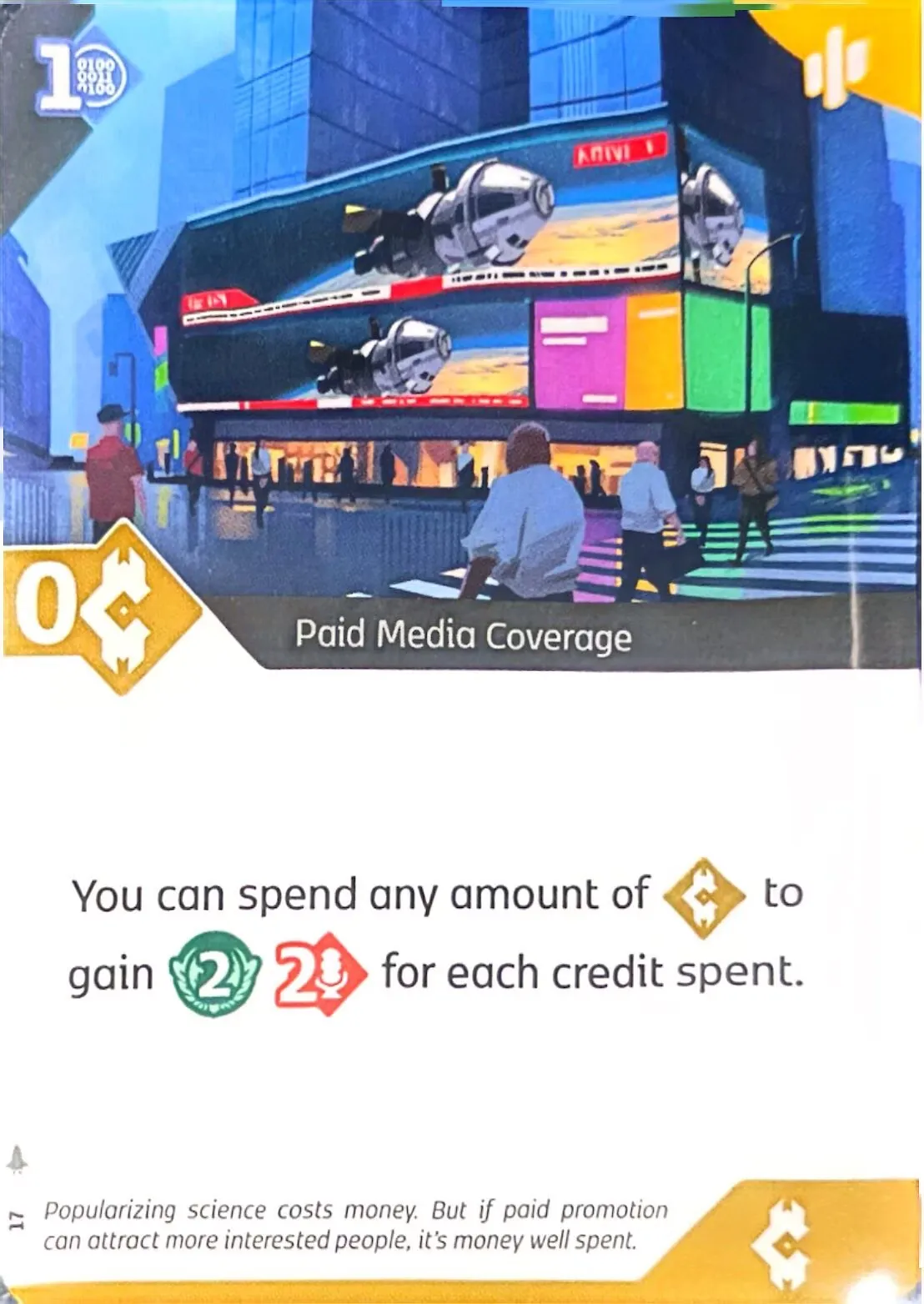
Paid Media Coverage
You can spend any amount of to gain for each credit spent.
SA.17
Popularizing science costs money. But if paid promotion can attract more interested people, it's money well spent.
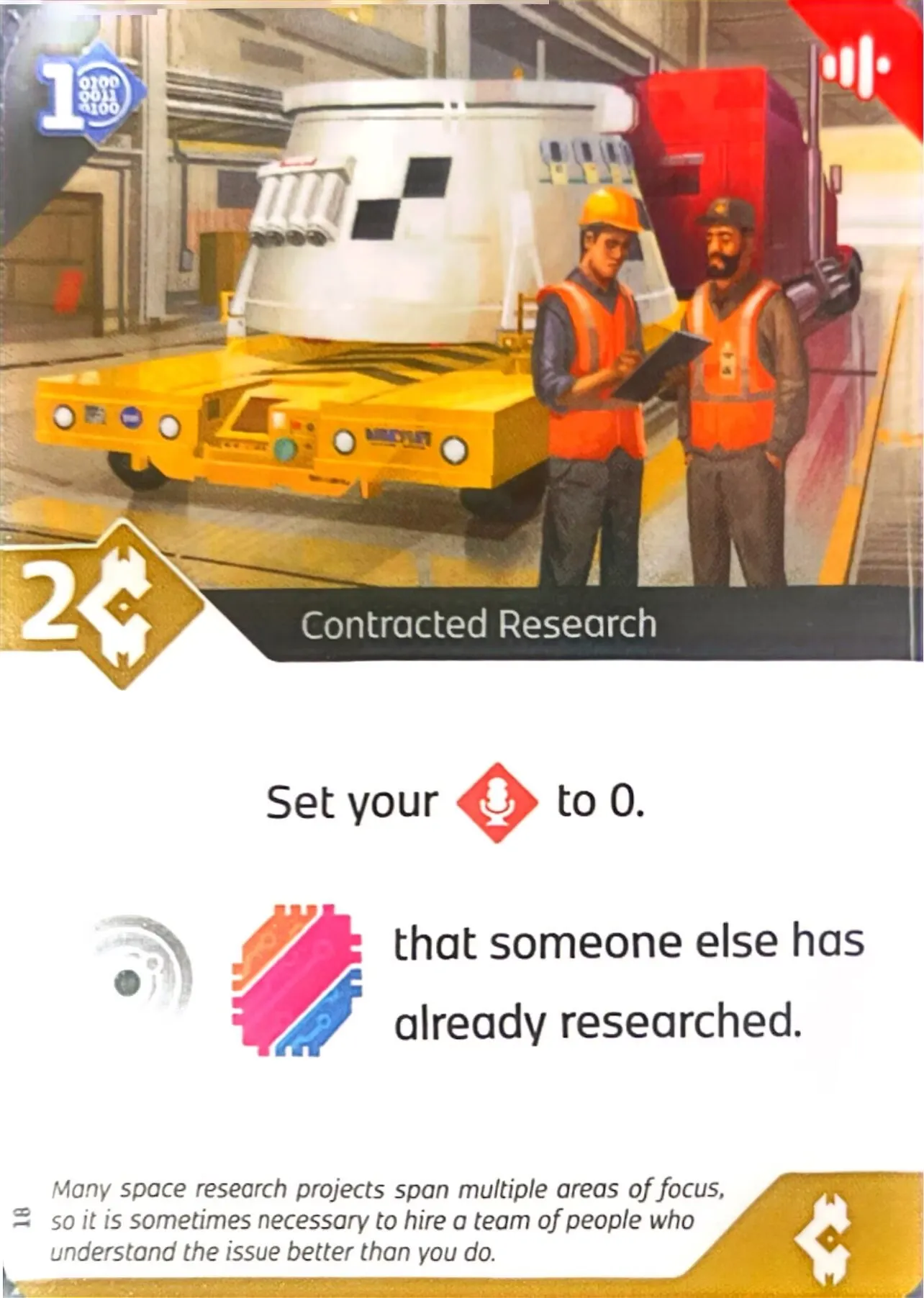
Contracted Research
Set your to 0.
that someone else has already researched.
SA.18
Many space research projects span multiple areas of focus, so it is sometimes necessary to hire a team of people who understand the issue better than you do.
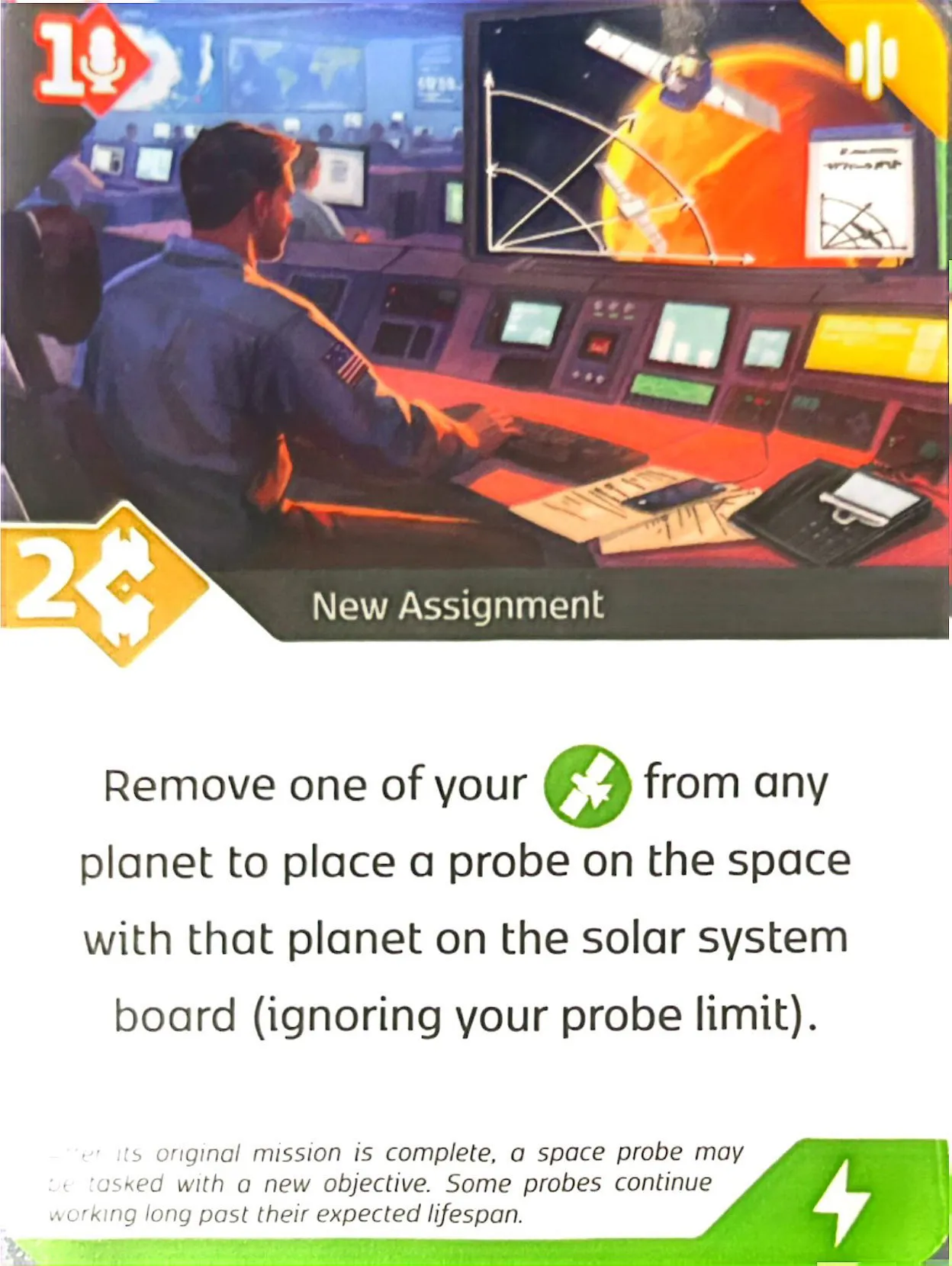
New Assignment
Remove one of your from any
planet to place a probe on the space
with that planet on the solar system
board (ignoring your probe limit).
SA.19
Planets outside the Solar System are hard to find. They are easiest to observe when they transit their parent star. These observations are the task of the TESS satellite.
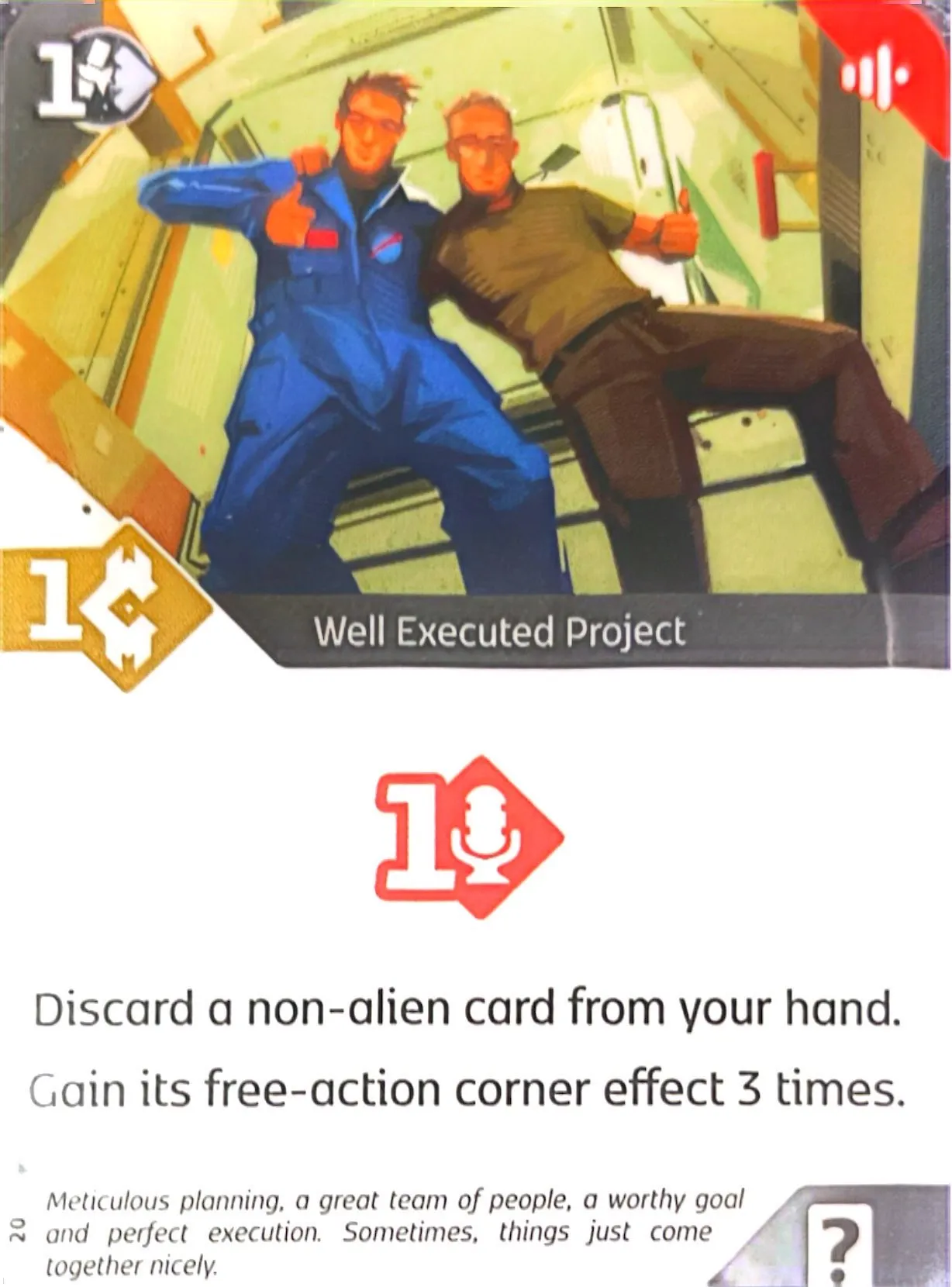
Well Executed Project
Discard a non-alien card from your hand.
Gain its free-action corner effect 3 times.
SA.20
Meticulous planning, a great team of people, a worthy goal and perfect execution. Sometimes, things just come together nicely.
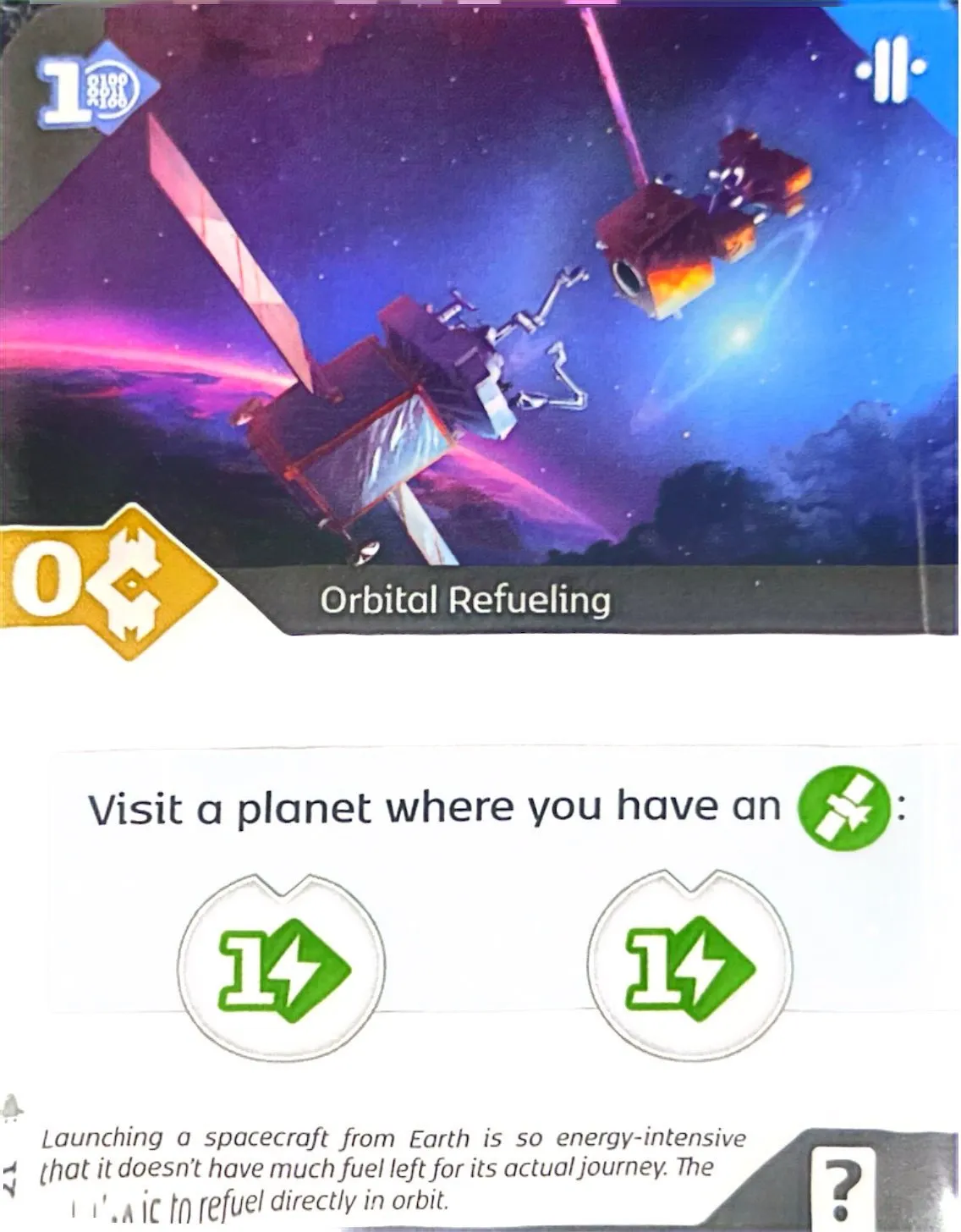
Orbital Refueling
Visit a planet
where you have an :
SA.21
Launching a space craft from Earth is so energy-intensive that it doesn't have much fuel left for its actual journey. The [待补充,看不清] refuel directly in orbit.
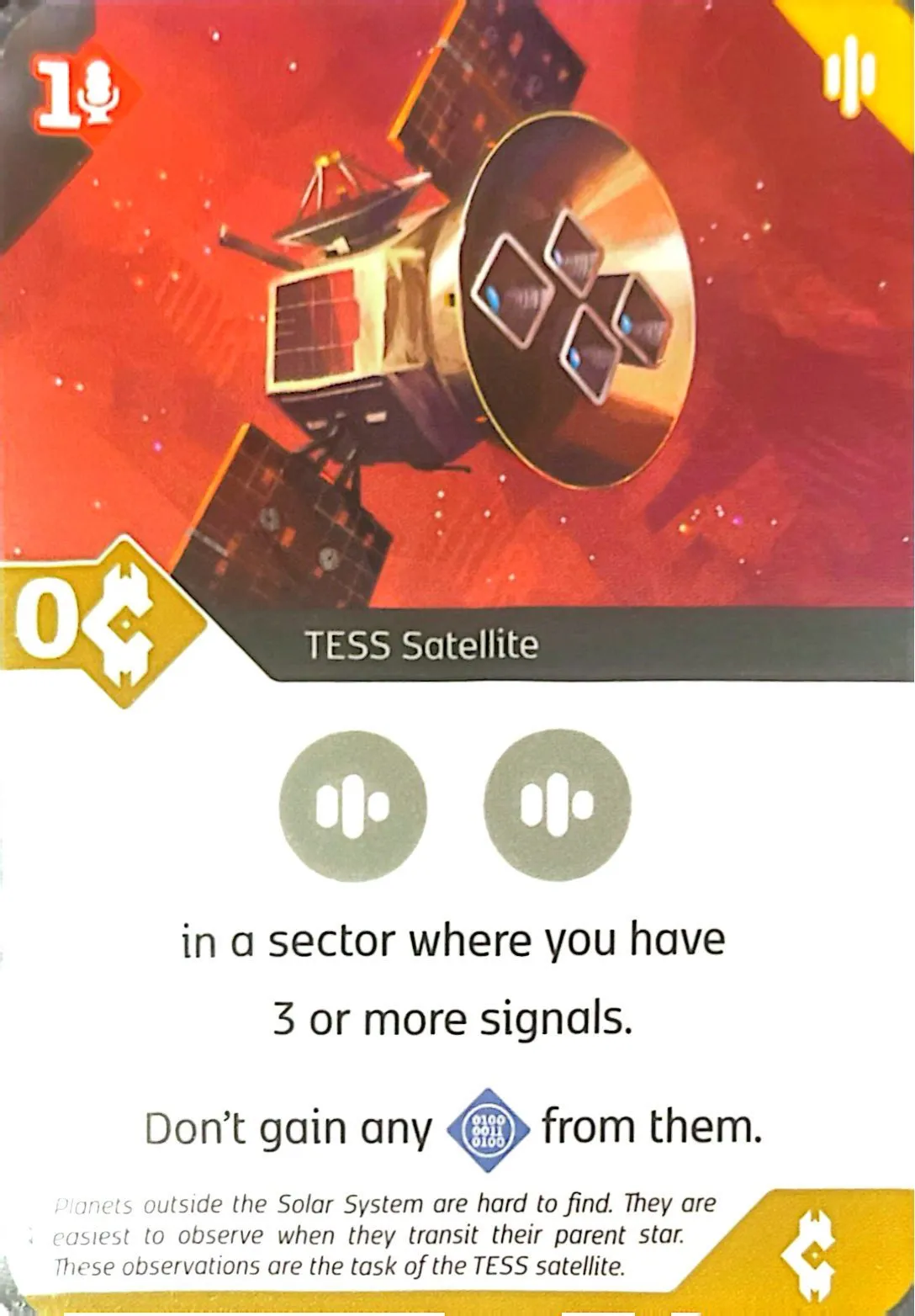
TESS Satellite
in a sector where you have
3 or more signals.
Don't gain any from them.
SA.22
The metallic asteroid Psyche could be the future embryo of a planet. A probe of the same name is expected to find out more when it visits the asteroid in 2029.
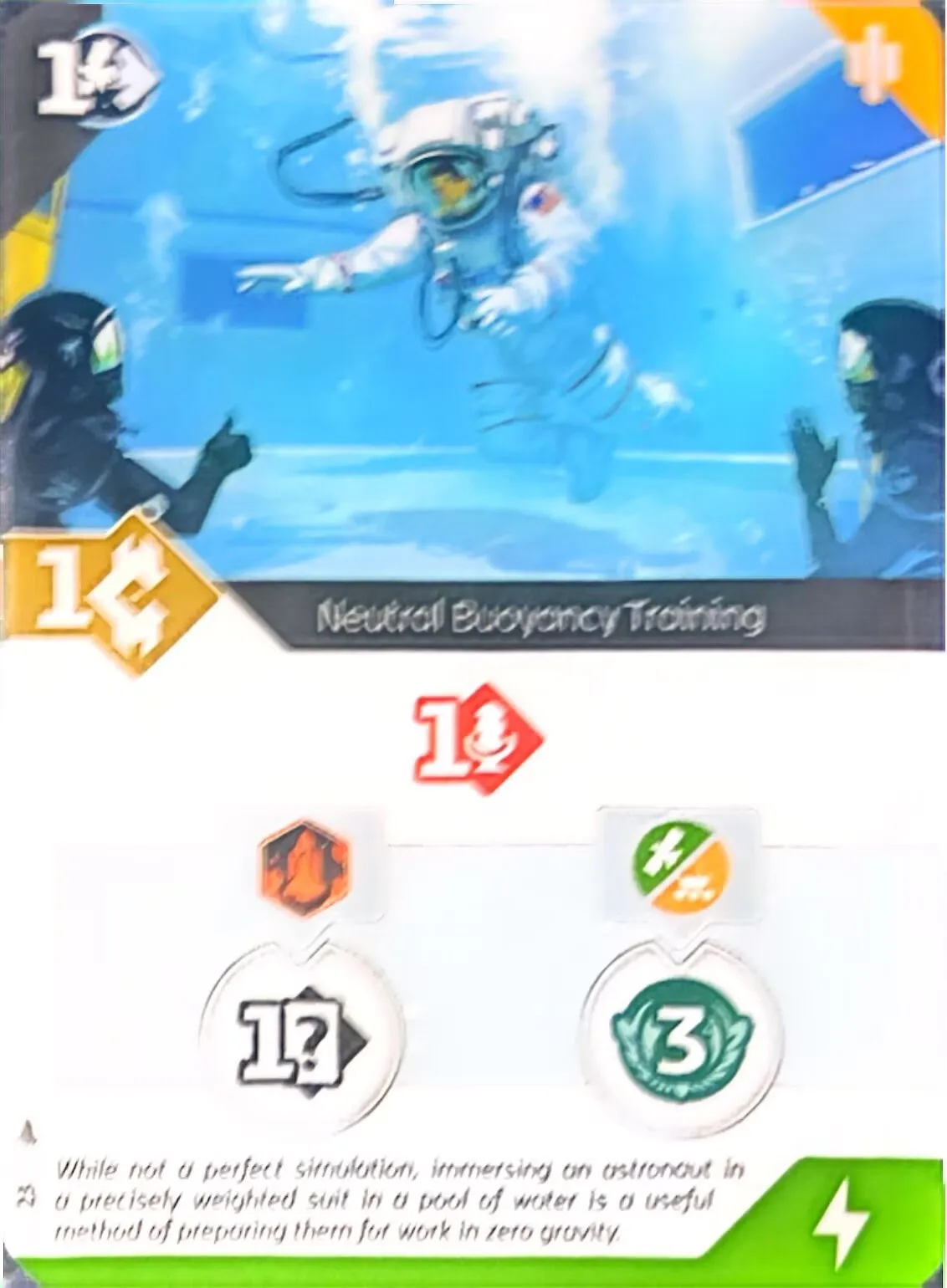
Neutral Buoyancy Training
SA.23
While not a perfect simulation, immersing an astronaut in a precisely weighted suit in a pool of water is a useful method of preparing them for work in zero gravity.
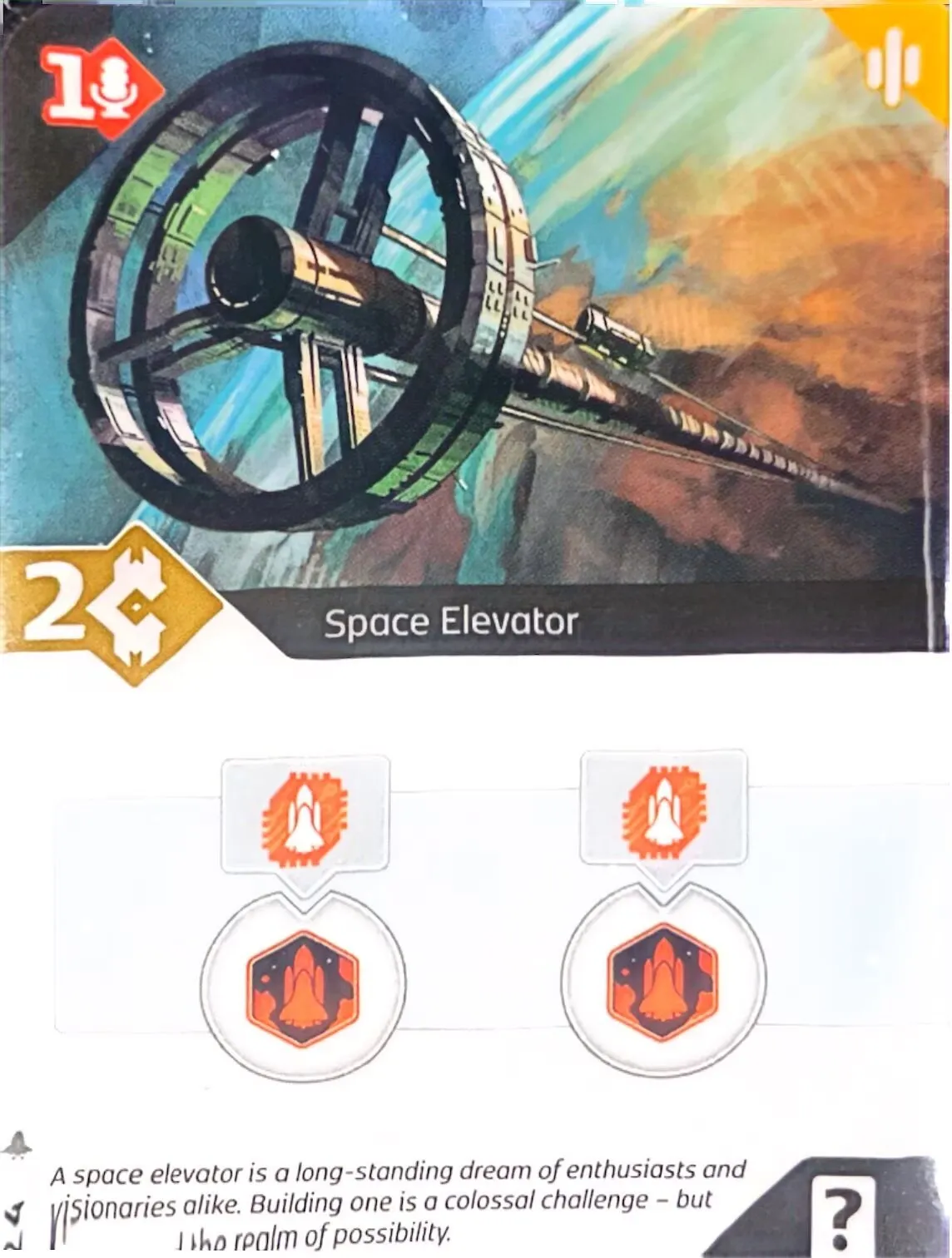
Space Elevator
SA.24
A space elevator is a long-standing dream of enthusiasts and visionaries alike. Building one is a colossal challenge - but [待补充,看不清] the realm of possibility.
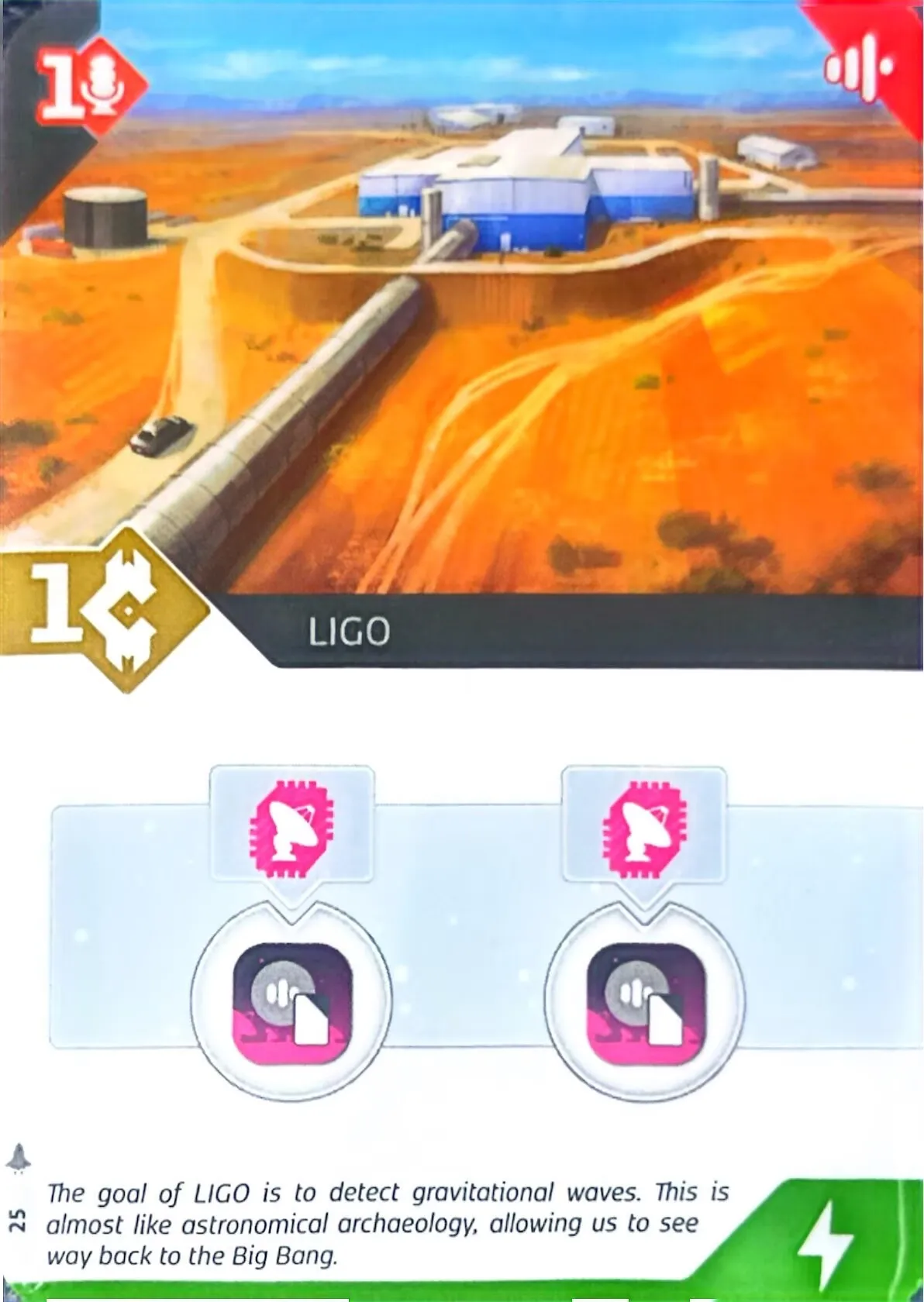
LIGO
SA.25
The goal of LIGO is to detect gravitational waves. This is almost like astronomical archaeology, allowing us to see way back to the Big Bang.
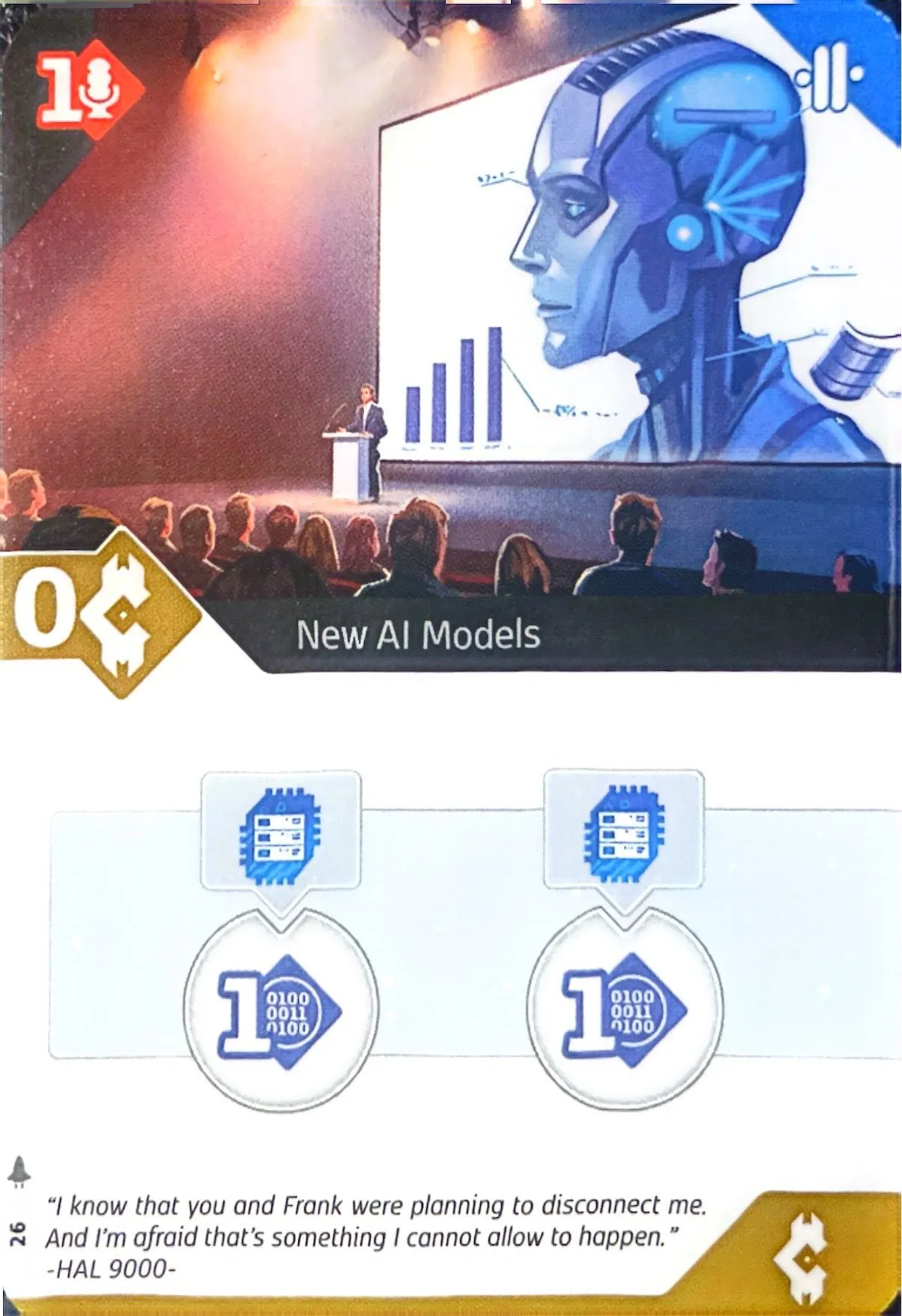
New AI Models
SA.26
"I know that you and Frank were planning to disconnect me. And I'm afraid that's something I cannot allow to happen." -HAL 9000-
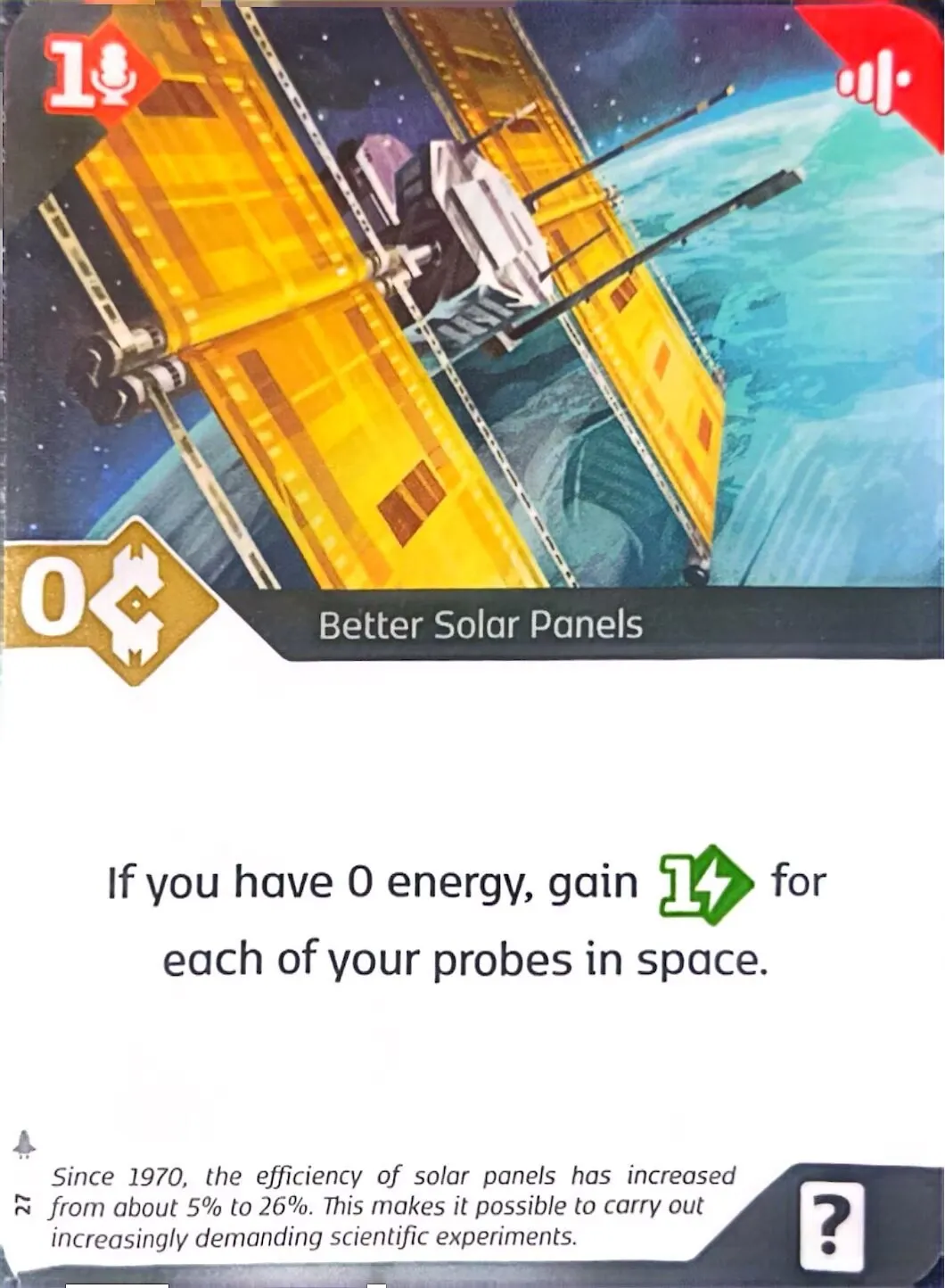
Better Solar Panels
If you have 0 energy, gain for
each of your probes in space.
SA.27
Since 1970, the efficiency of solar panels has increased from about 5% to 26%. This makes it possible to carry out increasingly demanding scientific experiments.
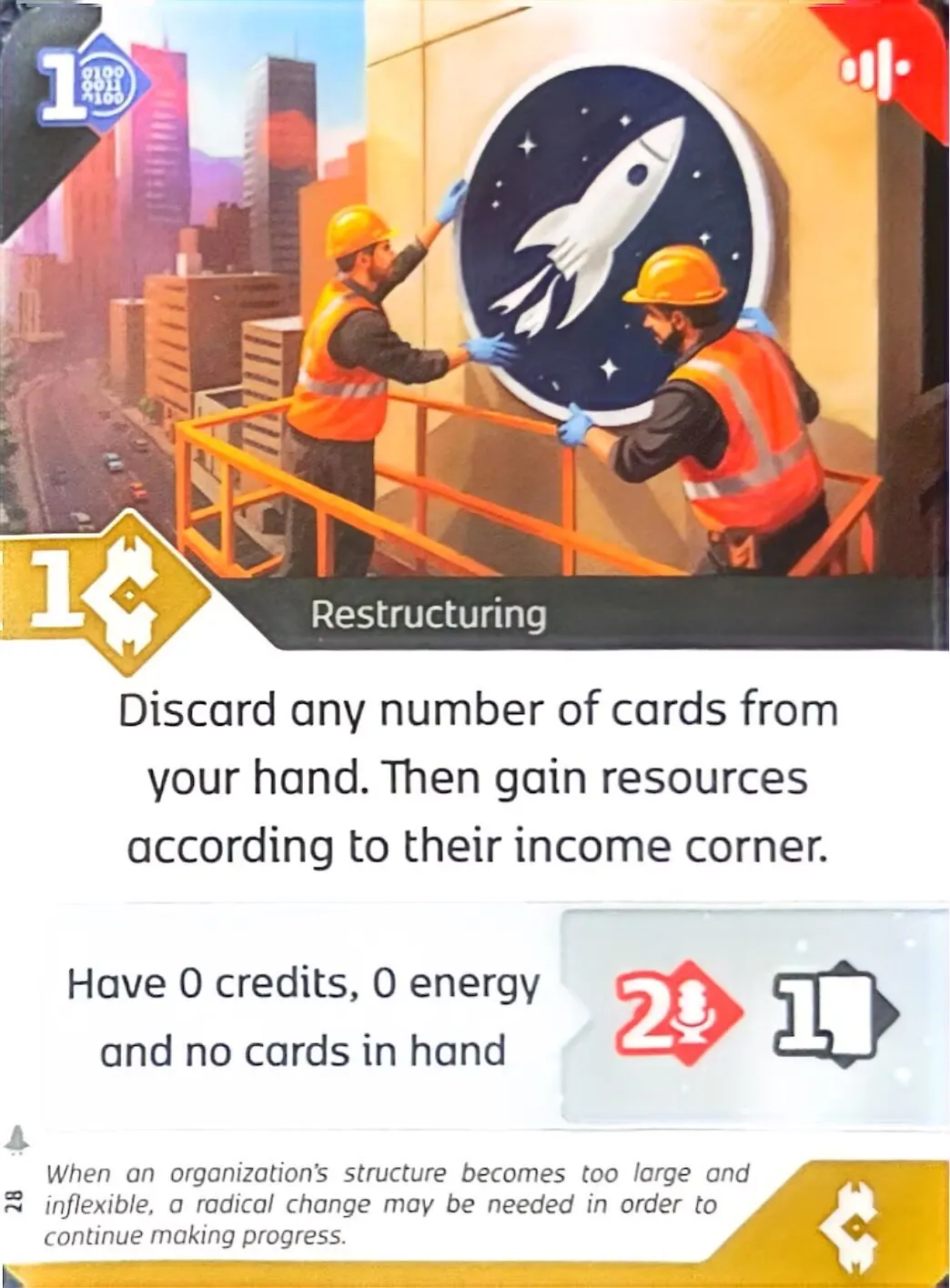
Restructuring
Discard any number of cards from
your hand. Then gain resources
according to their income corner.
Have 0 credits, 0 energy and no cards in hand
SA.28
When an organization's structure becomes too large and inflexible, a radical change may be needed in order to continue making progress.
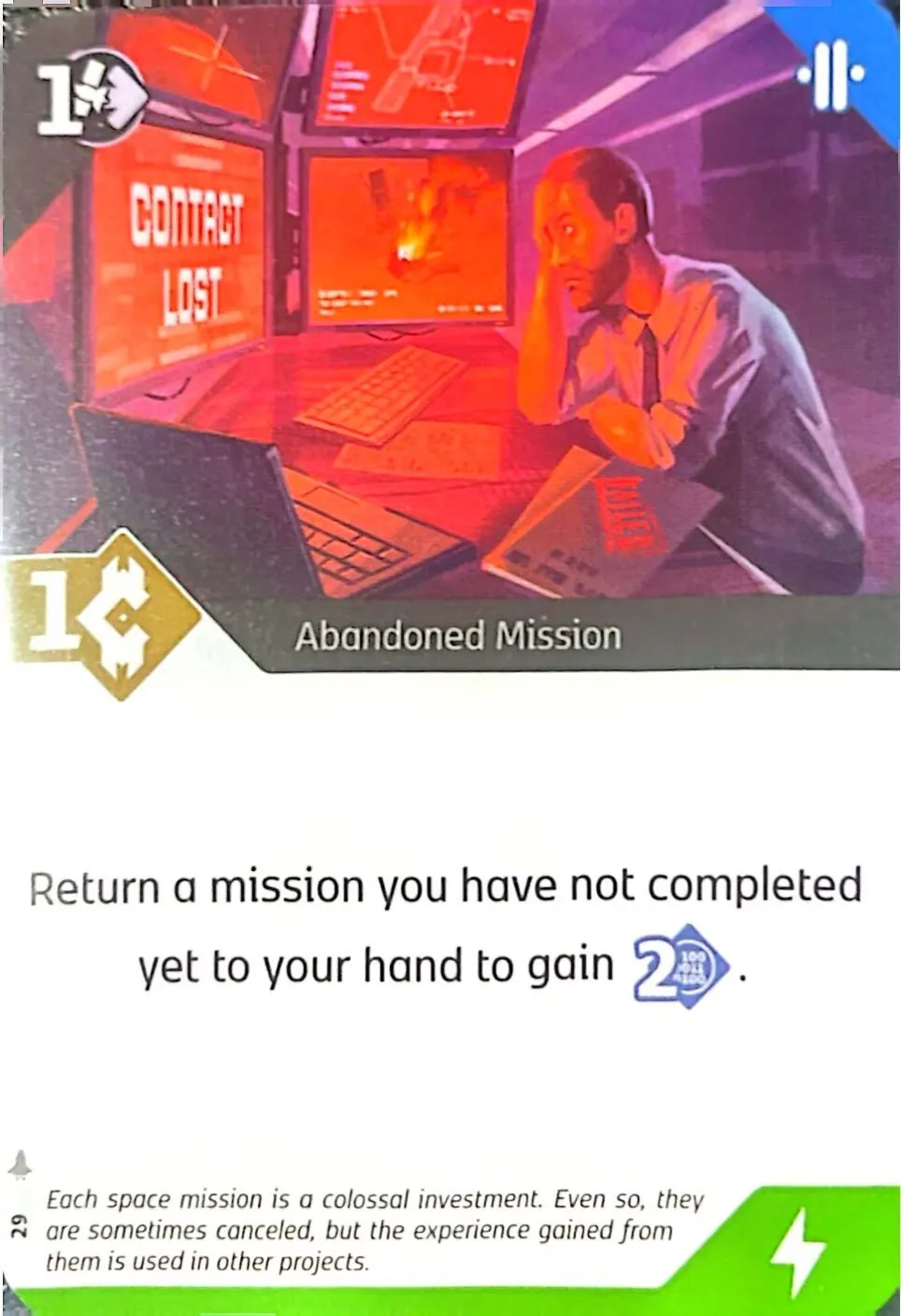
Abandoned Mission
Return a mission you have not completed yet to your hand to gain .
SA.29
Each space mission is a colossal investment. Even so, they are sometimes canceled, but the experience gained from them is used in other projects.
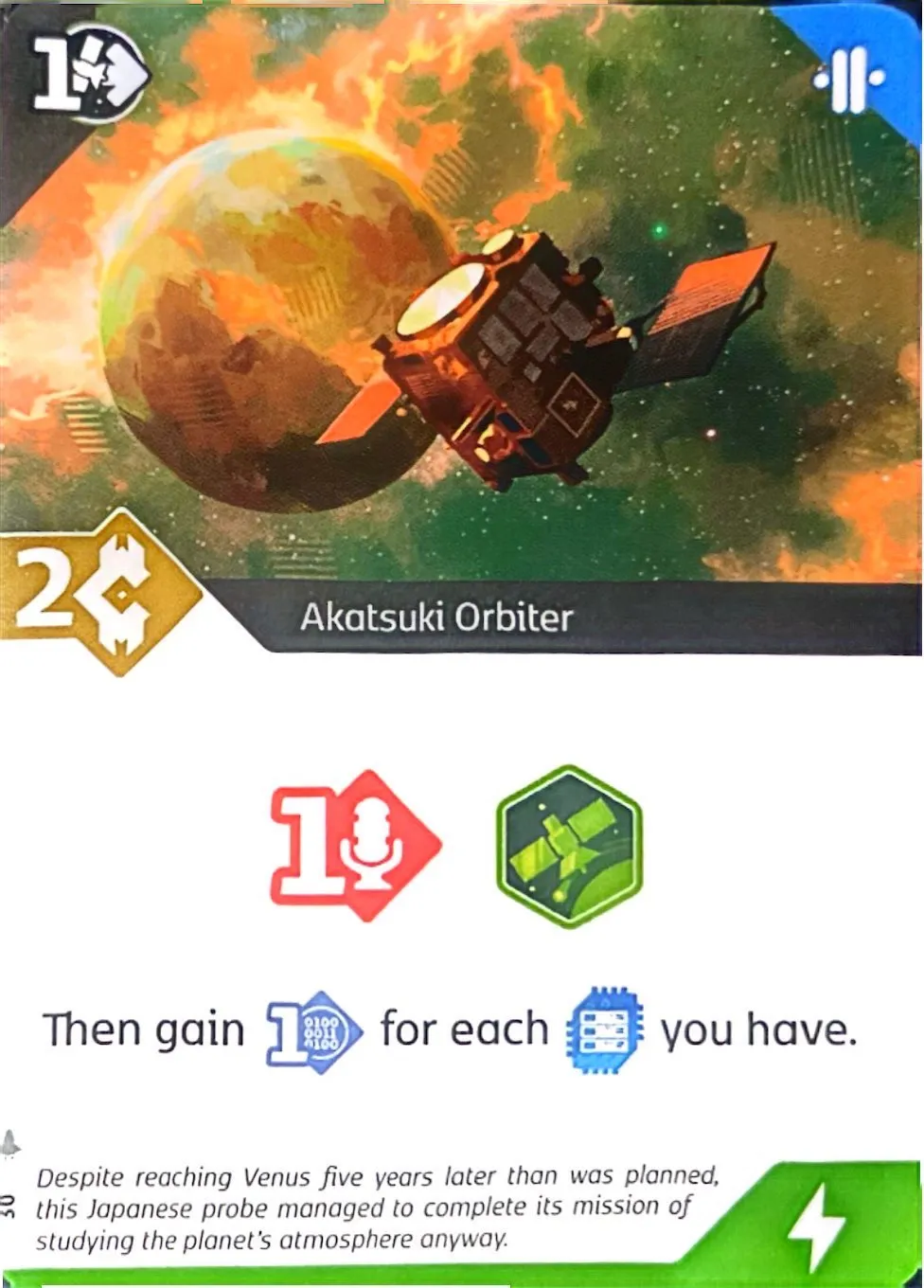
Akatsuku Orbiter
Then gain for each you have.
SA.30
Despite reaching Venus five years later than was planned, this Japanese probe managed to complete its mission of studying the planet's atmosphere anyway.
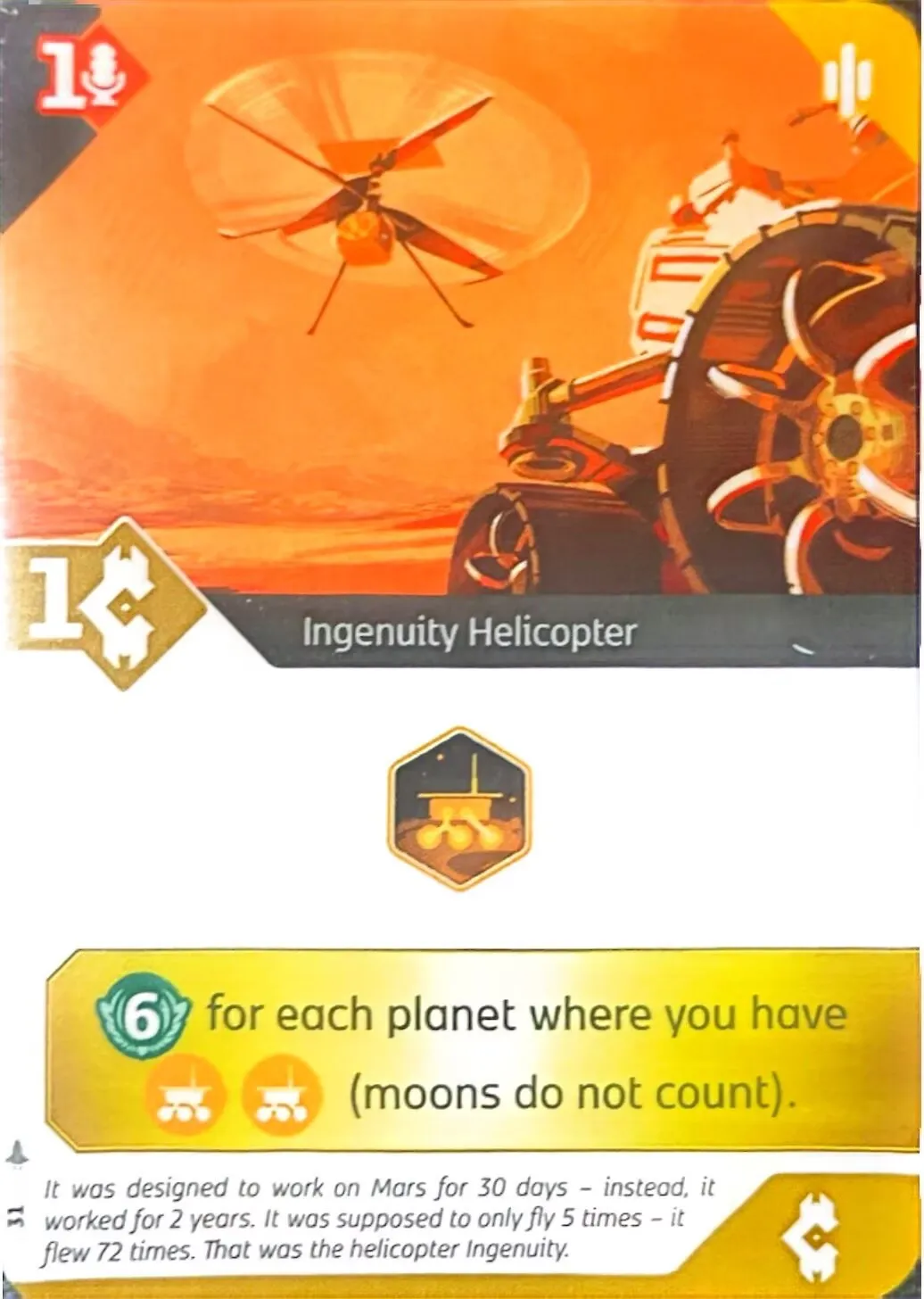
Ingenuity Helicopter
SA.31
It was designed to work on Mars for 30 days - instead, it worked for 2 years. It was supposed to only fly 5 times - it flew 72 times. That was the helicopter ingenuity.
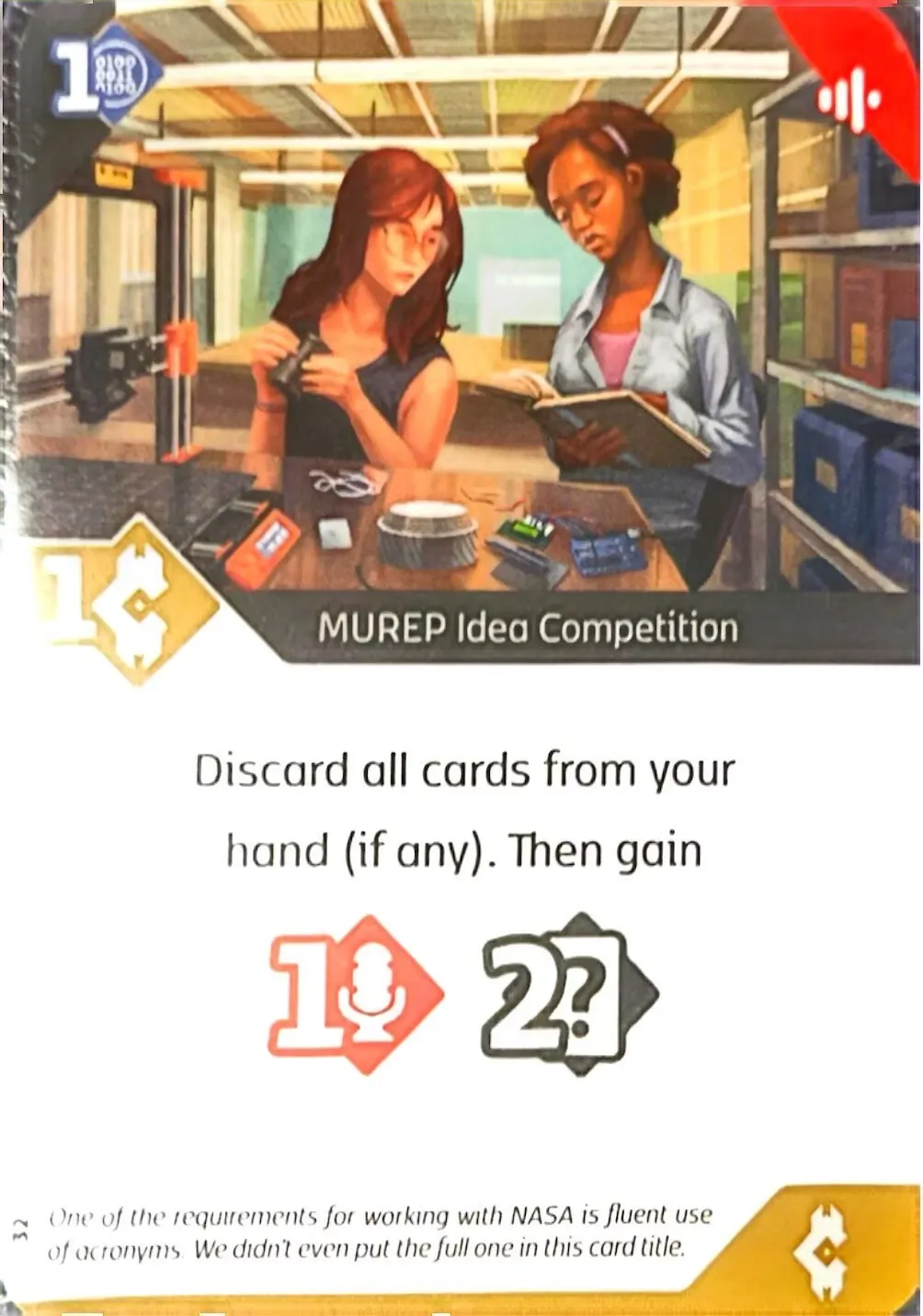
MUREP Idea Competition
Discard all cards from your hand (if any).
Then gain
SA.32
One of the requirements for working with NASA is fluent use of acronyms. We didn't even put the full one in this card title.
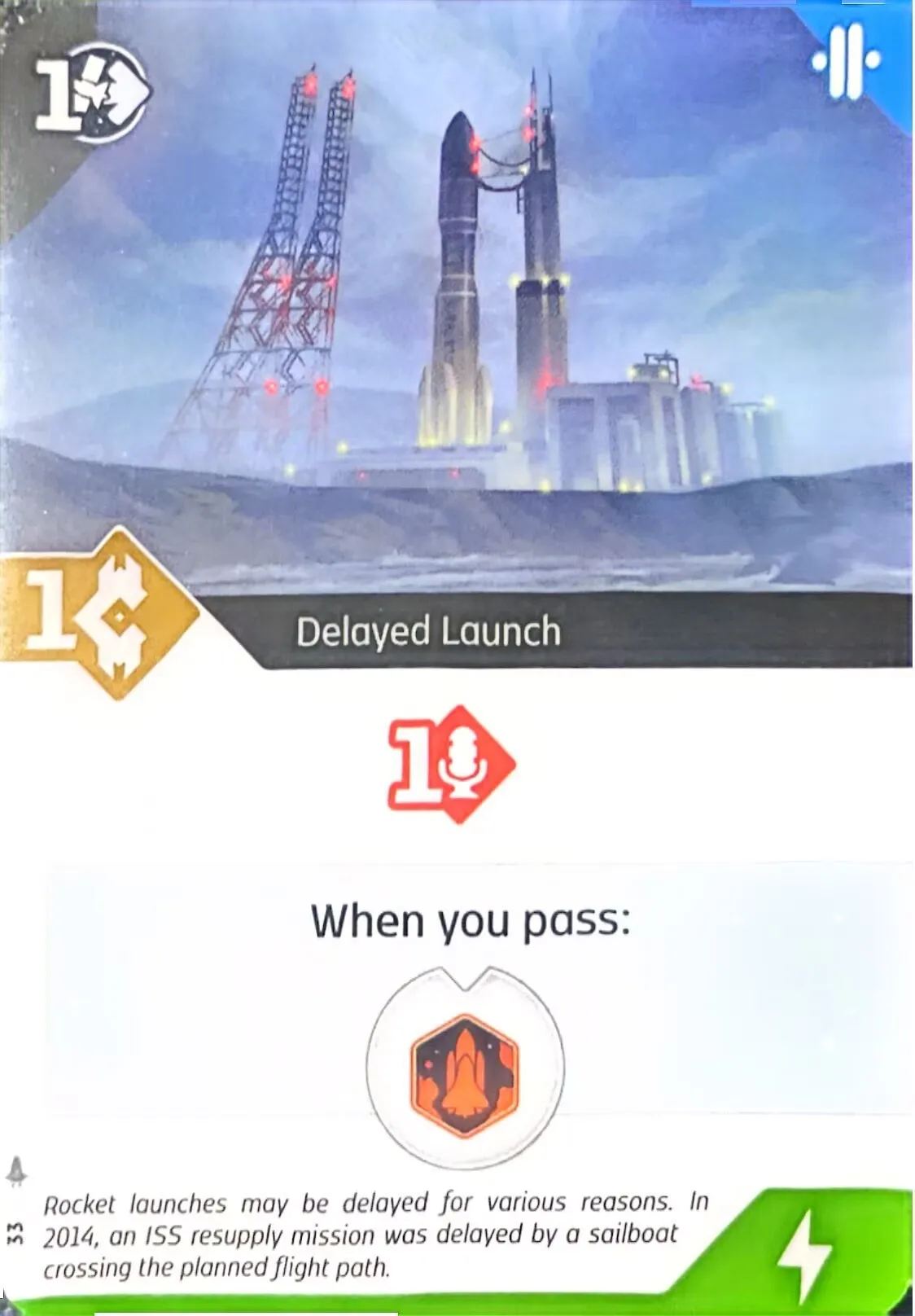
Delayed Launch
When you pass:
SA.33
Rocket launches may be delayed for various reasons. In 2014, an ISS resupply mission was delayed by a sailboat crossing the planned flight path.
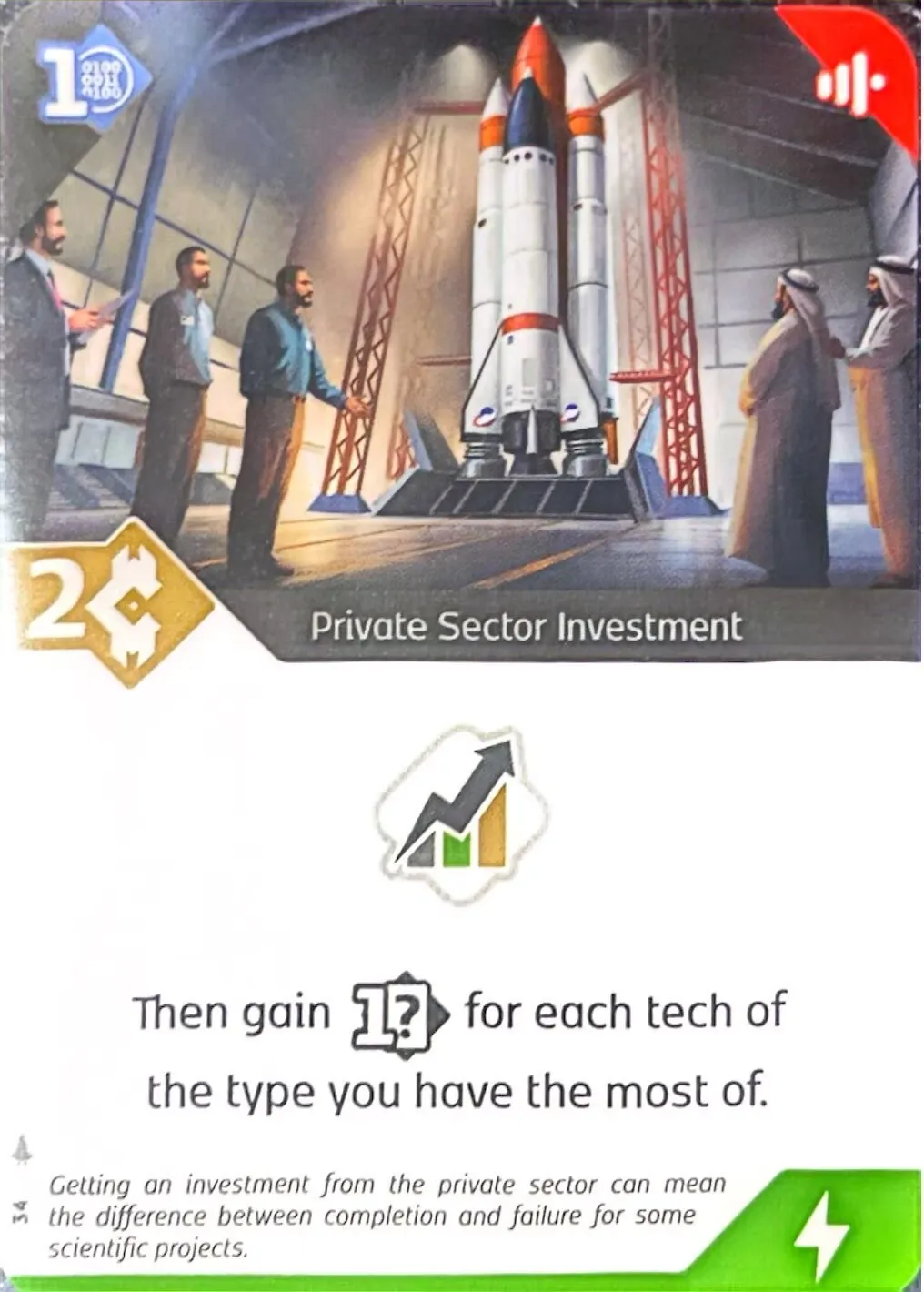
Private Sector Investment
Then gain for each tech of
the type you have the most of.
SA.34
Getting an investment from the private sector can mean the difference between completion and failure for some scientific projects.
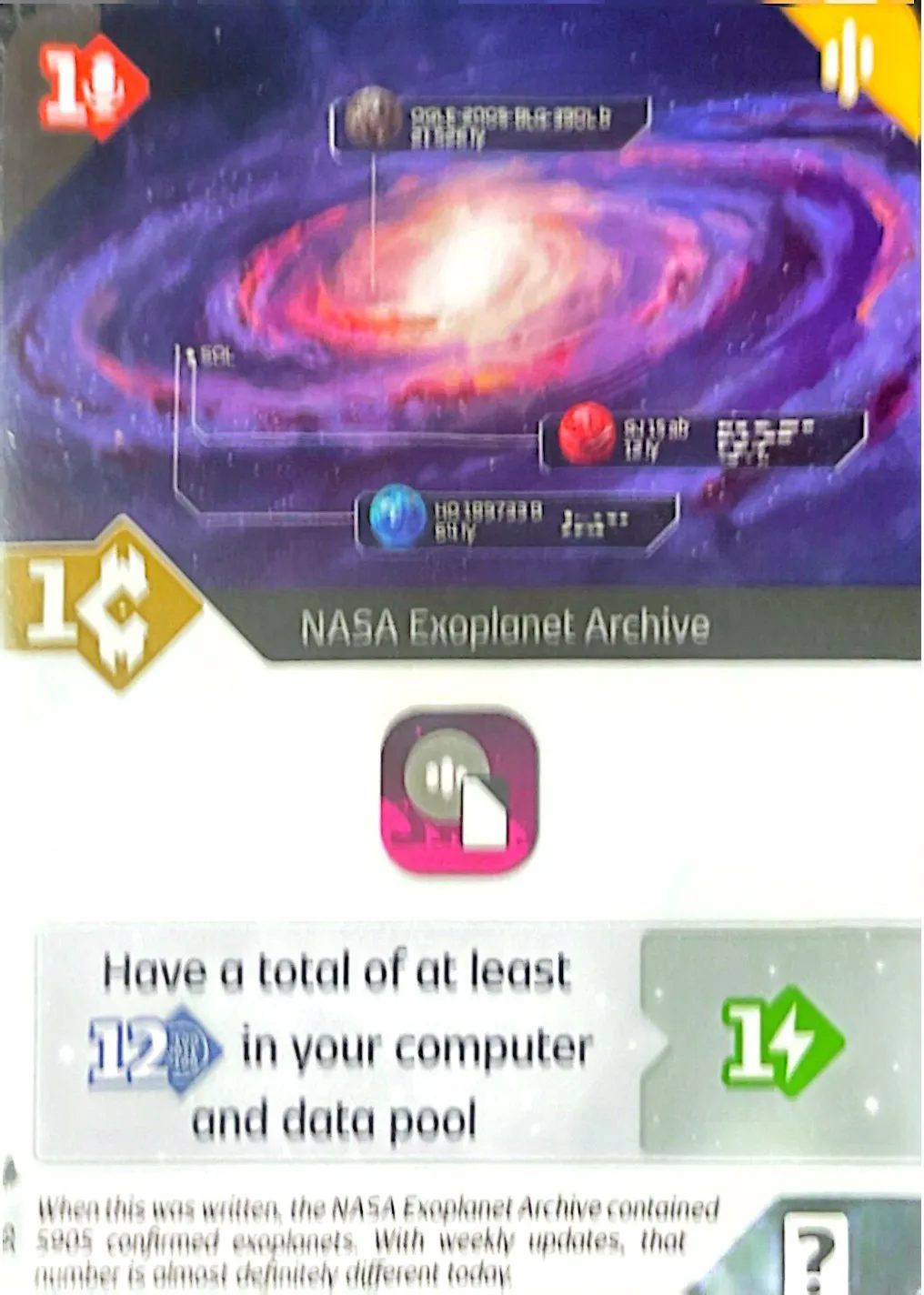
NASA Exoplanet Archive
Have a total of at least in
your computer and data pool
SA.35
When this was written, the NASA Exoplanet Archive contained 5905 confirmed exoplanets. With weekly updates, that number is almost definitely different today.
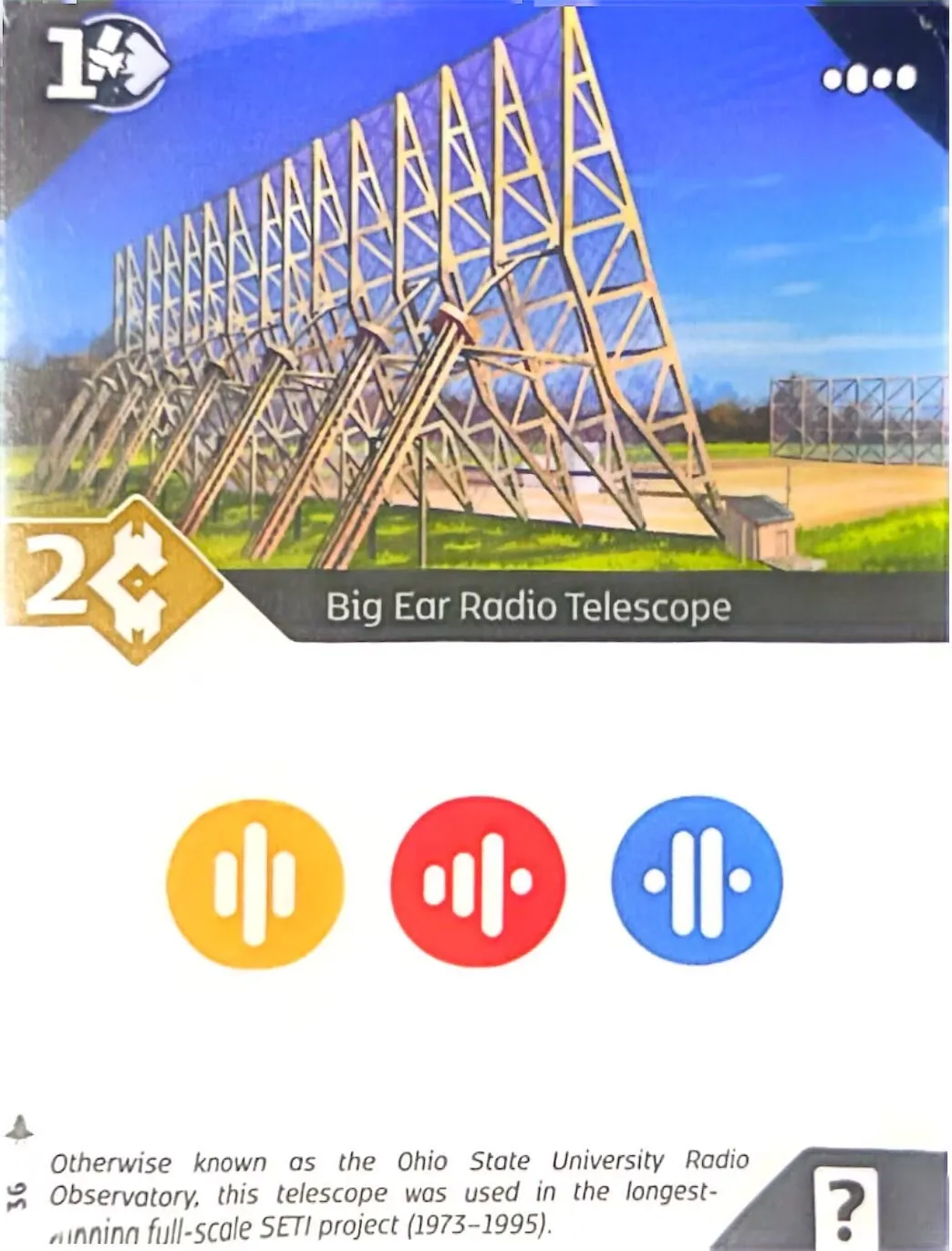
Big Ear Radio Telescope
SA.36
Otherwise known as the Ohio State University Radio Observatory, this telescope was used in the longest-running full-scale SETI project (1973-1995).
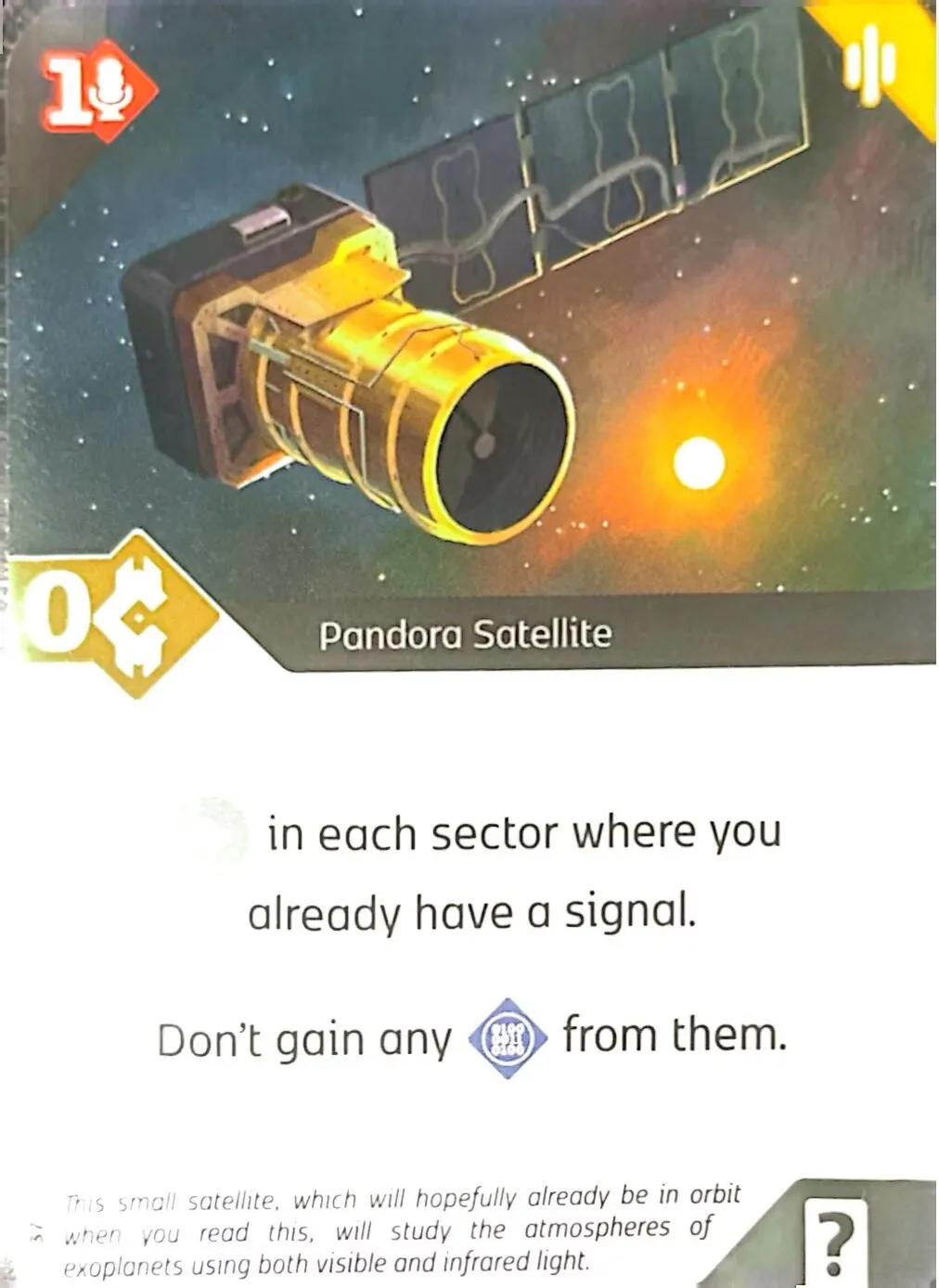
Pandora Satellite
in each sector where you already have a signal.
Don't gain any from them.
SA.37
This small satellite, which will hopefully already be in orbit when you read this, will study the atmospheres of exoplanets using both visible and infrared light.
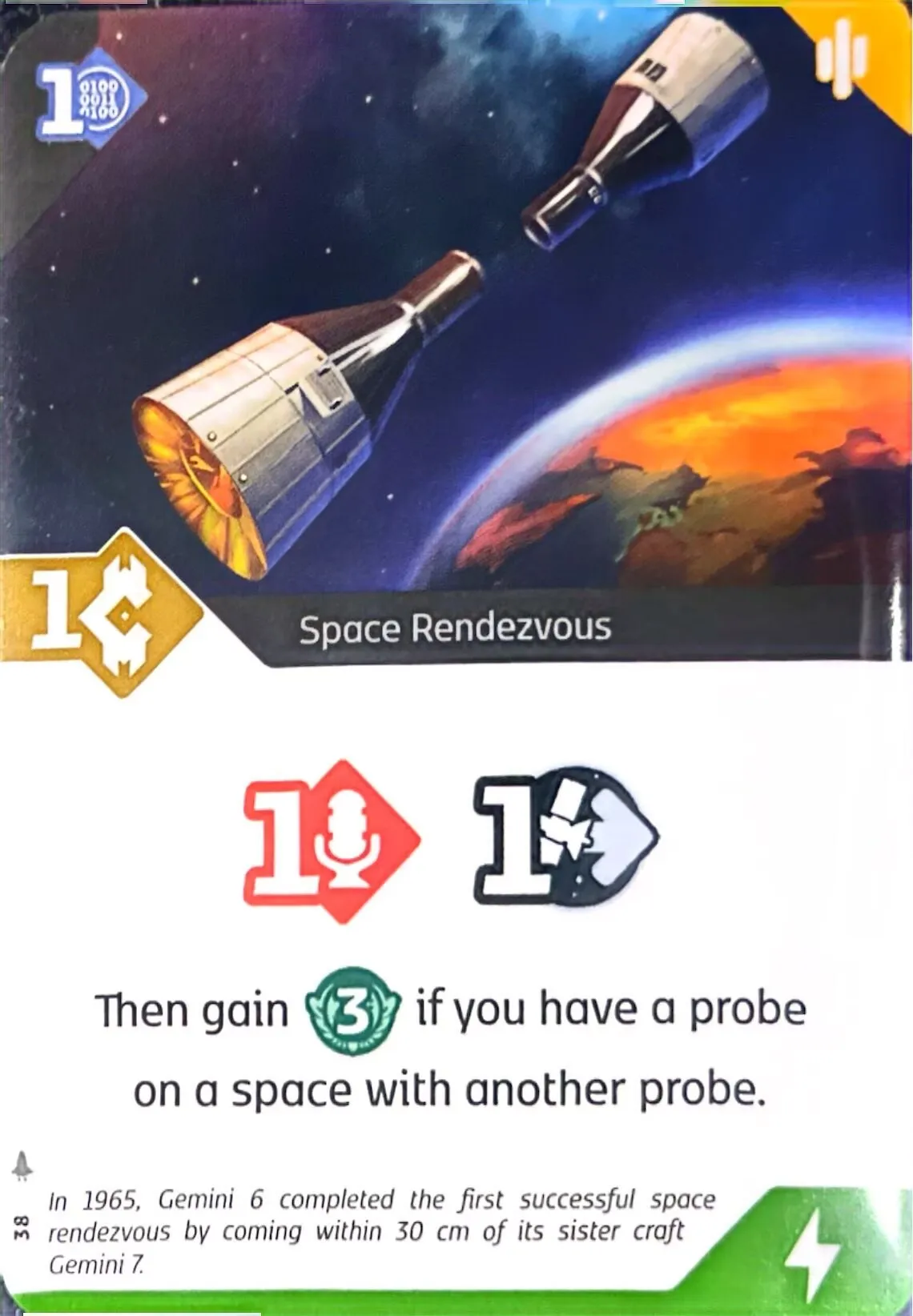
Space Rendezvous
1
Then gain if you have a probe
on a space with another probe.
SA.38
In 1965, Gemini 6 completed the first successful space rendezvous by coming within 30 cm of its sister craft Gemini 7.
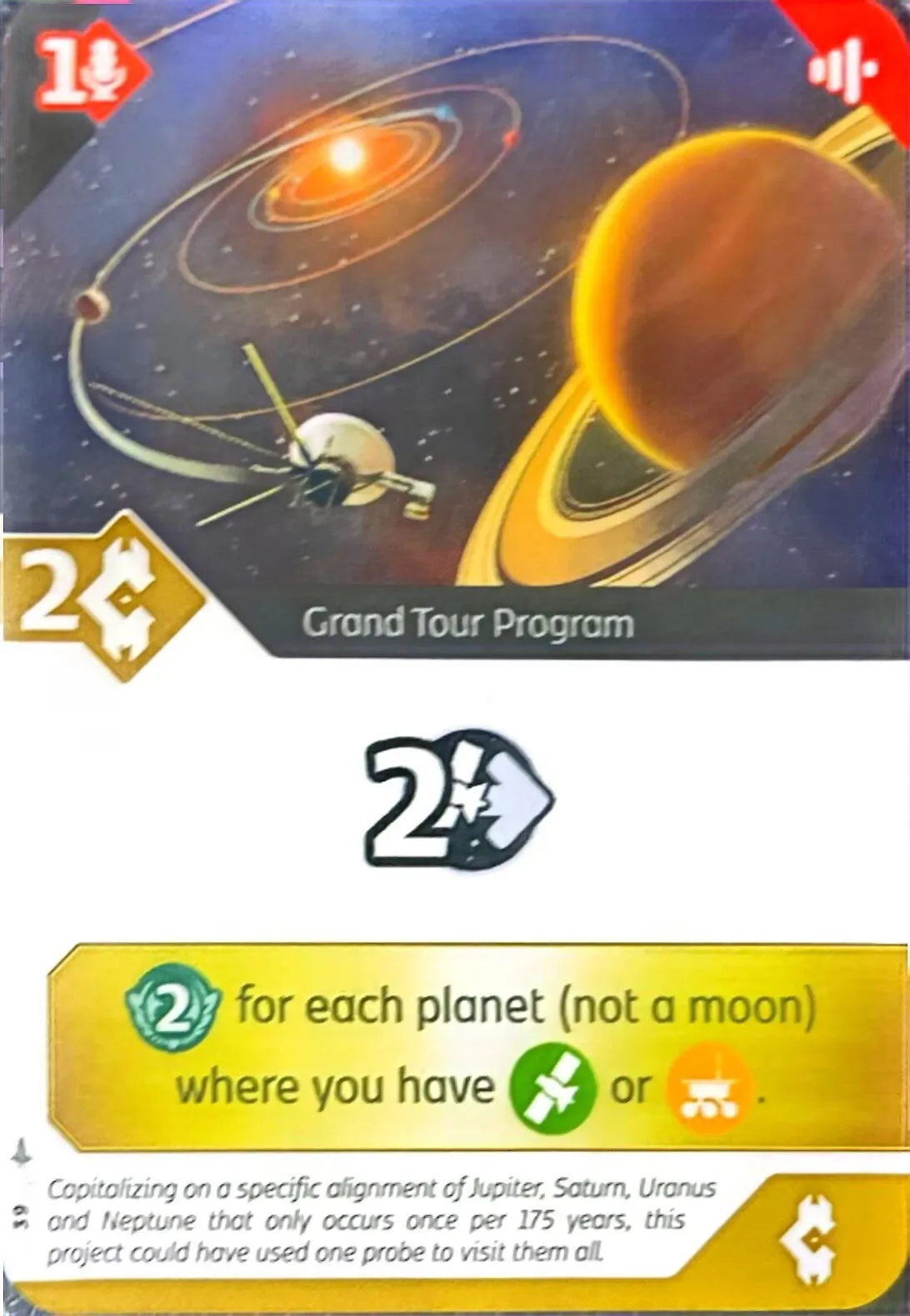
Grand Tour Program
2
where you have or .
SA.39
Capitalizing on a specific alignment of Jupiter, Saturn, Uranus and Neptune that only occurs once per 175 years, this project could have used one probe to visit them all.
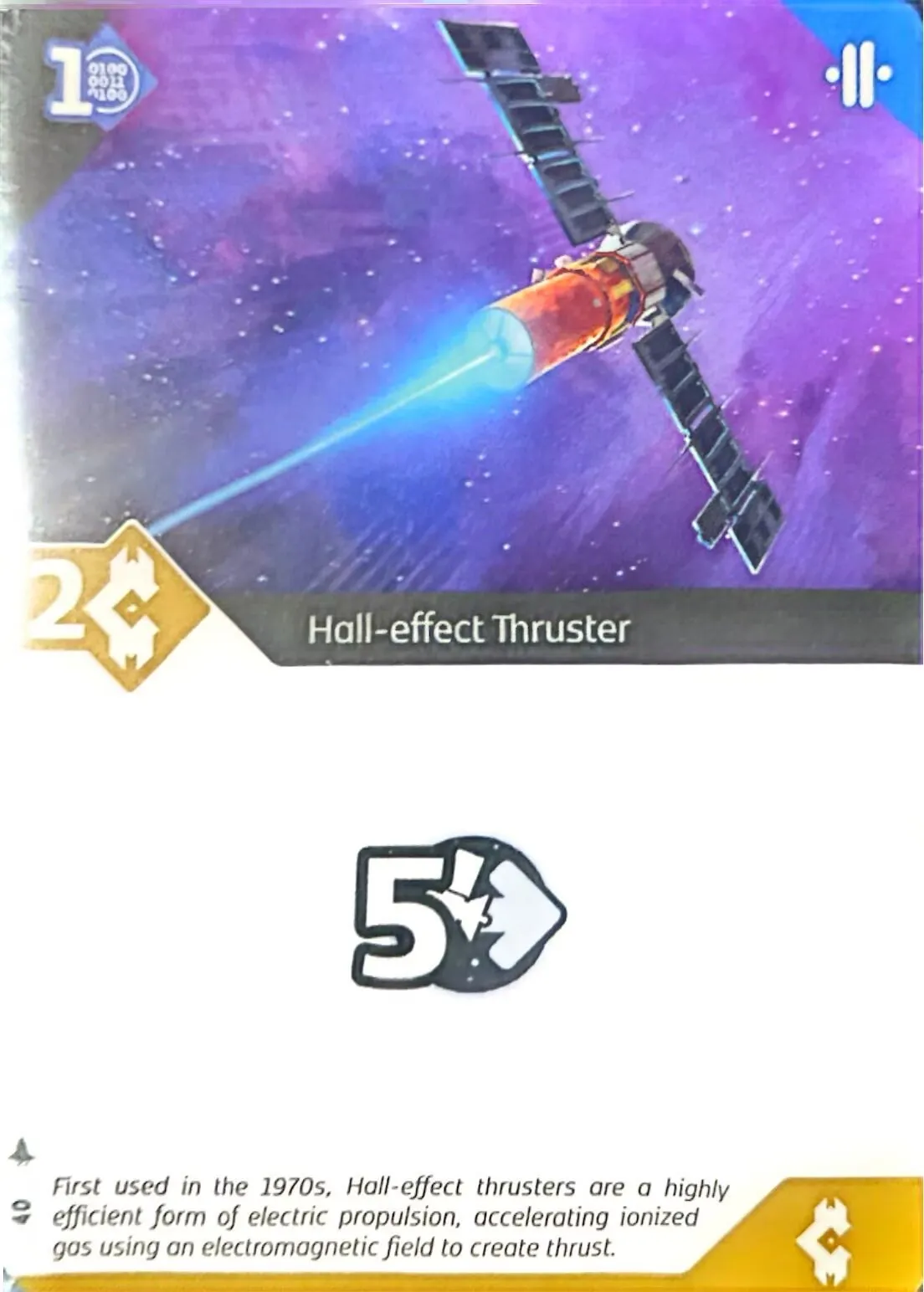
Hall-effect Thruster
5
SA.40
First used in the 1970s, Hall-effect thrusters are a highly efficient form of electric propulsion, accelerating ionized gas using an electromagnetic field to create thrust.
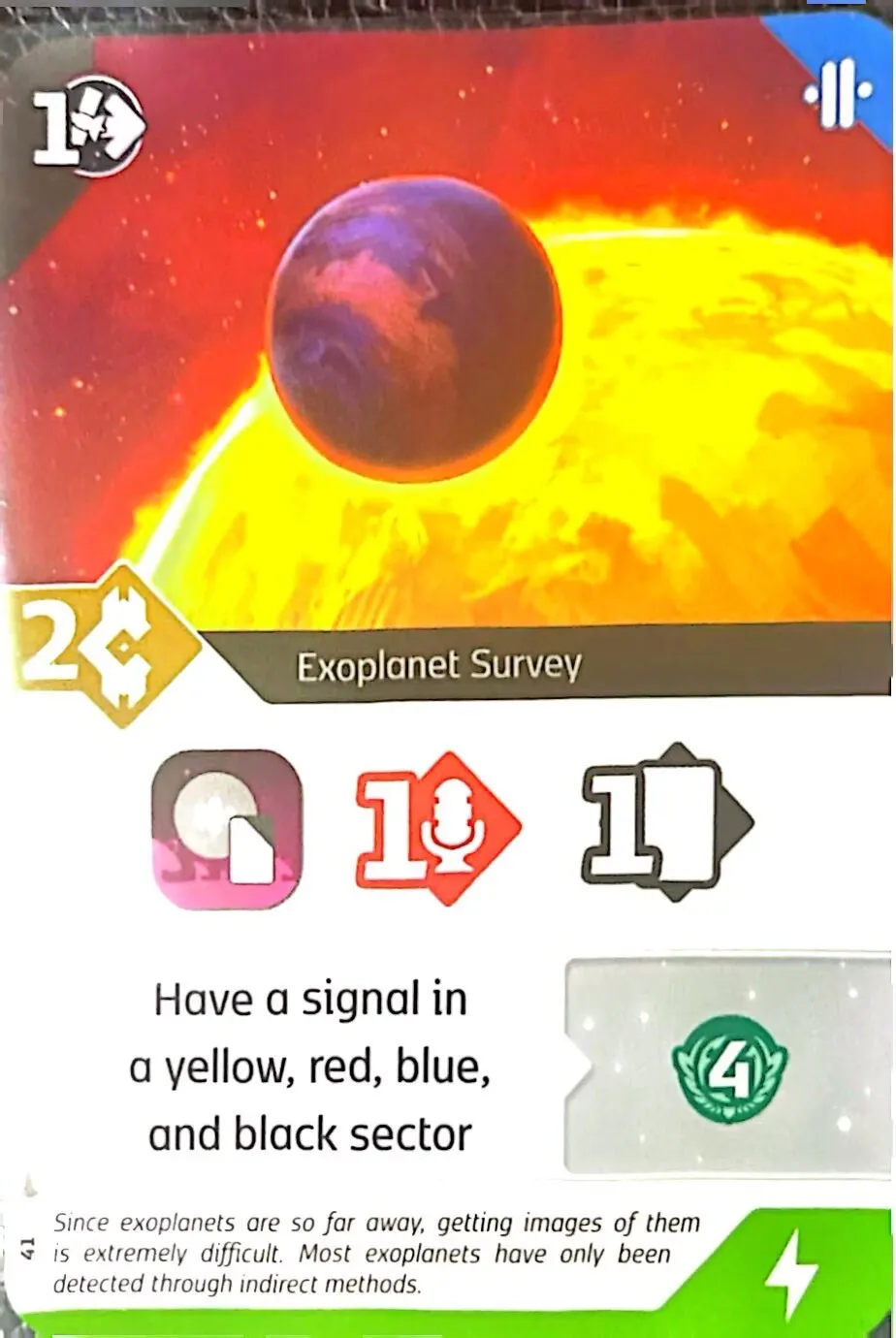
Exoplanet Survey
Have a signal in a yellow, red, blue, and black sector
SA.41
Since exoplanets are so far away, getting images of them is extremely difficult. Most exoplanets have only been detected through indirect methods.
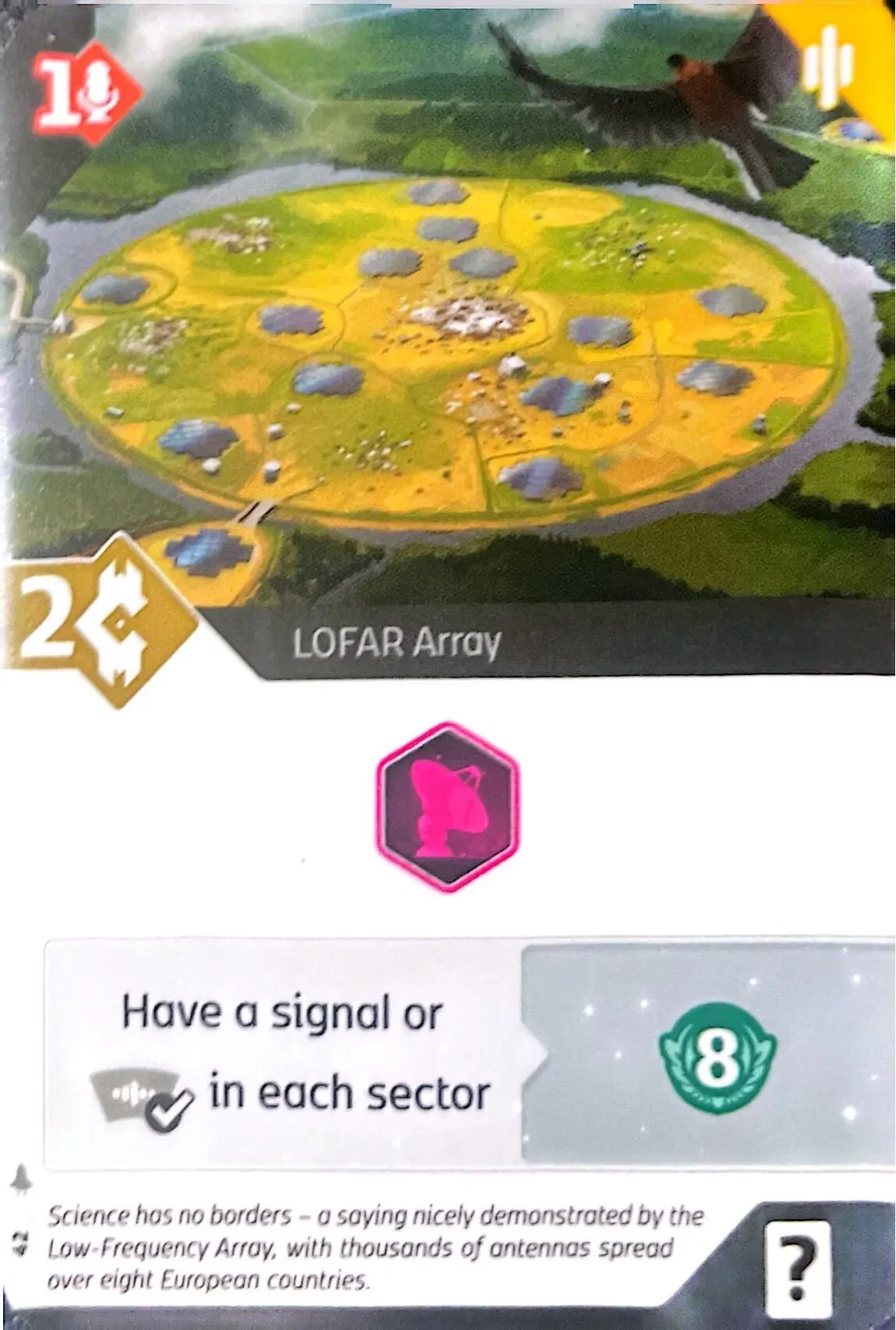
LOFAR Array
Have a signal or in each sector
SA.42
Science has no borders - a saying nicely demonstrated by the Low-Frequency Array, with thousands of antennas spread over eight European countries.